


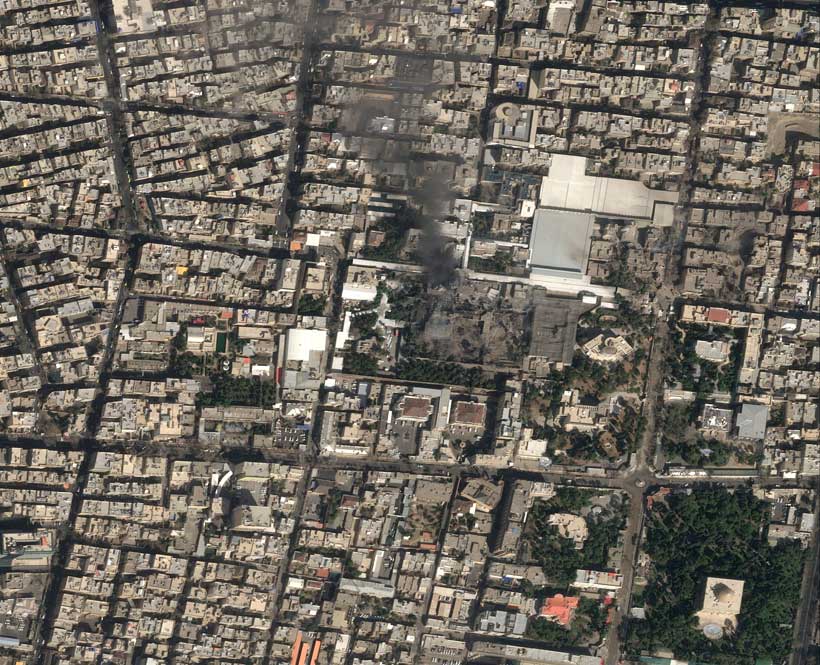
The killing of Ali Khamenei marks one of the most consequential moments in the history of the Iran’s Islamic Republic. Yet despite the symbolic and strategic magnitude of the event, senior officials in the United States remain skeptical that the ongoing U.S.–Israeli military campaign will trigger regime change in the near term.
While President Donald Trump publicly encouraged Iranians to rise against their rulers, intelligence assessments suggest that the collapse of the governing system is neither imminent nor probable.
The gap between political rhetoric and intelligence analysis reflects the complexity of dismantling entrenched authoritarian systems, even under extreme military pressure.
Intelligence Assessments: System Resilience Over Collapse
U.S. intelligence agencies had evaluated the implications of Khamenei’s possible death prior to the strikes. Their conclusions were sobering: rather than systemic collapse, succession could empower equally hardline figures drawn from the Islamic Revolutionary Guard Corps or conservative clerical networks.
Stay ahead of the geopolitical week.
MD Briefing delivers expert analysis across five global fronts — the Indo-Pacific, energy, geoeconomics, European security, and the Middle East — every Monday morning. Free.
The Islamic Republic’s power structure is deliberately layered to ensure continuity. Authority does not rest solely in the Supreme Leader but is distributed across clerical institutions, security services, and patronage networks that reinforce regime loyalty.
Critically, intelligence reporting noted the absence of IRGC defections during recent anti-government protests an essential precondition for revolutionary change. Without fractures inside the security apparatus, even widespread public dissent rarely translates into regime overthrow.
Opposition Weakness and the Limits of External Pressure
Although Iran’s government faces deep domestic dissatisfaction, the opposition remains fragmented and organizationally weak. Officials doubt that exiled figures such as Reza Pahlavi could consolidate authority in a post-regime scenario.
Recent internal debates in Washington reflect growing pessimism that any externally backed political alternative could govern effectively or maintain territorial cohesion in a diverse and geopolitically sensitive state.
The Islamic Republic’s durability stems not from universal support but from institutional cohesion and the coercive capacity of security forces.
Internal Transition and Elite Control
Following Khamenei’s death, President Masoud Pezeshkian announced that a leadership council has assumed interim authority. This mechanism signals institutional continuity rather than collapse.
Iran’s governing system has historically prioritized regime preservation. Elite consensus even amid internal rivalry tends to coalesce when the system faces existential threats.
Security officials have already warned separatist and opposition movements against exploiting the crisis, indicating readiness to use force to maintain territorial integrity and political control.
Policy Debate in Washington: Deterrence vs. Transformation
Within U.S. agencies, debate continues over whether Khamenei’s death will alter Iran’s nuclear negotiations posture, missile development ambitions, or regional behavior. There is no consensus.
Some officials believe leadership decapitation may harden Iran’s strategic posture, reinforcing siege mentality dynamics. Others argue it could open limited space for recalibration, especially if economic pressures intensify.
Notably, President Trump’s suggestion that communications with Tehran may resume underscores an implicit recognition: the regime is expected to endure, at least in the short term.
Analysis
History suggests that authoritarian systems rarely collapse solely from external military pressure or leadership decapitation. Instead, regime change typically requires simultaneous elite fragmentation, security force defections, and cohesive opposition mobilization. In Iran, none of these conditions currently appear fully aligned.
The Islamic Revolutionary Guard Corps remains the regime’s backbone, bound by ideological commitment, economic interests, and patronage networks. As long as this structure holds, systemic collapse is unlikely.
Khamenei’s death may reshape power balances within the elite, but it is more likely to produce continuity through hardline consolidation than revolutionary transformation. Indeed, external attacks often strengthen internal cohesion by reframing domestic dissent as national resistance.
For Washington and its allies, the strategic question is shifting from regime change to long-term containment, deterrence, and negotiation leverage. Military success does not automatically translate into political transformation.
The Islamic Republic faces one of its most severe crises since 1979 but crises do not always produce collapse. More often, they produce adaptation.
With information from Reuters.
