


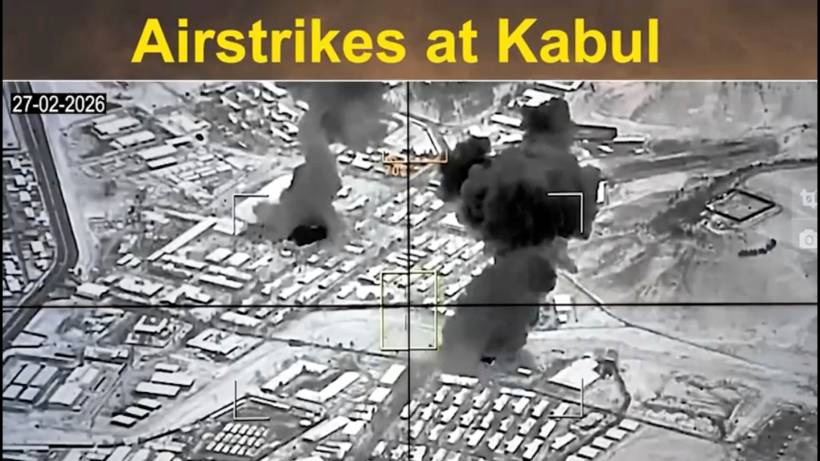
Pakistan has launched air-to-ground missile strikes on targets in Kabul, Kandahar and Paktia, marking one of the most serious escalations with Afghanistan’s Taliban authorities since 2021. Islamabad’s defence minister described the confrontation as “open war,” signalling a shift from episodic border skirmishes to overt interstate hostilities.
Security sources in Pakistan said the operation targeted Taliban military offices and border posts, accompanied by clashes along multiple sectors of the 2,600-kilometre frontier. The Taliban confirmed that air strikes hit parts of Kabul, Kandahar and Paktia, and said they responded with retaliatory attacks on Pakistani military installations.
Both sides reported heavy casualties, though the figures remain unverified. Pakistan claimed over 130 Taliban fighters were killed, while the Taliban said dozens of Pakistani soldiers had died. The sharply conflicting narratives reflect the fog of war and the high stakes of public messaging on both sides.
Background: A Border Dispute Turns Violent
Tensions between Islamabad and Kabul have simmered for years over Pakistan’s allegation that Afghanistan harbours militants from Tehreek-e-Taliban Pakistan (TTP), also known as the Pakistani Taliban. Kabul denies the accusation, insisting Pakistan’s security crisis is a domestic matter.
Stay ahead of the geopolitical week.
MD Briefing delivers expert analysis across five global fronts — the Indo-Pacific, energy, geoeconomics, European security, and the Middle East — every Monday morning. Free.
The dispute centres on militant sanctuaries in eastern Afghanistan and attacks inside Pakistan’s border regions. Islamabad argues that cross-border insurgent activity has intensified since the Taliban returned to power in 2021.
The latest escalation appears to have been triggered by Pakistani strikes earlier this week targeting alleged TTP and Islamic State camps inside Afghan territory. Kabul and the United Nations reported civilian casualties from those operations, including 13 deaths, and warned of consequences.
When Pakistan followed up with broader strikes against Taliban government installations, the confrontation crossed a psychological and strategic threshold.
Strategic Geography: Kabul, Kandahar and the Border Belt
The reported targeting of Kabul and Kandahar carries symbolic weight. Kandahar is the Taliban’s spiritual and political stronghold, and the base of supreme leader Haibatullah Akhundzada. Strikes there are not merely tactical they are a message.
The clashes along the mountainous frontier historically porous and volatile underscore the fragility of the Durand Line, the contested border separating the two countries. Skirmishes have occurred intermittently for decades, but large-scale coordinated strikes on urban centres represent a significant departure.
Military Asymmetry and Escalation Risks
Pakistan’s conventional military capabilities far exceed those of Taliban-controlled Afghanistan. The Pakistani air force, missile systems and organized ground forces provide Islamabad with technological and logistical superiority.
However, the Taliban’s strength lies in irregular warfare. After decades of insurgency against U.S.-led forces, Taliban fighters are experienced in guerrilla tactics, asymmetric retaliation and protracted conflict.
This imbalance creates a dangerous dynamic: Pakistan may dominate in open engagements, but prolonged instability could favour insurgent-style responses, including urban militant attacks inside Pakistan.
Reports from Afghanistan’s Nangarhar province suggesting suicide units are prepared for deployment raise the spectre of escalation beyond conventional military exchanges.
Regional Diplomacy Under Pressure
Previous clashes in October were contained after mediation by Turkey, Qatar and Saudi Arabia. This time, diplomatic channels appear strained but active.
Saudi Arabia’s foreign ministry confirmed discussions with Pakistan’s leadership aimed at reducing tensions. Meanwhile, Russia which has formally recognised the Taliban government has offered to mediate if both sides request assistance.
The involvement of external actors highlights a broader concern: instability along the Pakistan–Afghanistan border has implications for regional security, migration flows and counterterrorism cooperation.
Domestic Fallout in Pakistan
Pakistan has moved to high security alert nationwide. Authorities in Punjab province have initiated security sweeps and detentions, including Afghan nationals pending deportation. Officials warn of potential militant retaliation in urban centres.
The political dimension is equally sensitive. By publicly framing the conflict as “open war,” Defence Minister Khawaja Muhammad Asif has elevated expectations of decisive action. De-escalation, therefore, may now carry domestic political costs.
Analysis: Limited Strike or Protracted Conflict?
Three scenarios emerge from the current trajectory.
First, the confrontation could remain limited a short, intense exchange followed by third-party mediation. Both governments face economic constraints and security challenges that make prolonged warfare costly.
Second, the conflict could settle into sustained border violence: periodic air strikes, artillery duels and retaliatory militant attacks, without formal war but with persistent instability.
Third, and most concerning, escalation could spill into major urban centres, drawing in non-state actors and complicating diplomatic containment.
The structural drivers of tension disputed borders, militant sanctuaries and competing narratives of sovereignty remain unresolved. Unless a durable security mechanism is established, the cycle of accusation and retaliation is likely to continue.
For now, the rhetoric of “open war” signals that the Pakistan–Afghanistan relationship has entered its most volatile phase since the Taliban’s return to power. Whether it hardens into sustained conflict or is pulled back through regional diplomacy will shape South Asia’s security landscape in the months ahead.
With information from Reuters.
