


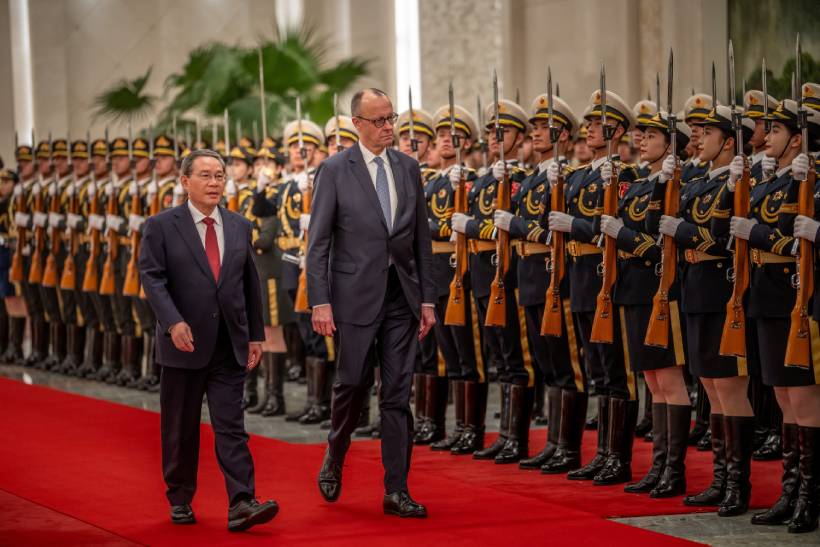
German Chancellor Friedrich Merz said Berlin wants deeper and fairer economic cooperation with China as he met Chinese Premier Li Qiang in Beijing, signaling an effort to recalibrate ties amid a widening trade imbalance.
Merz emphasized that Germany values its extensive economic relationship with China, which was its largest trading partner last year, but made clear that cooperation must be balanced and transparent. He acknowledged specific concerns about fairness and market access, reflecting growing unease in Berlin over structural disadvantages facing German companies.
Li, for his part, called on both countries to defend multilateralism and free trade, a message widely interpreted as a response to the trade policies of U.S. President Donald Trump. He urged China and Germany, as major global economies, to work together to promote a more equitable global governance system.
Trade Imbalance and Industrial Pressure
Germany’s export driven, manufacturing heavy economy has felt increasing pressure from China’s rise in advanced manufacturing sectors. European officials have warned of growing Chinese dominance in strategic industries, an expanding bilateral trade gap, and shrinking market share for European firms operating in China.
Stay ahead of the geopolitical week.
MD Briefing delivers expert analysis across five global fronts — the Indo-Pacific, energy, geoeconomics, European security, and the Middle East — every Monday morning. Free.
Merz arrived in Beijing accompanied by executives from major German companies, including Volkswagen and BMW, both of which are navigating intense competition from Chinese electric vehicle producers. The delegation underscores how central the Chinese market remains for Germany’s corporate sector, even as competitive dynamics shift.
At the same time, China’s own economic slowdown and manufacturing overcapacity have altered the relationship. Domestic demand growth has cooled, prompting Chinese firms to expand more aggressively into global markets, further intensifying competition for European manufacturers.
A Broader European Context
Merz is the latest European leader to pursue renewed engagement with Beijing, following outreach by Britain and Canada earlier this year. His visit could influence the trajectory of wider European Union relations with China.
European policymakers continue to debate how to balance economic engagement with strategic caution. Terms such as de risking and systemic rival have shaped recent EU policy discussions, reflecting efforts to reduce vulnerabilities in supply chains while preserving trade links.
Chinese state media ahead of the visit portrayed cooperation with Europe as a stabilizing force in a period of global trade disruption. Commentaries highlighted the size of China’s consumer market and its advanced manufacturing capabilities as incentives for deeper ties.
Analysis
Merz faces a delicate balancing act. Germany cannot easily decouple from China without harming its own industrial base, yet the political and economic costs of growing dependence are becoming clearer. His emphasis on fairness suggests Berlin is seeking to move from an era of optimistic engagement to one of more assertive reciprocity.
China, meanwhile, is positioning itself as a steady partner amid global trade uncertainty. The appeal to multilateralism is strategic, aiming to attract European alignment as tensions with Washington persist.
Whether this visit produces concrete changes will depend on market access reforms and tangible steps to address trade imbalances. Without measurable progress, calls within Europe for protective measures are likely to grow louder.
With information from Reuters.
