


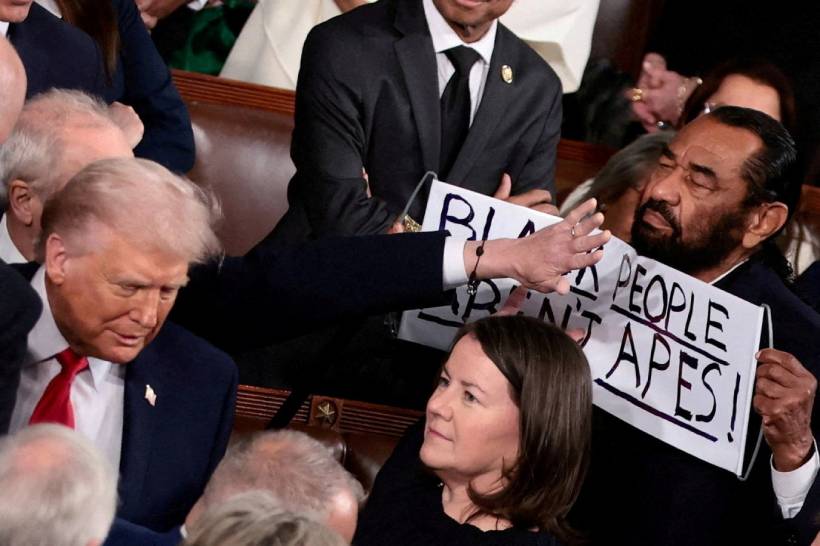
President Donald Trump delivered his State of the Union address at a pivotal political moment, seeking to consolidate Republican support ahead of the November midterm elections. Against a backdrop of rising tensions with Iran and persistent voter anxiety over living costs, the speech revealed shifting priorities, sharpened partisan rhetoric, and careful political positioning.
Below are the key takeaways.
The Economy Takes Center Stage
Trump placed economic issues at the heart of his address, signaling a recalibration after weeks of pressure from advisers to focus more squarely on voters’ financial concerns.
He spoke broadly about housing, healthcare, retirement security, crime, and utility bills. He defended his policies on tariffs and prescription drug pricing, insisting they were generating revenue and lowering costs. In his telling, inflation and mortgage rates are falling, gas prices are down, and investment and job growth are accelerating.
Stay ahead of the geopolitical week.
MD Briefing delivers expert analysis across five global fronts — the Indo-Pacific, energy, geoeconomics, European security, and the Middle East — every Monday morning. Free.
However, official data presents a more complicated picture. Inflation ticked up last year, factory employment declined, and overall job growth has been modest. While certain prices such as eggs have eased, broader food and household costs remain elevated. Polling reflects voter unease, with a majority expressing dissatisfaction with Trump’s handling of the economy.
The emphasis on kitchen table issues suggests Republicans recognize that economic messaging may determine control of Congress in November.
Political Theater and Symbolism
The address featured carefully choreographed moments designed for television and political impact. Trump awarded honors, introduced guests, and highlighted personal stories to reinforce themes of patriotism, strength, and cultural conflict.
Among those recognized were Korean War Navy pilot E. Royce Williams and Olympic gold medal winning goaltender Connor Hellebuyck. He also awarded a Medal of Honor to Army Chief Warrant Officer Eric Slover for actions during an operation involving Venezuelan leader Nicolas Maduro.
Guests in the gallery were woven into policy narratives. Victims of crime were cited in the immigration debate, while students were spotlighted in discussions about education and gender policy.
The spectacle underscored how modern State of the Union speeches function as both governing documents and campaign stagecraft.
Iran and the Unanswered Case for Military Action
One of the most anticipated questions was whether Trump would lay out a detailed case for military action against Iran.
He addressed Iran late in the speech, reiterating that the United States would not allow Tehran to obtain a nuclear weapon. He accused Iranian leaders of supporting militant proxies and violently suppressing protests. However, he did not explain why military action might be urgent now, nor did he specify strategic objectives.
Given recent U.S. military positioning in the Middle East, the lack of clarity stood out. Russia and Ukraine received minimal attention, and Trump avoided revisiting disputes over Greenland or the Panama Canal that featured prominently in past remarks.
The omission of detailed foreign policy discussion was notable considering the diplomatic efforts underway.
Immigration and Narrative Recalibration
Immigration, once Trump’s strongest political issue, has become more complicated amid public backlash over enforcement tactics and controversial incidents.
In the address, Trump focused on crimes committed by undocumented immigrants and accused Democrats of failing to secure the border. He avoided mention of enforcement agencies such as Immigration and Customs Enforcement and Border Patrol, whose operations have drawn criticism.
The strategy appeared designed to reclaim the emotional resonance of past immigration messaging while sidestepping more contentious operational details.
Shifting Priorities Compared With Last Year
Compared with his previous address to Congress, this year’s speech reflected a narrowing of foreign policy ambitions. China was not mentioned, despite featuring prominently last year. Praise for Elon Musk and the Department of Government Efficiency was absent.
Instead, Trump emphasized domestic deliverables, economic messaging, and proposed election law changes, including voter identification requirements and limits on mail ballots ahead of the midterms.
The recalibration suggests a White House more tightly focused on electoral positioning.
A Sharper Partisan Edge
Trump’s rhetoric toward Democrats was unusually direct, even by recent standards. He accused them of undermining the country and framed the upcoming election as a choice between stability under Republican leadership and decline under Democratic control.
Democratic lawmakers remained largely seated during applause lines, while some openly protested. The visible tension highlighted the deeply polarized political climate surrounding the presidency.
Analysis
This State of the Union was less about announcing sweeping new policies and more about consolidation. Trump appeared intent on stabilizing his political standing by emphasizing economic reassurance while avoiding deep commitments on contentious foreign policy decisions.
His treatment of Iran suggests strategic ambiguity. By repeating familiar warnings without detailing next steps, he preserves flexibility while maintaining pressure. Domestically, the recalibrated economic focus acknowledges voter anxiety that could determine congressional control.
The speech ultimately reflected a president balancing governance with campaign strategy. It was disciplined in structure but partisan in tone, restrained on foreign policy specifics yet assertive on cultural and economic themes.
Whether that balance strengthens Republican prospects in November will depend largely on economic trends and whether international tensions remain contained.
With information from Reuters.
