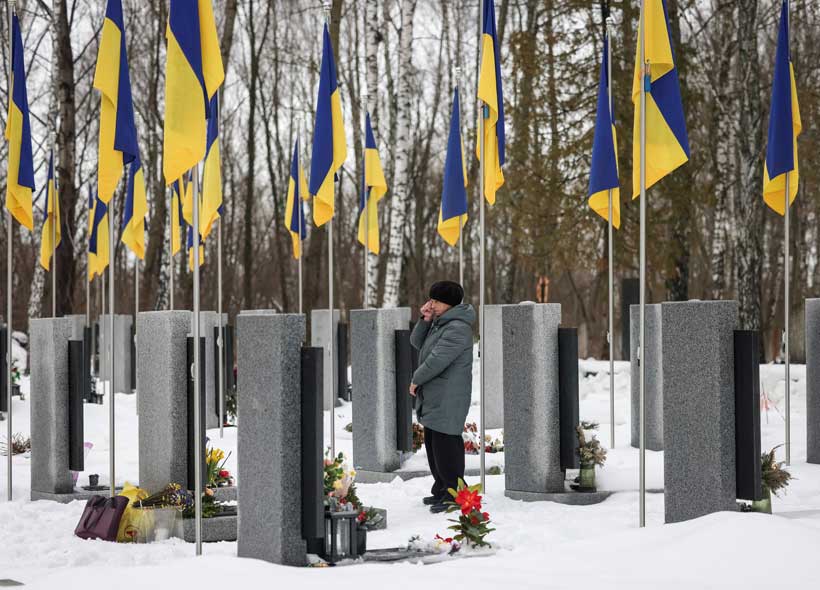
Four years after Russia’s 2022 invasion of Ukraine, the human cost is staggering. Thousands of soldiers have been killed, civilian populations have been displaced or subjected to crimes against humanity, cities have been devastated, and common claims of war crimes, including even the use of chemical weapons, have been documented by international investigations.
Yet, despite this scale of human suffering and destruction, the pathway to a plausible end remains clouded. The reason is that the U.S.’s and Europe’s efforts to explore a negotiated end with Russia and Ukraine have failed when addressing the core geopolitical issue in this conflict: Russia’s quest to control the Donbas territory as an opportunity to eventually control Ukraine in the future.
Understanding that is important because some continue to frame Russia’s invasion of Ukraine solely as a direct reaction to NATO’s enlargement in former Soviet countries, but that explanation is incomplete. Four years after the invasion, it is easier to deduce what Russia appeared to be attempting: the collapse of the Ukrainian government through a rapid decapitation strike against Kyiv, probably for an eventual annexation of the country. Yes, NATO provided a convenient narrative from the Georgia invasion until today, but the strategic ambition is clearly older and much deeper. The objective of somehow absorbing Ukraine had long been embedded in Moscow’s geopolitical desires, especially in Putin’s era. And today, after failing to seize the entire country thanks to a brave Ukrainian people, Russia appears to be pursuing now a narrower aim: consolidating control over the Donbas and holding its position until another opportunity arises.
The invasion was a long geopolitical strategy, not a local conflict.
Stay ahead of the geopolitical week.
MD Briefing delivers expert analysis across five global fronts — the Indo-Pacific, energy, geoeconomics, European security, and the Middle East — every Monday morning. Free.
When exploring a possible end to this conflict, it is important to understand its origins and Russia’s long-term geopolitical quest. Many observers date the conflict to 2022, but the military turning point really came in 2014 when Russia annexed Crimea, a southern peninsula of Ukraine, following the ousting of former Ukrainian President Yanukovych, who was closer to Moscow. Crimea’s invasion was a strategic move to prevent Ukraine’s political reorientation and to secure leverage over its future, a critical Russian foreign policy objective. The 2022 invasion continued that logic after Putin criticized today’s world order and advocated for sovereignty respect.
During the first week of the 2022 invasion, Russian forces did not stop at the Donbas region. They advanced rapidly toward Kyiv, the capital, and targeted key airports while advancing armored vehicles toward the city. Removing Ukraine’s leadership and installing a different regime could probably be the final goal, not just controlling the Donbas border territory. Some argue that Putin never intended to fully conquer Ukraine and that the invasion was merely designed to force Kyiv to the negotiating table from a position of weakness. However, the scale and direction of the initial offensive and so-called battle of Kyiv suggest otherwise. Negotiation was probably a consequence of that situation, not the primary objective from the beginning.
On the other hand, the deeper origins of this war and Russia’s continuous interest in Ukraine also lie in conflicting historical narratives. In Russian conservative politics and Putin’s statements, Ukraine is often described as part of the same people, another branch of a single Russian people separated for decades; thus, independence is explained as a historical anomaly. However, for most of the Ukrainian post-Soviet perspective, ethnicity, diversity, religion, language, and democracy have created a long distance and difference between both, a distance that had its origins even during the Tsarist era: from the Tsarist empire to the Bolshevik Revolution, following Stalin’s wartime consolidation to the Cold War, and even into the present in Putin’s era, Russia has consistently sought to keep Ukraine within its political control. What they clearly did not expect is that the war itself has consolidated a stronger national identity defined precisely by resistance to domination.
It is true that NATO’s eastward expansion, and particularly the deployment of U.S. missile defense systems in former Soviet republics, was perceived in Moscow as a direct security concern involving Ukraine. No serious geopolitical analysis can ignore the fact that NATO expansion has intensified Russia’s aggressive foreign policy over time and that it needs to be addressed in any agreement. Nonetheless, controlling Ukraine was not going to solve the NATO dilemma. At most, it would have prevented the U.S. from deploying more military infrastructure in Ukraine. In that sense, neither the question of Donbas following NATO expansion nor the shared history between the two countries fully explains why Russia was willing to undermine Ukraine’s sovereignty: The underlying reason has always been geopolitical.
The permanent war and the future of the rules-based order
Just a few weeks before the 2022 invasion, Vladimir Putin met with China’s President Xi Jinping and jointly declared that the international order needed to be changed, as it only represented Western values and objectives. That close sequence matters and tells us the real message. Through the invasion, Moscow was also testing the cohesion, resolve, and limits of what it describes as a Western-led order.
Prolonging the war may itself serve a strategic function. A sustained conflict might allow Moscow to observe how Europe adapts to permanent instability on its doorstep, how defense budgets evolve, how political distance with the U.S. appears, and how public opinion shifts over time. Sanctions were designed to affect Russia’s economy and constrain its war machine. Yet, Moscow appears to have adapted to it. Therefore, the message they are trying to communicate is the underlying reason to sustain that permanent war: Russia is willing to undermine the core principle of sovereignty while it claims it for a new international order.
This war represents more than a regional confrontation. It could mark the beginning of a broader pattern in which expansionist powers test the durability of the rules-based order. If the costs of territorial aggression prove manageable, the precedent extends beyond Eastern Europe. We cannot simply ignore the parallel situations surrounding Taiwan and the strategic calculations of China. The rules-based order must be preserved.
A Containment for Putin’s Era: A Difficult but Necessary Realism
Four years on, the situation remains extraordinarily difficult. Ukraine understandably rejects territorial concessions, and it would be a loss for the international rules-based order. Russia rejects the presence of foreign military structures near its borders. Perhaps a sustainable settlement may require hard realism with painful compromises from both sides: some territorial arrangements combined with credible international security guarantees for Ukraine’s sovereignty.
Such an outcome would clearly not represent perfect justice for the brave Ukrainian people, but it would definitely represent containment in Putin’s era. It could be a way to prevent permanent war or even renewed escalation while preserving Ukraine’s political independence. If political circumstances eventually allow for that kind of settlement to happen, any agreement must be carefully framed to reflect the disputed status of the Donbas and avoid legitimizing territorial acquisition by force if the rules-based order is to retain credibility. Like the Cold War era, history has shown us that over time internal evolution within Russia’s regime may open space for a more durable peace and, eventually, recovery of territory. Until then, and thinking especially of the human loss that we are witnessing today, prudence and realism are required for a negotiated exit.
Finally, beyond Ukraine, the problem is systemic and global. The international order is based on the principle that borders cannot be changed by force. That principle is not exclusively Western; it is foundational to modern international law. Today’s powers need to align on that principle and prevent any further military action from happening. Sovereignty is not a cultural preference; it is the basis of any international order.