


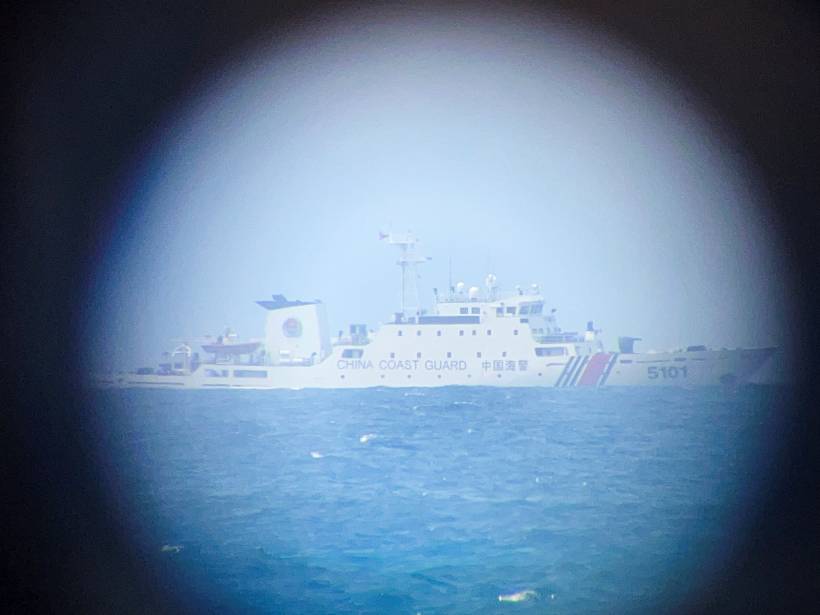
A recent visit by Philippine officials to Thitu Island, the country’s largest outpost in the contested Spratly archipelago, has underscored the intensifying pressures in the South China Sea. As the Philippine Coast Guard plane descended, passengers received a startling notification: “Welcome to CHINA.” Among those on board were Senator Risa Hontiveros and Coast Guard spokesperson Jay Tarriela, both vocal critics of Beijing’s maritime assertions.
Upon landing, the officials engaged with the island’s roughly 400 residents, emphasizing Manila’s claim: “We will never give up the Kalayaan Island Group, including Pag-asa,” Hontiveros declared, reaffirming the Philippines’ sovereignty over Thitu, also known locally as Pag‑asa, or “Hope.” Despite its modest size just 0.37 square kilometers the island holds strategic significance, lying 450 km from the Philippine mainland and within sight of Chinese Coast Guard and People’s Liberation Army Navy vessels.
Life Under Pressure
For residents, China’s presence has tangible consequences. Fishermen such as 45-year-old Rando Asiado report being forced to fish in less productive areas due to patrols, drones, and occasional harassment near Subi Reef and Sandy Cays. Encounters with Chinese vessels have escalated to collisions, close-quarter maneuvers, and injuries, highlighting the risks Filipino crews face daily. Residents describe a strategic imbalance: small fishing boats confront heavily armed and technologically superior Chinese ships, limiting their access to traditional waters and disrupting livelihoods.
Despite the pressure, islanders express resilience. “We’re not afraid because we know we’re in the right, but they’re using ships while we only have small boats,” said fisherman Ronnie Cojamco. Their steadfast presence serves not only as a livelihood strategy but as a living assertion of Philippine sovereignty in a region increasingly militarized and contested.
Stay ahead of the geopolitical week.
MD Briefing delivers expert analysis across five global fronts — the Indo-Pacific, energy, geoeconomics, European security, and the Middle East — every Monday morning. Free.
Strategic and Legal Context
China claims nearly the entire South China Sea, a stance invalidated by the 2016 Permanent Court of Arbitration ruling. In practice, the country has constructed artificial islands, including Subi Reef just 14 nautical miles from Thitu, equipped with airstrips, surface-to-air missiles, and other military installations to support its claims. Manila, meanwhile, has stepped up diplomatic measures, including the appointment of a dedicated maritime spokesperson and heightened attention to informational campaigns, reflecting recognition that sovereignty disputes now involve both physical presence and narrative control.
Analysis: The Broader Implications
The Thitu visit highlights the intersection of geography, geopolitics, and human endurance. Small islands like Pag‑asa serve as critical leverage points in territorial disputes, where the physical presence of residents bolsters legal claims under international law. China’s actions both physical and informational seek to normalize its presence and exert de facto control, but Manila’s continued engagement demonstrates the limits of coercive diplomacy when local communities and political institutions actively resist.
From a strategic perspective, the tension exemplifies a broader regional pattern: asymmetric power is leveraged through patrols, surveillance, and militarization, while weaker claimants rely on international law, public diplomacy, and civilian occupation to assert their rights. The Thitu example underscores that in the South China Sea, sovereignty is maintained as much through persistence and visibility as it is through formal agreements or treaties.
The episode also signals a potential flashpoint: visits by high-profile officials like Hontiveros may draw scrutiny from Beijing and elevate tensions, but they reinforce the Philippines’ long-term strategy of asserting rights through a combination of diplomatic visibility, civilian settlement, and international advocacy. In essence, the struggle over Thitu is as much about narrative and legitimacy as it is about physical control of contested waters.
With information from Reuters.
