



Poverty is often reduced to income. Yet lived poverty is far more complex. It is shaped by overlapping deprivations in health, education, and living standards. A child suffering from malnutrition struggles in school. A household without sanitation faces repeated illness. A family without electricity remains excluded from digital and economic opportunity. These dimensions reinforce one another, creating a cycle that is difficult to escape.
The Global Multidimensional Poverty Index 2025 offers a powerful framework to understand this layered reality. It does not merely count how many people are poor. It reveals how they are poor. The internal structure of deprivation varies significantly across countries, and those differences carry deep policy implications. Before discussing solutions, it is essential to see the structure clearly.
The Structure of Deprivation Across Countries
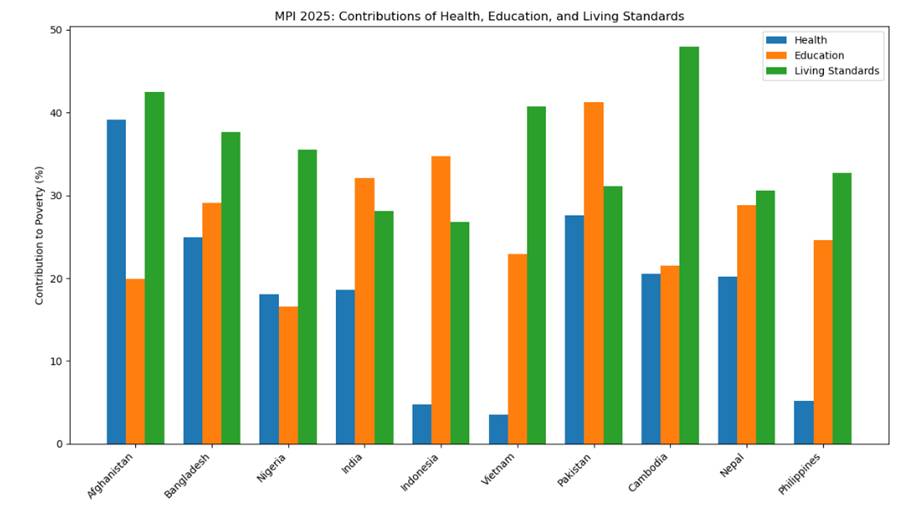
Poverty in every country balances out to be quite different from what this bar chart depicts. It‘s different everyplace. Afghanistan has huge numbers, with about 64.9 percent headcount. That‘s definitely a characteristic. Health accounts for about 39 percent of deprivations and living standards even larger at 42.5 percent. Education is lower, at about 19.9 percent. So, essentials of living such as healthcare, education, nutrition, and other welfare aspects tie up to explain why poverty is so immense there. This has to be mainly addressed before tackling anything else, potentially more than just education, although that is equally important.
Bangladesh has a lower overall headcount at about 14.9 percent. Education accounts for 29.1 percent, health 24.9 percent, and living standards 37.6 percent. Seems that a serious center on the educational gaps and infrastructure of this country needs to be addressed first. Building capabilities is still a large hurdle, despite being better off than a few developing nations.
Stay ahead of the geopolitical week.
MD Briefing delivers expert analysis across five global fronts — the Indo-Pacific, energy, geoeconomics, European security, and the Middle East — every Monday morning. Free.
India has a headcount of about 16.3 percent. Education appears to be the dominant long-term barrier, accounting for 32.1 percent, health 18.6 percent and living standards 28.1 percent. The focus on education implies that making equal access to schooling and the actual, quality of learning a top priority, would make the most difference. Improvements in health and sanitation are seen, but human capital is still critical.
Nigeria is at a headcount of about 33 percent. Living standards dominates at 35.5 percent, health 18.1 percent and education 16.6 percent. Visible gaps in housing, water, sanitation and electricity display quite prominently here. Approaches to these issues will center around; I suppose, infrastructure.
Thailand is better towards the bottom of the spectrum. Indonesia’s health share is only 4.8 percent and Vietnams health share is about 3.4 percent. But educational deprivation jumps considerably, especially in Vietnam at 22.9 percent. Thus, the health situation is making good progress; however, education and other say, structures need to be attended to.
Pakistan seems relatively balanced in a perverse way; education at 41.2 percent, health 27.5 percent, and living standards 31 percent. Keeping all three under control at the same time is obviously not easy.
Cambodia’s living standards are huge, at 47.8 percent, health 20.5 percent, educational 21.3 percent. Shortfalls in basic facilities at household levels are total.
Nepal is similar with somewhat lower proportions. Mainly health components at about 20.2 percent, education 28.7 percent, and living standards 30.5 percent while Philippines is a mix with health at about 5 percent, education 24.6 percent, and standards of living 32.8 percent.
Overall, the wide disparities in how countries carry the fraction of deprivations make it abundantly clear that a uniform policy would be wholly off base. Few of the countries prefer to lean on the food, health and sanitation aspects, while others targeting the educational attainment levels, or a combination of the two.
Why This Matters for Green Development
Environmental sustainability is strongly linked with multidimensional poverty. Dimensions of living standards deprivation include lack of access to clean cooking fuel, sanitation, access to adequate housing and electricity. These intersect with pathways of deforestation, indoor air pollution and climate change vulnerability. Education deprivation limits participation of communities in green transitions.
Thus, there are clear research implications of the MPI structure for climate resilience and for green policy making. In contexts with high standards of living, investing in renewable energy, water infrastructure and climate resilient housing is both poverty reduction and green policy, making. In contexts where Education dominates, green skills development and digital inclusion are essential.
Clarity of data supports clarity of sustainability.
AI as a Social Consciousness Infrastructure
However, AI can provide a revolution, but a revolution can only be built on an ethical foundation.
AI systems can ingest and analyze MPI data both across national and subnational levels. They can pinpoint which districts experience both health and education deprivation. They can model how access to sanitation would impact school enrollment and health costs. They can compare climate and deprivations data to uncover regions at high risk.
However, technology has to be used for justice. AI should be a social consciousness infrastructure rather than a confined optimization engine. This requires that fairness is built into algorithmic design. The most disadvantaged groups should be given priority. Transparency should be a rule during implementation so that communities can understand classifications. Mechanisms of responsibility should be set up to avoid exclusion or bias.
Community participation is just as crucial. Aligning AI with green development will direct investments toward cleaner energy, sustainable agriculture, climate resilient development, and human capital investments. It could help governments move from siloed multidimensional policy to integrated multidimensional strategy.
From Measurement to Transformation
The MPI 2025 evidence is very clear: Poverty is layered and country-specific. If managed ethically, artificial intelligence offers the chance to turn this map into reality. It can focus resources on areas of greatest need. It can build resilience. It can reconcile the fight against poverty with environmental sustainability.
With multidimensional data, visual insight and caring AI, our society can have more than reactive welfare; it can have a second wind. The challenge is not only to measure poverty, but to shatter its structure.
