


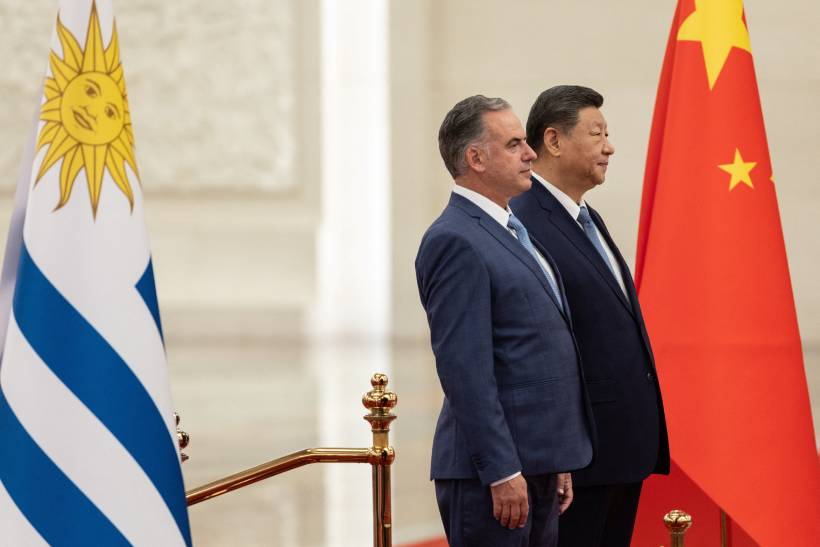
Chinese President Xi Jinping called on China and Uruguay to work together to advance an “equal and orderly multipolar world” as he met Uruguayan President Yamandú Orsi in Beijing on Tuesday, according to a media pool report.
Xi said the two countries should also promote “inclusive and universally beneficial economic globalisation,” reiterating China’s long-standing call for reforms to global governance and international economic systems. He said Beijing aimed to build a “community with a shared future for mankind.”
First South American visit since U.S. action in Venezuela
Orsi’s visit is the first by a South American leader to the Chinese capital since the United States launched a January operation in Venezuela that resulted in the capture of then President Nicolás Maduro, an action that has heightened tensions across the region.
The visit comes at a time of increasing geopolitical polarisation, as competition between major powers intensifies and smaller states seek to navigate shifting diplomatic alignments.
Stay ahead of the geopolitical week.
MD Briefing delivers expert analysis across five global fronts — the Indo-Pacific, energy, geoeconomics, European security, and the Middle East — every Monday morning. Free.
Uruguay seeks trade, investment and development
Orsi said ahead of the visit that the trip was intended to “empower Uruguay in the world and generate opportunities, investment and development,” according to a Facebook post following his arrival in Beijing.
He is leading a delegation of about 150 people, including business leaders, on a visit that runs until February 7. The trip also includes stops in Shanghai, China’s commercial and financial hub.
China courts partners amid high-level diplomatic traffic
The meeting follows a series of visits to China this year by Western leaders, including British Prime Minister Keir Starmer, Canadian Prime Minister Mark Carney and Finnish Prime Minister Petteri Orpo, underscoring Beijing’s efforts to maintain diplomatic engagement across political blocs.
“For Beijing, hosting Orsi signals that South American countries remain eager to engage, despite the increasingly polarised geopolitical environment,” said Francisco Urdinez, a professor at the Pontifical Catholic University of Chile.
Strong trade ties underpin relationship
China is the top destination for Uruguayan agricultural exports, including wood pulp, soybeans and beef. Uruguay recorded a trade surplus of $187.1 million with China in the first half of 2025.
Uruguay imports machinery, electronics and chemicals from China, reflecting a trade relationship driven by commodity exports and manufactured imports.
Analysis: Multipolar messaging meets pragmatic engagement
Xi’s emphasis on an “equal and orderly multipolar world” aligns with China’s broader diplomatic narrative, which seeks to position Beijing as a counterweight to U.S. dominance and as a partner to developing and middle-income countries.
For Uruguay, the visit reflects a pragmatic approach focused on trade and investment rather than ideological alignment. While Montevideo has avoided explicitly endorsing China’s geopolitical framing, its engagement highlights how smaller economies are diversifying partnerships amid growing uncertainty in the global order.
The timing of the visit, following renewed U.S. intervention in Venezuela, adds symbolic weight, even as both sides frame the talks in economic and cooperative terms. Together, the meeting underscores how China’s multipolar pitch is resonating with countries seeking strategic flexibility rather than firm alignment in an increasingly fragmented world.
With information from Reuters.
