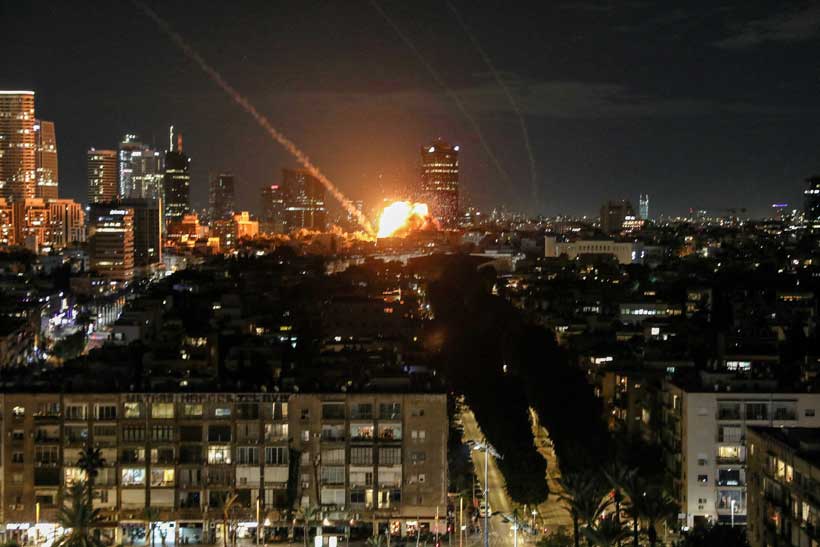
On March 31, five weeks into an active war, Pete Hegseth stood before reporters at the Pentagon and articulated what he presented as a strategic principle. You cannot fight and win a war, he said, if you tell your adversary what you are willing to do or what you are not willing to do. The point was to be unpredictable, to preserve every option, to ensure that Iranian planners would have to reckon simultaneously with fifteen possible approaches, any of which the United States could execute. The logic is actually familiar, even classically so. Thomas Schelling had formalized something close to it decades earlier, arguing that in coercive bargaining between sovereign actors, withholding commitment preserves leverage that explicit declaration would dissolve. The Nixon administration had pushed the intuition further, presenting presidential irrationality itself as a strategic resource. Herman Kahn had systematized the underlying logic into an escalation ladder whose very architecture assumed that each rung could be climbed or descended under rational control. Hegseth was offering a recognizable entry in a long tradition, the deliberately opaque actor as the more dangerous one.
Strategic ambiguity has a long record of apparent success, which is part of what makes its failures so difficult to diagnose. In a bilateral negotiation between two relatively bounded actors with shared channels of communication, ambiguity functions as coercive pressure. It forces the adversary to hedge against multiple contingencies simultaneously, exhausting planning capacity and inflating perceived risk. Cross-strait deterrence offers a working example: the deliberate ambiguity of American commitments to Taiwan has functioned as coercive stability precisely because the relationship remains largely dyadic, the signaling environment is relatively contained, and both parties share enough information about each other’s red lines to model the space between them.
Less attention falls on the environment the Schelling framework was built to describe. It assumes a dyadic relationship between sovereign actors, each with sufficient information about the other’s rationality to model their responses, and each operating within a system contained enough that the effects of their exchange are not substantially transformed by what lies outside it. The coercive logic of manufactured ambiguity holds precisely because, in that environment, the actor generating the uncertainty controls most of the pathways through which it travels, a condition the framework assumes rather than argues for, and one that determines everything that follows from it. Carried into an environment that does not share those properties, the doctrine encounters a system that processes its inputs by a different logic entirely.
In a contained, relatively stable environment, a signal dispatched toward a specific receiver arrives in roughly the form it was sent, producing a response proportional to the pressure applied. The sender’s intention governs the signal’s trajectory because the system does not substantially transform what passes through it. In an environment characterized by feedback loops, interdependent actors, and threshold dynamics, the same signal injected at one node travels according to the system’s own structure rather than the sender’s design. It reaches actors the originating party never targeted, generates responses bearing no proportional relationship to the original input, and leaves behind conditions that were absent before the signal entered. The system absorbs the signal and redistributes its energy along channels the sender did not map and cannot subsequently close. Clausewitz called something close to this friction, the gap between war as conceived and war as it actually unfolds, generated by the accumulation of uncertainties and resistances that no plan survives intact. What he was describing, in 1832, was the structural property that coercive bargaining theory would later bracket in order to make its models tractable. What makes an environment complex in the relevant sense is less a matter of how many actors it contains than the degree to which their simultaneous adaptations produce outcomes that no single actor’s intentions can govern.
Stay ahead of the geopolitical week.
MD Briefing delivers expert analysis across five global fronts — the Indo-Pacific, energy, geoeconomics, European security, and the Middle East — every Monday morning. Free.
When a strategic actor declares that it will remain unpredictable across a range of military options, that declaration travels through every node the system connects, allied partners who require clarity to coordinate their own positions, legislative actors whose authorization calculus depends on knowing what they are being asked to support, markets pricing risk across an uncertain resolution timeline, institutional actors within the military apparatus whose planning coherence requires some degree of signal stability from above. Each node receives the declaration and responds according to its own internal logic. What accumulates across those responses is a new systemic condition, one the initiating power did not design and cannot address through the same bilateral reasoning that produced the disruption. In that kind of environment, the declaration behaves less like an instrument than like a perturbation. In the Iran war, five weeks in, that appears to be what Hegseth’s declaration has begun to produce.
The Strait of Hormuz is, in the current conflict’s intermediate stages, the most structurally revealing case of this dynamic. Its closure is understood by the initiating coalition as a potential Iranian vulnerability, a move that isolates Tehran regionally and generates international pressure on the regime. It produces instead a displacement of the coalition’s organizing role from the conflict’s most consequential economic dimension. Dozens of countries have coordinated on maritime security restoration in a United Kingdom-hosted summit from which the United States was absent, a gathering whose composition was itself a signal of where organizing authority had migrated. Trump, in his national address, has invited the affected countries to manage the passage themselves. The coalition has organized around the problem the war created, along channels the war opened, outside the architecture the initiating power controls. The geometry of the conflict’s economic theater appears to be shifting in a direction the bilateral reading of the strait did not anticipate, and what is already visible is more legible as a systemic response than as the outcome of any single actor’s design.
Republican lawmakers who emerged from classified briefings on the war’s trajectory have begun demanding congressional authorization for any ground deployment, a position documented across multiple congressional statements in the conflict’s fifth week. The pressure has since hardened into constitutional terrain. The War Powers Resolution, triggered when Trump notified Congress of the strikes on March 2, expires on May 1 and requires either legislative authorization or termination of operations, a threshold the administration did not anticipate managing when the doctrine of unpredictability was announced. The constraint has not arrived from opposition. Lawmakers who had supported the war found themselves unable to answer constituents asking what the endgame was. It crystallized within the coalition, among actors who would under normal conditions support the executive posture, precisely because the deliberate refusal to specify intentions denied them the information they needed. The doctrine designed to preserve executive optionality has interacted with the system’s institutional nodes in ways that have progressively narrowed the flexibility it was meant to protect. The optionality the doctrine preserved in principle appears, at this stage, to be narrowing in practice through the systemic responses that preservation triggered.
Hegseth’s doctrine rests on an asymmetry in which the United States retains knowledge of its own options while denying equivalent knowledge to the adversary, imposing on Iranian planners a decision environment too uncertain to navigate with confidence. The asymmetry is coherent within the bilateral framework. In a system whose structure does not respect the boundary between the actor generating ambiguity and the actors receiving it, the fog travels in all directions simultaneously. What appears to be returning to Washington is the ambiguity it produced, progressively transformed by its passage through the system into emergent constraints on its own decision environment. Those constraints are not externally imposed. They are generated by the systemic responses to the actor’s own strategic posture, so that the attempt to impose unknown unknowns on the adversary introduces unknown unknowns into the operator’s own position through the structural behavior of the system the doctrine enters.
The language of unintended consequences is sometimes used to describe this kind of outcome, and the framing, on its own, stops short of what is structurally at stake. In a linear environment, unintended consequences are accidents, the product of incomplete information or miscalculated pressure, correctable in principle through better intelligence or more careful design. Complex environments produce something categorically different. The consequences are not unintended in the sense of being accidental departures from a plan that was otherwise sound. They are structurally generated by the environment’s own response to what was introduced into it, which means they are not correctable through the same reasoning that produced them.
Adapting the plan, refining the targeting, improving the messaging are all responses calibrated to a linear environment. They address the surface of the problem while leaving its architecture intact. The Iraq intervention empowered Iran as the region’s dominant strategic actor, an outcome so contrary to the operation’s stated objectives that no adjustment made within the theater could have reversed it, generated as it was by the region’s own response to the removal of the counterweight the intervention had destroyed. The Afghanistan presence destabilized Pakistan along a frontier that American planning had treated as a boundary rather than a membrane, producing a sanctuary dynamic that progressively undermined the theater it was meant to support. In both cases, the field shifted in ways that compounded the initiating actor’s strategic exposure, and that reorganization proceeded independently of whatever corrections were applied at the operational level. The mechanism does not account for everything those conflicts produced. Ideology, leadership miscalculation, and institutional inertia each contributed in ways that complexity theory does not reach. What it identifies is a class of failure that those other explanations leave structurally unmapped.
Hegseth argued that the lessons of Iraq and Afghanistan had been internalized and would not be repeated. The lessons most visibly absorbed concern duration and force posture, the determination to avoid open-ended occupation without defined exit conditions. The failure that reproduced itself across both theaters, however, operates at a level beneath those surface features. In Iraq, the removal of the Baathist state generated a political vacuum that organized itself around sectarian and militia dynamics the intervention had not modeled. In Afghanistan, the prolonged presence produced an institutional dependency in the Afghan state that collapsed the moment the external support structure was withdrawn. In each case, the environment responded by generating political, organizational, and temporal constraints that were not part of the initial design and that progressively redefined what was achievable within the theater. The reasoning architecture applied across all three engagements has remained consistent, and it is that architecture, rather than the specific decisions made within any given theater, that determines how the system responds.
Schelling’s framework is analytically rigorous within the environment it describes. The difficulty lies in the transposition: the bilateral assumption moves with the doctrine into environments where it no longer holds, largely invisible because the doctrine’s surface logic remains intact. An actor can articulate the Schelling rationale fluently, apply it consistently, and still be reasoning with a framework whose core environmental assumption has actually ceased to obtain. The category error operates at a different level than misapplication in the ordinary sense. It is a mismatch between the system the doctrine was built for and the system in which it is being used, and strategic culture has been considerably more attentive to the doctrine’s insights than to the conditions under which those insights hold.
What those conditions require, and what complex operational environments do not provide, is a system stable enough that signals remain instruments. The conditions structuring American strategic options five weeks into the Iran war were not present on February 28. They arise from the interaction between what was introduced and a system that is always more complex than the doctrine assumes, and that gap is where the emergent consequences accumulate. It is also, in different configurations, where they have accumulated before.