


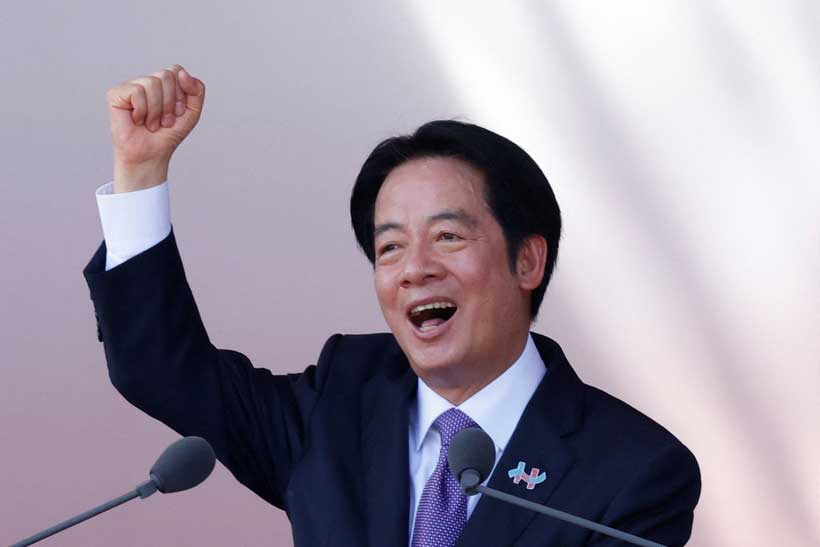
Taiwan must look to fellow democracies rather than China for trade and economic cooperation, President Lai Ching-te said on Tuesday, as his government outlined plans to deepen collaboration with the United States in areas such as artificial intelligence and critical minerals.
Lai’s remarks came as Taipei seeks to strengthen economic and technological links with Washington amid intensifying strategic competition between the United States and China.
U.S.–Taiwan talks focus on AI, tech and supply chains
Senior Taiwanese and U.S. officials last week discussed cooperation on artificial intelligence, technology and drones at a high-level forum launched during the first administration of U.S. President Donald Trump.
The U.S. State Department described Taiwan as a “vital partner” following the talks. The two sides also signed statements on cooperation in economic security and on the Pax Silica Declaration, a U.S.-led initiative aimed at securing artificial intelligence and semiconductor supply chains.
Stay ahead of the geopolitical week.
MD Briefing delivers expert analysis across five global fronts — the Indo-Pacific, energy, geoeconomics, European security, and the Middle East — every Monday morning. Free.
The initiative is designed to counter risks stemming from growing competition with Beijing, Washington’s main strategic rival, which claims Taiwan as its own territory.
Lai praises partnership with democratic allies
Speaking at a news conference at the presidential office on the U.S.-Taiwan Economic Prosperity Partnership Dialogue, Lai said the talks demonstrated that Taiwan was pursuing the right economic strategy.
“Taiwan is on the right economic path and is striding confidently onto the world stage,” Lai said. He added that Taiwan had both the capability and confidence to work with democratic partners to help lead future economic growth.
Remarks contrast with opposition engagement in Beijing
Lai’s comments came as Hsiao Hsu-tsen, deputy chairman of Taiwan’s main opposition party, the Kuomintang (KMT), was in Beijing for a think-tank exchange with China’s Communist Party.
The forum focused on what were described as non-political issues such as artificial intelligence and tourism.
Lai said Taiwan’s opposition parties “had their own positions,” but contrasted Taiwan’s slower economic growth under the previous KMT government which signed a landmark trade deal with China with faster growth since the Democratic Progressive Party (DPP) took office in 2016.
“Do we want to continue collaborating with the U.S., Japan, Europe and other allied nations, or again lock ourselves into China?” Lai said.
KMT stresses cross-strait cooperation
There was no immediate response from the KMT to Lai’s remarks. However, the party said Hsiao told the opening of the Beijing forum that “peaceful development” served the interests of both sides.
“We should cooperate across the Taiwan Strait to earn money from the world, rather than oppose each other across the strait and let foreign countries reap the benefits, exploiting Taiwan and hollowing it out,” Hsiao said, according to a party-provided readout.
Background: Strained ties with Beijing
China refuses to speak to Lai, calling him a “separatist.” Lai has rejected that label, saying only Taiwan’s people can decide their future.
Speaking to reporters on Tuesday, Lai reiterated an offer to engage in dialogue with Beijing, saying talks should be based on parity and equality.
Analysis: Economic alignment as political signal
Lai’s comments underline how economic policy has become a central front in Taiwan’s broader struggle to define its international space amid pressure from Beijing.
By explicitly framing trade cooperation as a choice between democratic partners and China, Lai is reinforcing the DPP’s strategy of embedding Taiwan more deeply in U.S.-led and allied supply chains, particularly in high-value sectors such as semiconductors and artificial intelligence.
The contrast with the KMT’s engagement in Beijing highlights Taiwan’s internal political divide ahead of future elections, with economic growth and external alignment emerging as key fault lines. While the opposition argues that engagement with China can deliver stability and commercial opportunity, Lai’s government is betting that closer ties with democracies will offer greater resilience and strategic security in an increasingly polarised global environment.
With information from Reuters.
