


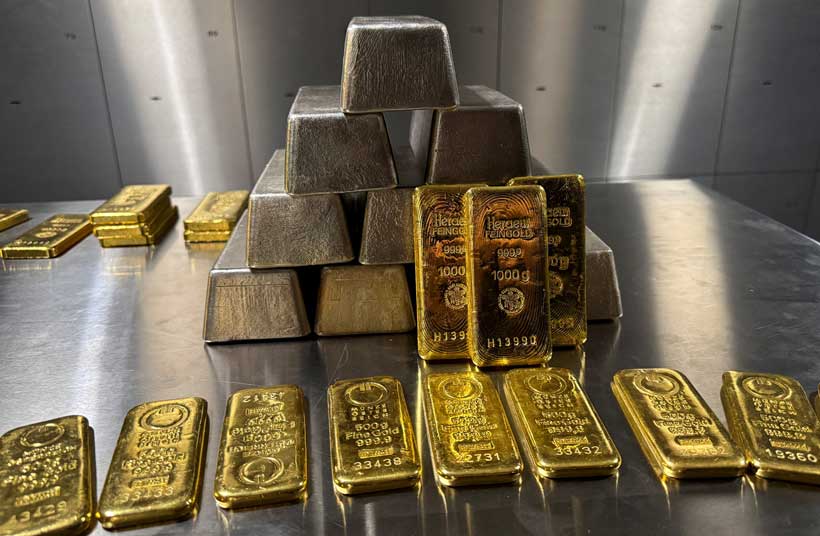
Gold has surged to a historic high above $5,000 an ounce, capping one of the strongest rallies in modern market history. The metal gained 64% in 2025 its biggest annual rise since 1979 and is already up 18% this year. The rally has been powered by a potent mix of geopolitical anxiety, expectations of U.S. interest-rate cuts, aggressive central-bank buying, de-dollarisation trends, and renewed inflows into investment funds as investors seek shelter from volatility.
The Spot Market: Where Prices Are Set
At the core of the gold market lies the spot trade, dominated by large banks, institutions, and major buyers. Prices here reflect real-time supply and demand. London remains the most influential hub, with the London Bullion Market Association setting global standards and anchoring the over-the-counter market. Alongside London, China, India, the Middle East, and the United States play central roles in physical gold trading, reflecting both investment demand and deep-rooted cultural consumption.
Futures Markets and Financial Exposure
Beyond physical trade, many investors gain exposure through futures markets, where gold is bought or sold for delivery at a future date at a fixed price. The COMEX exchange in New York is the world’s largest gold futures market by volume, shaping global price discovery. In Asia, China’s Shanghai Futures Exchange and Japan’s TOCOM add regional depth, allowing traders to hedge risks or speculate on price movements.
ETFs and the Financialisation of Gold
Exchange-traded funds have transformed how investors access gold. Backed by physical metal, ETFs allow exposure without the logistical challenges of storage or delivery. In 2025, global gold ETFs recorded record inflows of $89 billion, led by North American funds, signalling that institutional and retail investors alike are treating gold as a core portfolio asset rather than a niche hedge.
Stay ahead of the geopolitical week.
MD Briefing delivers expert analysis across five global fronts — the Indo-Pacific, energy, geoeconomics, European security, and the Middle East — every Monday morning. Free.
Bars, Coins, and Retail Demand
Physical ownership remains important, especially for retail investors. Bars and coins are widely purchased through dealers and online platforms. In major consumer markets like China and India, high prices have shifted demand away from jewellery and toward bars and coins, reflecting a more investment-driven mindset among households.
Investor Sentiment and Speculation
Market psychology plays a decisive role in gold’s price. Rising interest from hedge funds and asset managers has amplified price swings, with sentiment responding rapidly to headlines, crises, and macroeconomic shifts. In periods of uncertainty, speculative flows tend to reinforce upward momentum.
Currencies, Rates, and Politics
Gold’s traditional inverse relationship with the U.S. dollar remains a key driver. A weaker dollar makes gold cheaper for non-dollar investors, boosting demand. At the same time, expectations of lower interest rates raise gold’s appeal by reducing the opportunity cost of holding a non-yielding asset. Political shocks from trade wars to diplomatic crises have further strengthened gold’s status as a safe haven.
Central Banks and the Structural Bid
Perhaps the most powerful long-term force behind gold’s rally is central-bank demand. Emerging market central banks, in particular, have been steadily increasing gold reserves to diversify away from the dollar and hedge geopolitical risk. Net purchases reached nearly 300 tons in the first 11 months of 2025. China has continued adding gold for over a year straight, while Poland has openly committed to significantly expanding its reserves, underscoring how official-sector buying has become a structural pillar of the market.
Personal Analysis
Gold’s surge to $5,000 is not just a speculative spike it reflects a deeper transformation in the global financial order. Investors are no longer treating gold solely as insurance against inflation; they are using it as protection against geopolitical fragmentation, currency weaponisation, and systemic uncertainty. The scale of central-bank buying suggests waning trust in the dollar-centric system, while ETF inflows show that gold has been fully reabsorbed into mainstream portfolios. Yet this also means volatility is here to stay. As gold becomes more financialised and sentiment-driven, price swings will likely intensify. In a world defined by strategic rivalry and climate, political, and monetary shocks, gold is no longer just a refuge of last resort it is fast becoming a barometer of global anxiety.
With information from Reuters.
