


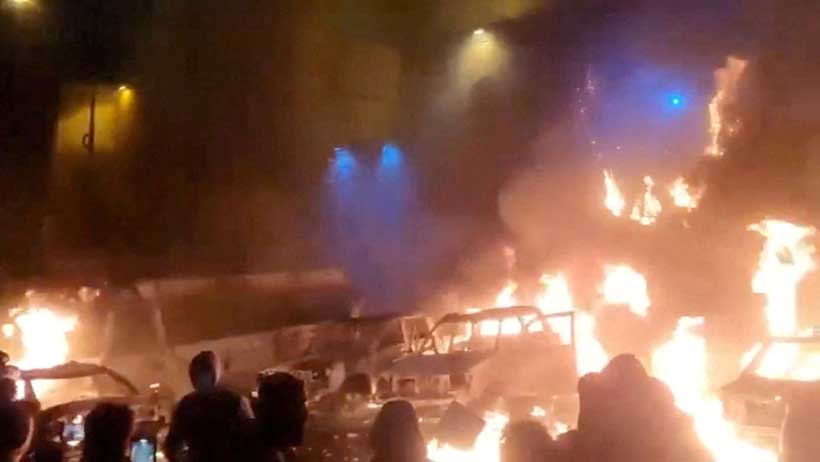
Despite relentless crackdowns, large-scale protests continue to erupt across Iran. Available reports suggest that recent demonstrations have reached all 31 provinces and more than 180 cities, cutting across geographic, ethnic, and political divides. Beyond Tehran and other major urban centers, protests have appeared in Kurdish regions and in provinces long considered socially conservative.
This wave of unrest was initially sparked by Iran’s deepening livelihood crisis. Years of high inflation have sharply devalued the rial, while the cost of essentials like food, electricity, and water has risen steadily. Yet economic grievances alone cannot explain the intensity of the current protests. Within days, demonstrations evolved from demands for material relief into open defiance of the Islamic Republic itself, challenging not just state authority but the religious foundations of political power.
The media reported that during clashes on January 9, numerous mosques in Tehran were damaged or set ablaze. Footage circulated widely on social media. Around the same time, a satirical post by an Iranian expatriate in California went viral, joking that Iranians might donate the tomb of Ayatollah Ruhollah Khomeini to the U.S. president to be turned into a hotel and casino. Iranian officials swiftly condemned the remark as blasphemous, underscoring the regime’s sensitivity to symbolic challenges.
In Rasht, a major northern city, opposition groups and human rights organizations reported that after several students were killed during security crackdowns, enraged protesters attacked religious buildings across the city. One image in particular became emblematic of the protests: a young woman, presumably Iranian, without wearing a hijab, calmly lighting a cigarette with a burning portrait of Supreme Leader Ali Khamenei. The clip became viral, and her action was replicated, turning a single act into a collective visual language of defiance.
Stay ahead of the geopolitical week.
MD Briefing delivers expert analysis across five global fronts — the Indo-Pacific, energy, geoeconomics, European security, and the Middle East — every Monday morning. Free.
From the streets to the symbolic realm, it is clear that Iran is no longer witnessing a conventional protest movement aimed at policy reform. What is unfolding is a broader rejection of religious rule itself, a process that can best be described as de-Islamization. This is not a fleeting emotional backlash but the result of long-term structural changes, especially a profound ideological shift among Iran’s younger generation.
Understanding this transformation requires looking beyond today’s clashes to the historical evolution of Iran’s political system. After the 1979 Islamic Revolution overthrew the Pahlavi monarchy, Ayatollah Khomeini established the Islamic Republic, where Shiite Islamic law became the ultimate source of political legitimacy, and clerical authority was embedded at the core of the state.
In its early years, the regime enjoyed relative stability. It unified diverse revolutionary factions and reinforced cohesion through external confrontation, notably during the Iran–Iraq War. Under conditions of war and isolation, religious authority retained moral credibility, particularly among a generation shaped by revolutionary fervor and sacrifice.
That social contract, however, has steadily eroded. From the 1990s onward, expanded education, exposure to global culture, and repeated governance failures reshaped Iranian society. Younger generations increasingly embraced pragmatic nationalism, secular values, and personal autonomy. From the protests following the death of Mahsa Amini in 2022, who died after being detained by Iran’s morality police for alleged improper hijab, to the most recent demonstrations, the driving force has been Gen Z, who are highly educated, digitally connected, and deeply skeptical of inherited authority.
Two factors are central to the rise of de-Islamization. First, the fusion of religion and state has produced systemic corruption that has drained religious authority of its moral legitimacy. Second, Iran now has one of the largest populations of educated yet profoundly disillusioned young people in the Islamic world.
Education and globalization have produced a cohort fluent in scientific reasoning, individual rights, and global cultural norms. At the same time, sanctions, inflation, and entrenched corruption have deepened economic insecurity, turning material frustration into political alienation. For many young Iranians, economic hardship has become shorthand for systemic failure.
The ideological divide between generations is stark. For Gen Z, religion is a personal matter, not a source of public authority. Modern lifestyles are seen as non-negotiable rights, not privileges subject to religious approval. Yet institutions such as the morality police, mandatory dress codes, and religious intrusion into private life have not relaxed; in many cases, enforcement has intensified. This growing gap between social consciousness and institutional control has made confrontation inevitable.
The actions seen today should not be mistaken for a wholesale rejection of faith. Rather, it is a rejection of the politicization of religion and compulsory Islamization. Politically, religion is losing its role as the regime’s primary source of legitimacy. Socially, its sacred aura is eroding, and authority is no longer beyond question. In this sense, de-Islamization reflects the secularization of power rather than the disappearance of belief.
Iran was once the most complete institutional model of Islamic political rule. Today, it faces a challenge its founders could scarcely have imagined. De-Islamization is no longer a quiet undercurrent; it has become a visible social force. Whether this ultimately marks the triumph of modernity over Islamic governance remains uncertain. What is clear is that the trend is entrenched. Short of eliminating an entire generation, resentment born of repression, death, and enforced piety cannot simply be undone.
