


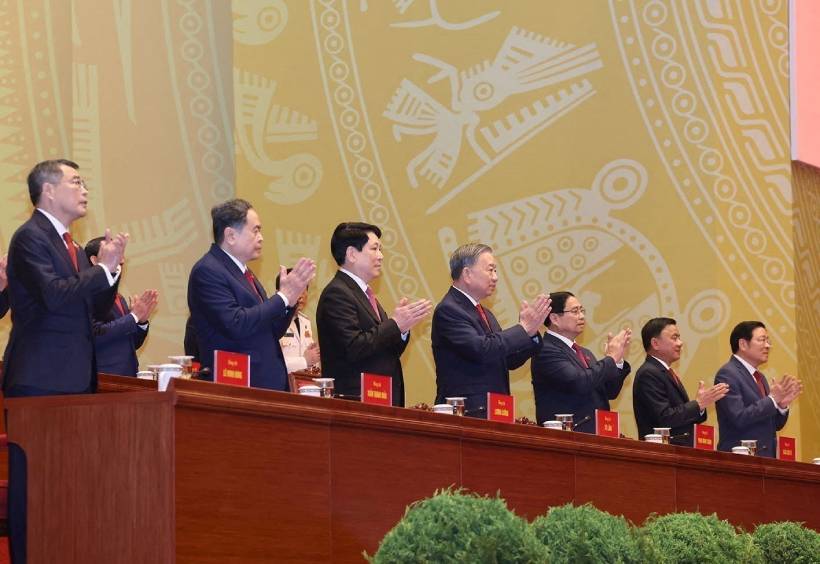
Vietnam’s ruling Communist Party is concluding its 14th five-yearly national congress, a tightly choreographed political event that determines the country’s top leadership and sets policy priorities through 2030. About 1,600 delegates, representing more than 5 million party members, gather to endorse senior appointments and approve long-term economic and political goals.
The congress comes at a moment of global economic uncertainty, as Vietnam faces rising U.S. tariffs and shifting geopolitics while trying to sustain rapid growth and preserve political stability under one-party rule.
How the Leadership Is Chosen
Delegates to the congress elect roughly 200 members to the Communist Party’s Central Committee, which then selects between 17 and 19 members for the Politburo, the party’s most powerful decision-making body. From within the Politburo, the general secretary the country’s top leader is chosen.
Current party chief To Lam, 68, received early party backing in December to retain his position, though the final endorsement comes only after the new delegates are seated. Following the congress, the Politburo nominates candidates for president, prime minister, and parliamentary speaker, whose appointments are later formalised by the National Assembly.
Stay ahead of the geopolitical week.
MD Briefing delivers expert analysis across five global fronts — the Indo-Pacific, energy, geoeconomics, European security, and the Middle East — every Monday morning. Free.
Although parliamentary elections are scheduled for March, an extraordinary legislative session could be convened earlier to approve key appointments. In recent years, the role of party chief has eclipsed other offices in power, consolidating authority at the top of the party hierarchy.
Will Policies Change After the Congress?
Major policy shifts are unlikely. Vietnam’s leadership system is based on collective decision-making, a model that has delivered policy continuity since the Doi Moi economic reforms of the late 1980s. Those reforms transformed Vietnam into one of Asia’s fastest-growing economies while maintaining strict political control.
Foreign policy is expected to continue its careful balancing act among China, the United States, and Russia. Although Lam has avoided using the term “Bamboo Diplomacy,” the underlying strategy of flexibility and non-alignment remains intact unless major geopolitical shocks intervene.
Economically, Lam has promoted a model that strengthens private enterprise through state-guided “national champions,” while keeping the party firmly in charge of strategic sectors.
What Are the Main Targets to 2030?
Economic performance remains central to the Communist Party’s legitimacy. Lam has pledged annual economic growth of more than 10% for the rest of the decade, far exceeding the government’s missed targets for 2021–2025 and reflecting ambitious expectations despite global trade disruptions.
Vietnam aims to reduce bureaucratic obstacles, expand trade partnerships, and shield its economy from external pressure, particularly as U.S. tariffs threaten exports to its largest market. The leadership is pushing for a new growth model in which the private sector acts as the main engine of expansion, while the state maintains a “leading role.”
Public investment is set to rise sharply to support infrastructure and development projects, with the budget deficit projected at around 5% of GDP in the next five-year period, up from just over 3% in the previous cycle.
How Long Has the Party Ruled?
The Communist Party of Vietnam was founded by Ho Chi Minh in 1930 and took control of northern Vietnam in 1954 following the end of French colonial rule. After the fall of Saigon in 1975, the party reunified the country and has governed ever since without permitting political opposition.
Analysis: Stability Over Change, Ambition Over Caution
This congress underscores the Communist Party’s priority of stability and continuity at a time of mounting external and internal pressures. While leadership selection appears orderly and predictable, the economic goals outlined by To Lam are strikingly ambitious and may prove difficult to achieve amid slowing global growth and rising trade barriers.
The concentration of power in the role of party chief suggests a more centralized governance style, even as the leadership maintains the rhetoric of collective decision-making. The challenge for Vietnam will be to reconcile its push for rapid growth and private-sector dynamism with tighter political control and an increasingly hostile global trade environment.
With information from Reuters.
