


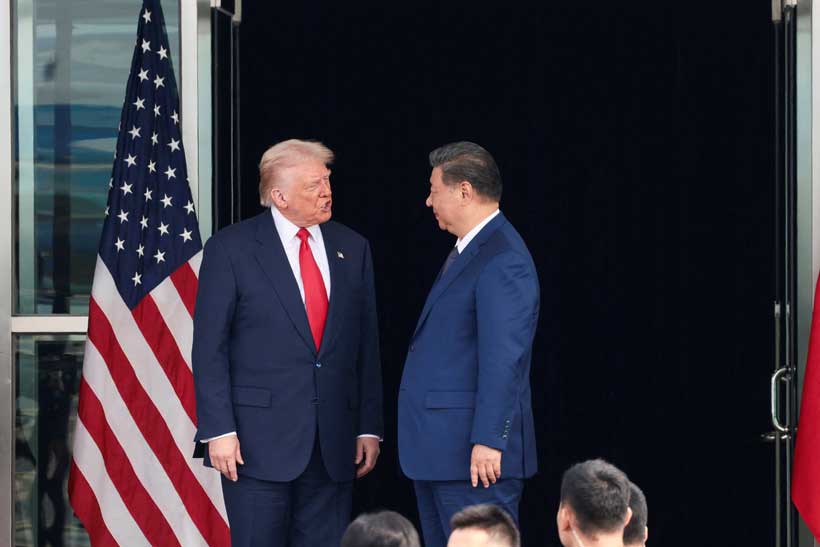
China views US tensions with countries like Iran and Venezuela as a golden opportunity to bolster its own influence and offer an alternative model of international cooperation. Its strategy aims to counter the US containment strategy through soft power and economic cooperation. China consistently criticizes what it calls US hegemony and opposes US attempts to interfere in the internal affairs of other countries or control their resources, advocating for a multipolar world. China leverages the tensions created by US policies to enhance its economic and political influence in the Middle East and other countries through mutually beneficial cooperation.
China’s stance on American control over the resources of nations and peoples, such as Venezuela, the Arctic, and most recently Greenland, is characterized by its complete rejection of American hegemonic policies over the world’s resources and wealth. China works to undermine these policies through various strategies, including
(strengthening the yuan as a reserve currency, using rare earth minerals as leverage, and providing loans in exchange for resources to developing countries. Meanwhile, China presents itself as an alternative model that does not impose hegemony and seeks to establish a more balanced global order that rivals Western influence, particularly in the areas of infrastructure and strategic resources. Its position in Venezuela serves as an example of the struggle for influence in Latin America.
China’s plans and policies to counter American hegemony over the world’s resources and wealth, particularly in developing countries of the Global South, involve undermining the dollar’s dominance. China is working diligently to break the dollar’s monopoly through currency swap agreements, pricing goods in yuan, and developing alternative financial platforms to the current (SWIFT global financial system), which is controlled by Washington.
Stay ahead of the geopolitical week.
MD Briefing delivers expert analysis across five global fronts — the Indo-Pacific, energy, geoeconomics, European security, and the Middle East — every Monday morning. Free.
This is achieved through China’s efforts to implement its Belt and Road Initiative using the yuan, thus limiting the control of the Western and American financial system over the world. Furthermore, China’s strategy of using rare earth minerals as leverage against Washington and the West is evident. China leverages its control over rare earth mines and resources in Africa and other regions as a strategic tool to counter Western and American pressure, as demonstrated by trade tensions with the United States. In addition to China’s “oil-for-loans strategy” and its infrastructure projects, China is filling the void left by the United States in developing countries by offering massive loans in exchange for their resources, as in the case of Venezuela. This expands its strategic influence and challenges American hegemony.
For this reason, China strongly criticizes American military and political interventions in other countries, portraying itself as a sovereign, not imperial, development power. It considers American hegemony a threat to global stability, even as it seeks to increase its own influence. Therefore, China aims to play a role in the global balance of power by striving for a global monetary balance and reducing dependence on the dollar. It believes its economic development and alternative policies undermine the Western imperial system, which provokes Western hostility. Here, China’s strategy is clearly evident in Venezuela, where it provided massive loans in exchange for oil and minerals. This allowed the former “Maduro” regime to withstand US sanctions and strengthened the Chinese presence in Latin America, posing a direct challenge to US influence in the Caribbean and Latin America, which Washington considers its backyard.
China also rejects US claims of tightening its grip on Greenland in the face of China. In this regard, China called on the United States to stop using the pretext of the “China threat” to advance its own interests in Greenland, asserting that its activities in the region are legitimate and in accordance with international law. The official Chinese position regarding US pretexts for controlling Greenland can be summarized as follows: China categorically rejects these pretexts and claims. The Chinese Foreign Ministry urged the United States not to use other countries, especially China, as a pretext to serve its own interests in Greenland. Washington seeks to control Greenland, an island rich in natural resources, including rare earth elements. Greenland is a potential area for global investment, from which China is already benefiting significantly, particularly through its investment in transportation infrastructure projects on the island. This has provoked Washington and President Trump, leading them to consider controlling Greenland to secure its resources in response to the Chinese presence there.
China has asserted the legitimacy of its activities, countering any American claims of controlling the resources of other countries and peoples under the pretext of China threatening American interests. For example, Chinese Foreign Ministry spokesperson Mao Ning stated that “Beijing’s activities in the Arctic aim to promote peace and stability and are in accordance with international law.” She denied the existence of a Chinese threat worldwide, as alleged by the United States. Beijing views the exaggeration of the Chinese threat as part of a broader political maneuver within the broader competition for influence in the Arctic, Greenland, and other regions around the world. Washington also seeks to control the Arctic region, given its increasing importance due to melting ice and the potential opening of new trade routes, making it a strategic area for the United States, which is trying to hinder Chinese presence and influence in the Arctic region, which is closer to its borders than the United States.
The official Chinese position in confronting the unilateral American hegemony in the global system can be summarized as follows: China’s consistent emphasis on respecting the principle of sovereignty and non-interference: China stresses the principle of national sovereignty and non-interference in the internal affairs of states, a principle it uses to criticize American military and diplomatic activities that it considers violations of this sovereignty. Furthermore, China consistently emphasizes the mechanism of economic cooperation, focusing on building strong economic and trade relations with Arab countries, leveraging the Belt and Road Initiative and major energy deals (such as the purchase of cheap Iranian oil), and presenting itself as a reliable partner for economic stability rather than military dominance. China also supports global stability, and Beijing calls on the international community to work towards stabilizing tense situations, such as the conflict in Gaza, through UN mechanisms and international conferences, thus demonstrating its role as a pole seeking stability in contrast to the conflicts in which America is involved.
