


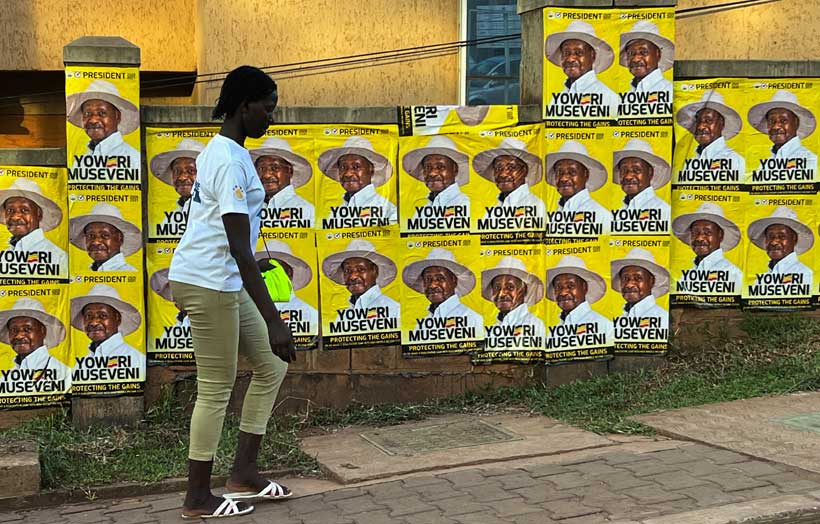
Ugandan President Yoweri Museveni, 81, who has ruled the country since 1986, appears to be on track for a decisive victory in early results from Thursday’s election. The electoral commission reported that Museveni held 76.25% of the vote based on tallies from nearly half of polling stations, while his main challenger, pop star-turned-politician Bobi Wine (Robert Kyagulanyi), trailed with 19.85%.
The election was conducted under an internet blackout and followed a campaign marred by violence, arrests, and intimidation. Security forces reportedly opened fire at Wine’s rallies, killing at least one person, while hundreds of his supporters were detained. Wine’s party, the National Unity Platform (NUP), claimed he was effectively under house arrest in Kampala, though authorities denied this allegation.
Museveni has repeatedly expressed confidence in his victory, stating that he would secure around 80% of the vote “if there’s no cheating.” A seventh term would further cement his long-standing rule, amid ongoing speculation about the eventual transfer of power, including the potential succession of his son, military chief Muhoozi Kainerugaba.
Why It Matters
This election carries significant implications for Uganda’s democratic process and regional stability. Firstly, it raises questions about the credibility of the electoral system, as observers, including the U.N. human rights office, have highlighted widespread repression, intimidation, and restricted civic freedoms. Allegations of voter manipulation and fraud could further erode public trust in government institutions.
Stay ahead of the geopolitical week.
MD Briefing delivers expert analysis across five global fronts — the Indo-Pacific, energy, geoeconomics, European security, and the Middle East — every Monday morning. Free.
Secondly, the election outcome affects Uganda’s political succession. Museveni’s long tenure has concentrated power in the executive and reinforced his family’s influence. A decisive victory would likely entrench this dominance, delaying prospects for political renewal or generational leadership transfer.
Finally, Uganda’s stability is critical for the East African region. Political unrest, disputed results, or a crackdown on opposition supporters could spill over borders, affecting trade, security, and regional cooperation among neighboring countries and the African Union.
Several groups are central to the unfolding electoral and political dynamics. Museveni and his National Resistance Movement (NRM) are seeking to consolidate authority and secure another term. Bobi Wine and the NUP represent the opposition, campaigning for reform but facing systemic repression.
Ugandan security forces, including the military and police, play a key role in enforcing campaign restrictions, maintaining order, and controlling opposition activity. International observers, such as the United States and the United Nations, monitor the election and advocate for democratic standards and human rights. Meanwhile, the Ugandan electorate particularly supporters of the opposition is directly affected by restrictions on information, assembly, and protest.
What’s Next
The electoral commission will release complete results in the coming days, which may be followed by legal challenges from Wine and the NUP over alleged irregularities. While no major protests have occurred so far, opposition calls for demonstrations could escalate if final results are contested.
The international community is likely to respond to the election outcome with statements regarding its fairness, potentially influencing Uganda’s diplomatic relations and foreign aid programs. Finally, Museveni’s projected victory raises long-term questions about succession planning, governance, and political stability in Uganda, particularly if opposition and civil society voices continue to be suppressed.
With information from Reuters.
