


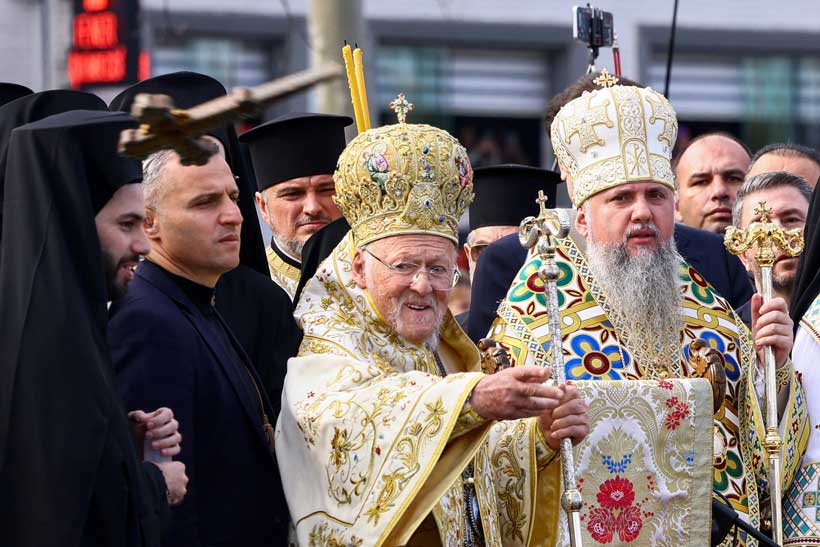
On 12 January 2026, Russia’s Foreign Intelligence Service, the SVR, published a text attacking Ecumenical Patriarch Bartholomew with language closer to a security briefing than an ecclesiastical statement. On 13 January 2026, the Ecumenical Patriarchate responded with a restrained communiqué, underlining one point above all: the latest assault came from state agencies.
The shift matters. A conflict born in the church sphere now travels through state infrastructure. The message becomes harder, the theater widens, and the target expands from canon law disputes to geopolitical alignment.
A change of author changes the category of conflict.
A synodal text argues doctrine, jurisdiction, and canonical order. The SVR text argues power. The author alone marks escalation. A state intelligence service speaking in the name of “information received” signals an official national line, with the authority and reach of a security apparatus. The Ecumenical Patriarchate framed the moment in similar terms, without matching the vocabulary. The communiqué avoided theological counterpolemics and placed the episode in the category of propaganda, false news, insults, and fabricated narratives.
Stay ahead of the geopolitical week.
MD Briefing delivers expert analysis across five global fronts — the Indo-Pacific, energy, geoeconomics, European security, and the Middle East — every Monday morning. Free.
A new stage emerges: ecclesiastical diplomacy under direct pressure from state instruments. The SVR text uses religious vilification to achieve political effects. Terms such as “Antichrist” and “devil” aim at moral delegitimization, not canonical debate.
Such language performs three functions.
First, mobilization. A sacred vocabulary hardens group identity, mainly among audiences primed for spiritual warfare narratives.
Second, polarization. A demonized interlocutor becomes nonnegotiable, which narrows space for mediation by third churches.
Third, permission structure. Once an opponent becomes an existential evil figure, harsher measures appear “defensive” in public perception, across media, diplomacy, and domestic policy.
The Ecumenical Patriarchate refused entry into that frame. The response moved the argument away from sanctified conflict and into the realm of information operations.
The Baltic theater explains the urgency.
The SVR text places the Baltic states at the center, claiming a plan to “oust” Russian Orthodoxy and install structures “controlled by Fanar.” Behind the exaggeration lies a real pressure point. Estonia has debated, amended, and contested legislation aimed at limiting ties between churches and foreign leadership structures linked to national security concerns. Estonian public broadcaster ERR described the law passed by the Riigikogu in September 2025 and the president’s move to take amendments to the Supreme Court.
Even earlier in 2025, reporting tracked parliamentary efforts and the religious freedom debate around those amendments.
The SVR therefore speaks into an existing political process. The function resembles pre-positioning. If Baltic governments pursue legal separation from Moscow-linked ecclesiastical structures, Moscow gains an argument: foreign intelligence, foreign manipulation, hostile “Russophobia.” The SVR text already supplies the storyline.
Britain as a familiar anchor for an external enemy
The SVR accusation of British special services serves a predictable role. A single external director simplifies a complex local reality across Lithuania, Latvia, and Estonia. The narrative also internationalizes responsibility. Local Orthodox communities become secondary actors. Baltic governments become instruments. The Ecumenical Patriarchate becomes an agent. Britain becomes the strategist. Such framing turns a jurisdictional conflict into a counterintelligence tale. A counterintelligence tale invites countermeasures.
Expansion beyond Ukraine as a strategic warning
Ukraine appears as the foundational grievance: the SVR text describes Bartholomew as the figure who “split Orthodox Ukraine.” Moscow uses the Ukrainian precedent as a template for future alarms. The message reads like a map of feared contagion: Ukraine first, Baltic states next, then Eastern Europe.
The SVR then inserts Serbia and Montenegro. The text claims an intention to grant autocephaly to an unrecognized “Montenegro Orthodox Church,” framed as a strike against a “particularly obstinate” Serbian Church. Russian state media echoed the same claim.
Whether the scenario corresponds to any near-term plan matters less than the signalling function. Moscow broadcasts a warning to Belgrade, to Orthodox hierarchies watching Serbia’s position, and to governments in the region. A message emerges: alignment with Constantinople carries a cost in Moscow’s security narrative.
Three audiences stand out.
Domestic Russian audience
A state agency uses sacred language to transform a church dispute into a national cause. Ecumenical Patriarch Bartholomew becomes a hostile instrument, linked to foreign intelligence. The state becomes the guardian of Orthodoxy.
Orthodox audiences beyond Russia
The “false prophet” motif and Gospel reference are aimed at Orthodox believers for whom theological vocabulary carries weight. The point seeks to shape perceptions across diaspora communities, monasteries, and local hierarchies.
Western public and policy space
The Baltic segment targets a Western arena where religion intersects with national security debates. Estonia’s legal struggle offers a readymade hook. A state agency statement seeks to create reputational pressure on Baltic decisions and to frame any future restriction as persecution.
The Ecumenical Patriarchate response reads as strategic discipline. No counter-demonization. No long rebuttal of details. A single line of defense: the institution continues its mission and service, immune to propaganda campaigns.
What escalation changes inside the Orthodox system
Escalation shifts the center of gravity.
Inter-Orthodox dialogue weakens.
When intelligence services enter the arena, ecclesiastical mechanisms lose primacy. Even a future synodal conversation begins under suspicion and securitized logic.
Local churches face higher risk.
Baltic jurisdictions and dioceses turn into contested terrain where pastoral choices trigger state narratives. Clergy and communities become targets for pressure, recruitment accusations, and loyalty tests.
Canon law becomes a proxy language.
Autocephaly, jurisdiction, and recognition remain the vocabulary. The engine becomes geopolitical. The SVR text uses canonical terms as a cover for influence mapping.
A measured interpretation of the moment
The episode signals a phase of consolidated confrontation. Moscow’s messaging no longer relies only on church diplomacy or media-friendly clerics. A state intelligence brand carries formal weight and tactical intent.
For the Ecumenical Patriarchate, the reply shows a choice: refuse the trap of symmetrical escalation. The communiqué marks the author, names propaganda, and closes the door to a shouting match.
For the broader Orthodox world, the danger lies in precedent. Once intelligence services claim authority inside ecclesiastical disputes, future conflicts across borders become easier to securitize. The church space begins to resemble contested political territory.
The Baltic front explains timing. Legal and political processes in Estonia and regional security anxieties offer a fertile theater. The Montenegro reference expands the warning into the Balkans. Moscow signals readiness to contest influence beyond Ukraine and beyond the Baltic arc.
