


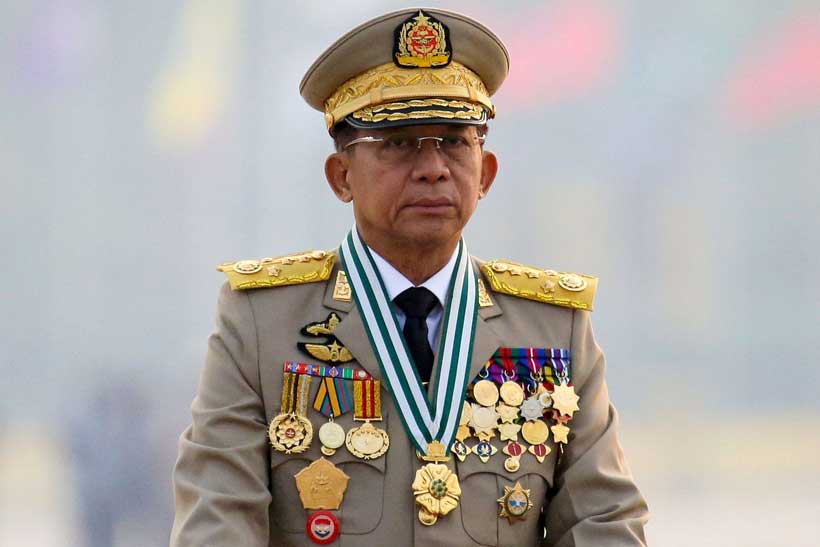
Myanmar’s military decision to hold a phased general election during an ongoing civil war stems directly from the February 2021 coup that overthrew the elected government of Aung San Suu Kyi and her National League for Democracy (NLD). The coup ended a decade-long experiment with partial civilian rule and plunged the country into nationwide resistance, armed rebellion, and state fragmentation. Despite initial promises to restore democracy after alleging electoral fraud in the 2020 polls a claim rejected by Suu Kyi and dismissed by international observers the military has since ruled by force, detaining political opponents and dismantling the electoral infrastructure that once legitimised civilian governance. Against this backdrop, the election represents not a return to democratic normalcy, but an attempt to redefine legitimacy under conditions of coercion and conflict.
Rationale Behind the Election
The junta’s primary motivation for holding elections is political consolidation rather than democratic restoration. With large areas of the country outside its effective control and armed resistance showing resilience, the military appears to view elections as a mechanism to institutionalise its dominance through constitutional means. By eliminating the NLD and other major opposition parties from the political field—largely through legal and administrative measures the junta has engineered an electoral environment populated almost exclusively by military-aligned actors. This allows the armed forces to claim procedural legitimacy while avoiding genuine electoral competition. The repeated delays to the election, originally promised for August 2023, underscore how battlefield realities rather than democratic readiness have dictated the timing.
Structure and Conduct of the Polls
Stay ahead of the geopolitical week.
MD Briefing delivers expert analysis across five global fronts — the Indo-Pacific, energy, geoeconomics, European security, and the Middle East — every Monday morning. Free.
The election itself is neither nationwide nor uniform, reflecting the fractured territorial control of the state. Voting is limited to 265 of Myanmar’s 330 townships and spread across three phases, including areas where the junta lacks full authority. The introduction of electronic voting machines and a shift away from the previous plurality system appear designed to accelerate results and manage outcomes, rather than enhance transparency. Crucially, the 2008 constitution drafted under military supervision ensures that 25% of parliamentary seats remain reserved for serving military officers, guaranteeing the armed forces decisive influence regardless of electoral outcomes. This constitutional architecture effectively insulates the military from electoral risk.
Political Participation and Outcomes
With the dissolution of dozens of parties, political participation has been narrowed to junta-approved entities, most notably the Union Solidarity and Development Party (USDP), the military’s longstanding proxy. Early results, showing overwhelming USDP victories and low voter turnout compared to previous elections, reinforce perceptions that the contest lacks popular credibility. The absence of meaningful opposition, combined with reports of walkover victories and subdued participation, suggests that the election functions more as a managed political exercise than an expression of popular will. The process for selecting the president further entrenches military influence, as one of the three presidential electoral colleges consists entirely of military-appointed lawmakers.
International Response
International reaction has been largely dismissive. The United Nations, Western governments, and human rights organisations have characterised the election as neither free nor fair, arguing that it entrenches military rule under a democratic façade. ASEAN’s cautious stance reflects internal divisions and the limits of regional diplomacy, while support from China, Russia, and India highlights the geopolitical calculations surrounding Myanmar. For these states, stability and strategic alignment appear to outweigh concerns about democratic legitimacy. The junta’s expectation that elections will lead to greater recognition and sanctions relief, however, remains uncertain given the depth of international scepticism.
Implications
Domestically, the election risks deepening political polarisation and prolonging conflict by closing off non-violent avenues for opposition. Rather than fostering reconciliation, it may reinforce the perception that armed resistance is the only viable response to military rule. Institutionally, the polls entrench a hybrid authoritarian system in which electoral mechanisms coexist with entrenched military veto power. Internationally, the election is unlikely to restore Myanmar’s standing, but it may complicate diplomatic engagement by providing the junta with a nominally civilian government through which to negotiate.
Analysis
From an analytical perspective, the junta’s election strategy reflects a classic authoritarian attempt to convert coercive power into institutional legitimacy without surrendering real control. Elections held under conditions of civil war, restricted participation, and constitutional militarisation cannot plausibly serve as vehicles for democratic transition. Instead, they function as instruments of regime survival, aimed at normalising military dominance while fragmenting opposition narratives. Far from stabilising Myanmar, this approach risks locking the country into a prolonged cycle of contested authority, where electoral rituals mask, rather than resolve, the fundamental crisis of political legitimacy.
With information from Reuters.
