


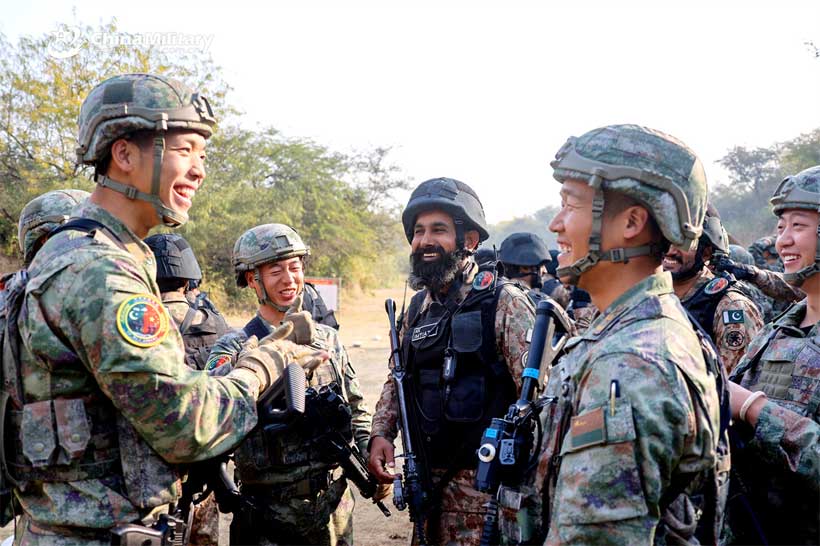
The Inter Service Public Relations (ISPR) announced the beginning of the ninth annual joint military exercise of Pakistan and China, codenamed “Warrior IX,” from December 1, 2025. The drills at the National Counter Terrorism Centre (NCTC) Pabbi, one of South Asia’s largest specialized counterterrorism facilities, were conducted by the Pakistan Army and the People’s Liberation Army (PLA) of China. A two-week-long counter-terrorism exercise was conducted to “enhance interoperability and strengthen military-to-military cooperation between the two countries,” said the military’s media wing. China has consistently been Pakistan’s steadfast friend and a key partner in promoting international and regional peace and stability. And to further bolster peace and security, the strategic allies conducted drills in line with modern joint military tactics.
The drill marked over 10 days of high-intensity integrated military training. Troops from both sides operated in mixed units, conducted mountain clearing, hostage rescue, joint fire strikes, and live-fire combat drills. The exercise featured advanced warfare capabilities, including Unmanned Aerial Vehicle (UAV) swarms, suicide drones, long-endurance reconnaissance drones, and unmanned bomb-disposal systems. The drill strengthened logistical and tactical coordination, as well as real-time combat readiness, as both sides deepened defense cooperation amid evolving regional security challenges. During these coordination efforts they learned from each other and shared combat experiences. Warrior IX drill deepens Pak-China military cooperation.
The “Warrior” series differs from other military exercises by emphasizing counter-terrorism operations. Moreover, Warrior IX is distinguished from Warriors VI, VII, and VIII by its incorporation of advanced technological equipment in both land and air operations. Notably, this drill was conducted following Pakistan’s conflict with India in May 2025, where Pakistan used China’s PL-15 missile in an air battle with India. Keeping these upshots in view, the drill is of paramount importance. The timings and tech-related strategies are what distinguish it from other drills.
From the co-development of Al-Khalid tanks to the JF-17 Thunder combat, the all-weather friendship of China and Pakistan proved that their ironclad ties cannot be weakened by any third party. During the May 2025 conflict, the Chinese-built J-10CE fighter aircraft performed exceptionally well, shooting down at least 6 Indian Air Force fighters. The Pak-China military cooperation under the umbrella of Warrior IX is creating a vacuum for the security dilemma, meaning the security of one country becomes the insecurity of the other country, not only for India but also for the United States of America.
Stay ahead of the geopolitical week.
MD Briefing delivers expert analysis across five global fronts — the Indo-Pacific, energy, geoeconomics, European security, and the Middle East — every Monday morning. Free.
In the international arena, there is this saying that “With Great Power Comes Great Insecurity.” The advisers of U.S. President Donald Trump are pursuing the policy of “peace through strength.” Meanwhile, the leader of China, Xi Jinping, is working on strengthening the People’s Liberation Army to make his country “self-reliant and strong.” The Warrior IX might pave the way to security dilemmas, leading to an arms race. History repeats itself when we see Thucydides’s analysis of the Peloponnesian War:
“The growth of the power of Athens, and the alarm it inspired in Sparta, made war inevitable.”
When threats or conflicts increase, countries conduct military drills as a way to deter those threats. At the regional level, the joint anti-terrorist exercises of China and Pakistan also imparted fear to the non-state actors (NSAs) like the Baluchistan Liberation Army (BLA) and Tehrik-i-Taliban Pakistan (TTP) as well.
When it comes to standing by Pakistan in upholding its sovereignty and territorial integrity, the first country that comes to mind is China. Both countries maintained close coordination and regular rapport on matters of mutual interest in the diplomatic and security fields. The cooperation of both countries on intelligence sharing, border security, and counterterrorism training leads to bolstering security.
Moreover, both Pakistan and China should focus on enhancing integrated deterrence, like the United States of America, a strategy to combine all strengths—military, economic, diplomatic, tech, and informational. Additionally, for stronger defense diplomacy, strategic allies should enhance focus on the power triads that are air, sea, and land power. Both Pakistan and China need to nurture robust economies to withstand financial pressures that might come their way while securing their borders. In the world of anarchy, Pakistan should also design self-reliance policies, establish its own potential, and increase its international outlook.
In a nutshell, the Warrior IX military drill of China and Pakistan, just like other military operations of the world, was conducted in order to feel safe against the contemporary global threats. Because no global police force can respond in times of trouble, the countries of the world are racing to accumulate power to ensure their safety. The military coordination of the two countries not only increases security dilemmas for the powerful countries but also for the NSAs.
