


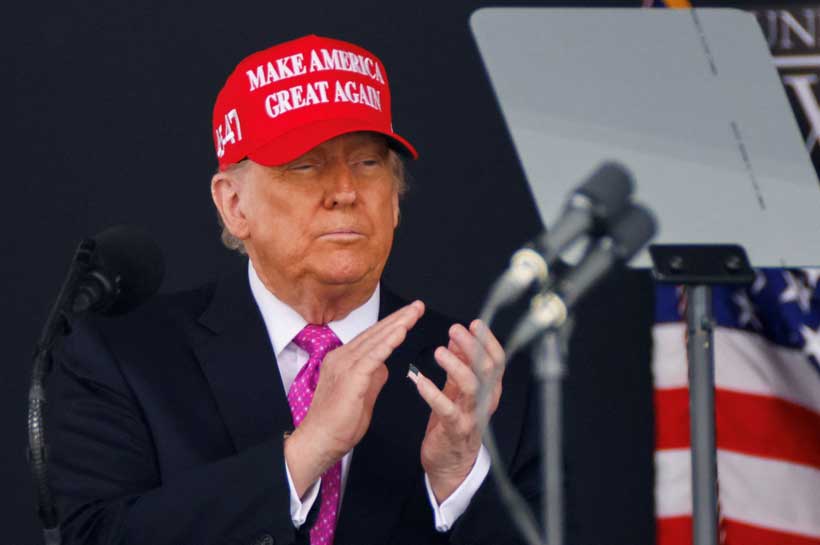
The United States National Security Strategy, published in late 2025, devotes little attention to the South and Central Asian region. Donald Trump’s second-term strategy is a unique and intriguing document, one that could be described as revolutionary to a certain extent. It primarily focuses on America and its self-serving economic and political interests. The text is informative and remarkably non-confrontational. But what does it and the practice of American policy suggest about the strategy for South and Central Asia?
Of all the countries in the region, India, designated as an ally of the United States, receives the most mention and reverence. “We must continue to improve commercial (and other) relations with India and encourage New Delhi to contribute to Indo-Pacific security, including through continued quadrilateral cooperation with Australia, Japan, and the United States (the Quad). Moreover, we will also work to align the actions of our allies and partners with our joint interest in preventing domination by any single competitor nation,” the strategy states. It further notes that Washington will seek not only “investment in our military—especially naval—capabilities, but also close cooperation with all potentially affected countries, from India to Japan.”
Despite the C5+1 diplomatic platform, which has existed since 2015 and represents the U.S. government’s approach for jointly engaging all five Central Asian governments (the C5)—Kazakhstan, the Kyrgyz Republic, Tajikistan, Turkmenistan, and Uzbekistan—these countries are also not mentioned in the strategy.
Furthermore, despite the fact that Afghanistan is not mentioned in Trump’s strategy at all, and Pakistan only once, and then only in the context of peace between Delhi and Islamabad, Washington’s policy toward that country can hardly be called passive. Under President Joseph Biden, Afghanistan policy became a symbol of failure, primarily due to passivity and a chaotic troop withdrawal. Trump, for his part, quickly and immediately outlined his interests: Bagram Air Base.
Stay ahead of the geopolitical week.
MD Briefing delivers expert analysis across five global fronts — the Indo-Pacific, energy, geoeconomics, European security, and the Middle East — every Monday morning. Free.
In September 2025, he declared: “If Afghanistan doesn’t give Bagram Airbase back to those who built it, the United States of America, bad things are going to happen,” Trump said in a Truth Social post. Why does the United States need this facility in the center of Eurasia? This military facility has special strategic and even historical significance. According to Afghan legend, built by Alexander the Great, the towering Bagram is located near the Afghan-Chinese border and in the very center of Eurasia. “One of the reasons we want the base is, as you know, it’s an hour away from where China makes its nuclear weapons,” Mr. Trump said. In an interview with Fox News in late 2021, Mr. Trump also expressed concern that China would “take over Bagram.” It’s worth noting that China manufactures its nuclear weapons deeper within the country, according to nuclear experts, but there is an old nuclear test range at Lop Nur, about 1,200 miles from Bagram, according to media reports.
The White House’s desire is dictated by the need for an American military presence in a region where political and economic processes are developing quite rapidly. The Afghan government, composed of the Taliban, began to pursue a fairly rational and generally sovereign policy. Kabul began to actively seek new partners and economic counterparts.
Trade relations with a number of Central Asian countries were restored or created out of thin air. Uzbekistan and Kazakhstan are particularly prominent in this list. Relations with India, which historically had been highly suspicious of the radical Islamist movement, have been normalized. A similar situation has developed with the Islamic Republic of Iran. The Taliban has also managed to bring the complex relationship here to a relatively acceptable level.
Ties with China, which immediately after the withdrawal of American troops demonstrated a significant interest in Afghanistan’s natural resources, have been re-engaged. Relations with Russia have begun to develop in a new and positive way. The only country with which Afghanistan has difficulties is Pakistan. The once-powerful patron, creator, and mentor of the Taliban has encountered communication difficulties with the new Afghan government, which have escalated into frequent and bloody clashes on the border. Both sides accuse each other of supporting terrorism. Afghan leaders have repeatedly stated that the Pakistani military supports and harbors the radical Islamists of ISIS-Khorasan, while Pakistani officials cite Afghan ties to the Tehrik-Taliban Pakistan. The April 2025 terrorist attack against Hindus in Indian-administered Kashmir by a Pakistani terrorist organization further complicated relations in the region and brought them to a new level of escalation.
In fact, an attempt to return to Afghanistan is needed by American specialists as an important tool for maintaining a presence in a key part of Southern Eurasia. China, Iran, and Russia are all nearby. However, there is reason to believe that this will be very difficult. The Taliban places the sovereignty and independence from any foreign power centers at the core of its ideology and strategy. Consequently, establishing a mutually beneficial dialogue will be difficult. This is despite Washington’s significant leverage, such as Afghanistan’s sovereign financial assets frozen in Western banks.
In short, Donald Trump’s America has little interest in the South and Central Asian region, per se. Economic and political cooperation with a powerful and rapidly developing India and the Bagram Air Base in Afghanistan are perhaps the key aspects that can be identified in the current alignment of interests of Trumpist America. At the same time, both of these points are interesting largely in view of the confrontation with China and the attempt to maintain its influence in Eurasia.
