


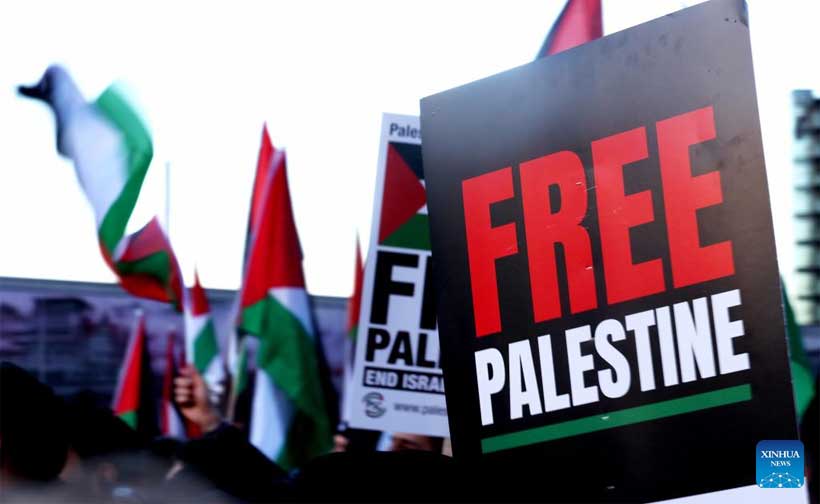
One country in the world, Palestine, is currently experiencing injustice in terms of human rights by Israel. In the past year, the global community has witnessed protests by students in various countries fighting for Palestinian rights. Activities that should not occur in academic spaces, which are generally reserved for research, lectures, and seminars as symbolic acts, have now become the most influential places of resistance on the Palestinian issue. From Melbourne, Jakarta, and Colombia to Oxford, students have become the most vocal in opposing the violence occurring in Palestine and demanding accountability from the university.
The author considers this protest to be a symbolic act against universities, which are considered the safest places for thinking and expressing opinions but have instead become centers of global debate on power, humanity, and moral legitimacy. To understand this, the author will focus on three arguments, namely the freedom of academic students at stake, the exposure of the university’s involvement in the war economy, and the shift in public opinion that has led to state involvement.
Keeping up with current developments, many universities around the world depend on funding from companies, governments, and other sources. This makes campuses vulnerable to external political pressure. This happened at Columbia University, when a number of students formed a solidarity camp to support Palestine out of humanitarianism, but the harsh reality was that they received an unexpected response from the university, with participating students receiving punishments ranging from suspension to unilateral dismissal (Looker, 2025). This was the climax, with students considering the repressive actions taken by the university to be a threat to the campus, which is considered a place of freedom of thought and expression. The pro-Palestinian movement also continues to grow due to high humanitarian solidarity and the disappointment felt by students when the university fails to fulfill its ethical responsibilities.
Several universities around the world have good working relationships with companies that support Israel. Students are also demanding one thing from universities, namely divestment. They are demanding that institutions stop investing and cooperating with various companies that have involvement with Israel, such as arms suppliers, technology companies, and financial companies that encourage military operations. This can be seen at Australia’s top university, the Australian National University (ANU), which decided to stop investing in arms manufacturers after pro-Palestinian student protests, one of whose demands was to force ANU to stop investing in various arms manufacturers involved with Israel (Xinhua, 2024). These student protests reveal the fact that universities, commonly known to the public as ethical institutions, are in fact connected to the global war industry.
Stay ahead of the geopolitical week.
MD Briefing delivers expert analysis across five global fronts — the Indo-Pacific, energy, geoeconomics, European security, and the Middle East — every Monday morning. Free.
When protests spread across universities, they attract the attention of the global media. These student protests have sparked public debate on human rights, students’ right to freedom of expression, and countries’ responses to the Palestinian conflict. Some governments strongly reject these student protests, even accusing the movement of being extremist. However, this pressure has shaped the narrative of the younger generation, which has led to widespread public sympathy for Palestine. This growing public sympathy has prompted governments to intervene and stop the pro-Palestinian student protests. The United States government has issued a warning to students involved in pro-Palestinian protests. One part of this warning was directed at immigrant students. The United States government warned that immigrant students involved in pro-Palestinian actions would face deportation and revocation of their student visas (Al Jazeera, 2025). The younger generation, often considered apathetic by society, has been able to change the moral legitimacy and force the government to intervene.
Overall, it can be said that pro-Palestinian student demonstrations are a form of solidarity that can change institutional structures, political power, and public opinion. Universities can no longer remain neutral; they must choose between economic interests and integrity. As students fight for Palestinian rights, universities around the world have become arenas for moral debate that could determine the direction of political policy in the coming years.
