


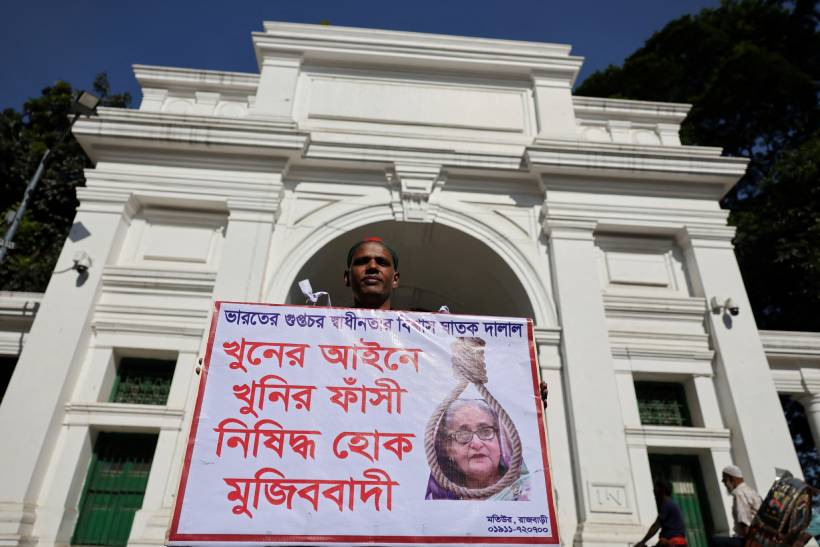
A Bangladesh court on Monday sentenced ousted Prime Minister Sheikh Hasina to death, concluding a months-long trial that found her guilty of ordering a deadly crackdown on last year’s student-led uprising. Her fall has left the South Asian nation of 170 million in deep political uncertainty. Here is how events unfolded and what has shaped the country since her ouster.
Deadly July Protests Trigger a Political Meltdown
What began as a student protest over job quota reforms exploded into a nationwide revolt in mid-2024. The group Students Against Discrimination led demonstrations that escalated into violent clashes between protesters, security forces, and Awami League supporters.
The government’s crackdown left hundreds dead and thousands injured. By August 5, swelling crowds surrounded Hasina’s residence, forcing her dramatic escape to India, where she still resides.
Yunus Steps In, But Reforms Lag
An interim government took charge soon after, with Nobel laureate Muhammad Yunus, 85, emerging as the de facto prime minister. His mandate: restore order and prepare for elections in early February.
Despite promises of sweeping institutional reform including reviving a non-partisan caretaker government and depoliticising state bodies progress has been sluggish. Political parties remain divided over deeper reforms, including constitutional changes, judicial restructuring, and proposals for a bicameral parliament.
Election Dilemmas and Exclusion Fears
Yunus’ administration is under growing pressure: move quickly to elections but also deliver meaningful reforms. The suspension of the Awami League’s registration effectively barring it from the polls—has sparked debate over the fairness and legitimacy of upcoming elections.
Meanwhile, the newly formed National Citizen Party (NCP), born from the 2024 protests, is viewed by critics as enjoying official favour, an accusation the government denies. The perception of bias could cast a long shadow over the vote.
Stay ahead of the geopolitical week.
MD Briefing delivers expert analysis across five global fronts — the Indo-Pacific, energy, geoeconomics, European security, and the Middle East — every Monday morning. Free.
A Shift in Political Culture-But Fragility Remains
Though authoritarian habits of past governments have waned, Bangladesh continues to struggle with instability.
Mob violence, attacks on journalists, and intimidation of minorities remain widespread, with at least 261 deaths reported between August 2024 and October 2025.
Human Rights Watch warns that the interim government has itself adopted troubling tactics including arbitrary detentions, mass arrests, and targeted prosecutions of Awami League supporters.
The government rejects these allegations.
The July Declaration: A Blueprint for a New Bangladesh
The July Declaration, crafted in the aftermath of the uprising, outlines an ambitious roadmap for democratic renewal.
Yunus has announced a national referendum held alongside February’s parliamentary elections on whether to implement the charter. If approved by the next parliament, it will become part of the constitution.
The document envisions a transformed political system: greater judicial independence, expanded fundamental rights, enhanced presidential powers, term limits for prime ministers, and constitutional recognition of the 2024 uprising.
With information from Reuters.
