It is indeed known that the United States and China have been locked in an economic war. All possibilities of a further “pause” agreement being arrived at – after four rounds of economic and trade negotiations between the US and China since Trump imposed tariffs in April – in Kuala Lumpur recently were thrown into disarray by mutually hostile trade and tariff measures announced by the two countries last month. That explains why Busan summitry was keenly awaited and yet the US stock futures wobbled after the summit meeting. This further explains why Washington and Beijing were compelled to agree in KL, Malaysia for a one-year truce on the implementation of tit-for-tat economic measures and could avoid derailing the Trump-Xi meeting.
It is important to recall Trump has been seeking to cripple China’s hi-tech industries with restrictions on the export of top end computer chips and chip making equipment. Hence, the Trump administration expanded the range of companies, including many Chinese ones, banned from accessing American technology. Additionally, Trump declared he would call off the summit with Xi and impose an additional 100 percent tariff on Chinese goods. China, on the other hand, responded on October 9 by announcing more stringent controls on the export of rare earths. Lack of rare earths threatens a broad range of US industries including those connected to the military.
Trump-Xi Summit in a Third Country: Reactions in the Global Media
As was expected, in the mainstream press internationally, the Trump-Xi first handshake since Trump commenced his second presidency in January this year has been largely welcomed with enthusiasm and optimism. “After Trump trade meeting, it’s advantage Xi,” Trump shaves China tariffs in deal with Xi on fentanyl, rare earths,” “Trump-Xi meeting: America has discovered that bullies can be bullied back,” “Trump lowers tariffs on China and announces end to ‘rare earths roadblock’ after Xi meeting,” etc. are some headlines from the US, the BBC and Al Jazeera.
Stay ahead of the geopolitical week.
MD Briefing delivers expert analysis across five global fronts — the Indo-Pacific, energy, geoeconomics, European security, and the Middle East — every Monday morning. Free.
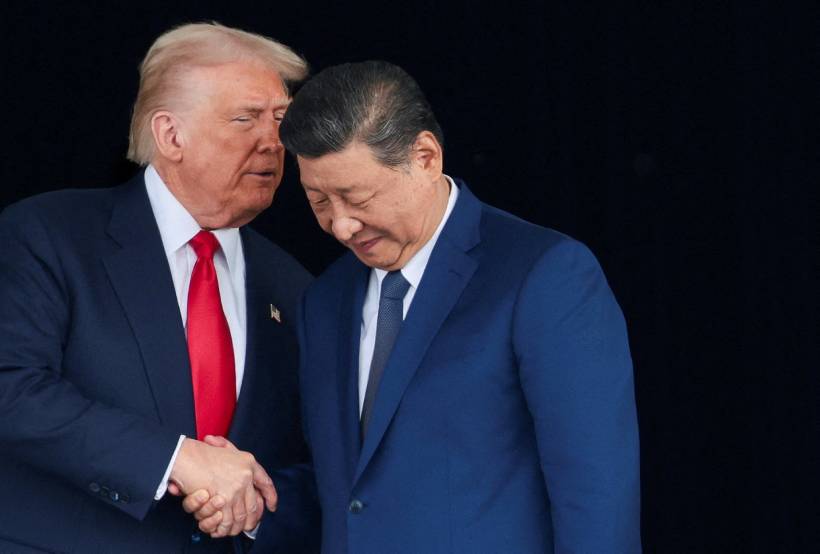
The state-run media in China mostly gave positive coverage to the summit. The Xinhua news agency headlined “Xi, Trump meet in Busan to steady ties, shore up global confidence,” the only English language channel in the communist mainland, China Global Television Network (CGTN), sounded rather neutral and business-like – “Xi, Trump conclude talk on China-US ties in Busan”; and the Chinese capital-owned media in Hong Kong – the South China Morning Post (SCMP) showed in its summit reporting far more professionalism and gave extensive and minute-by-minute live coverage. Some of SCMP headlines read as “Charm, whispers, and pats on the back: Xi and Trump break summit ice with loads of warmth” and “Xi-Trump summit yields both for China and US despite lack of breakthroughs.”
So, who gains more from the outcome of their summit meeting in South Korea – the US, China, or the global economy?What are the important takeaways from the Trump-Xi meeting?
Interestingly, a lot of media has been writing about “3 takeaways,” “5 takeaways”, “6 takeaways” “Five key takeaways” and “Trade takeaways” from Trump’s meeting with Xi, etc. and so on. Among the media enthusiasts, the Trump-Xi bonhomie and the characterization by the two leaders of US-China as “G-2” or “grouping of two biggest global powers” have received more attention than it actually deserves. A section of the international media even viewed the summit as “a shift in power dynamics on display.”
Both Trump and Xi signalled ‘Thumbs up’ to their home audiences
But cynics say in trade talks both “Trump and Xi project strength and hide vulnerabilities.” Moreover, there are critics who believe the meeting was overshadowed by Trump’s highly provocative announcement that the US would immediately recommence “nuclear testing” in a move that threatens to dramatically escalate the nuclear arms race. Typically, Trump named China, along with Russia, to justify re-starting nuclear testing by America. Trump tweeted shortly before going into the meeting with Xi: “Because of other countries’ testing programs, I have instructed the Department of War to start testing our Nuclear Weapons on an equal basis.”
Perhaps Trump thought he could use his nuclear gambit to put China or Xi Jinping under pressure before going into the meeting. But Trump clearly miscalculated. China has, a day after the Xi-Trump summit, responded to Trump ordering the Pentagon to resume nuclear weapon testing. In reaction to Trump’s Truth Social announcement ahead of meeting President Xi in Busan, China’s foreign ministry spokesperson Guo Jiakun said in Beijing last Friday: Beijing hopes the US will abide by the CTBT and moratorium on nuclear tests.
Moreover, the Trump announcement on nuclear weapon testing might have led to an earlier than scheduled ending of the Trump-Xi meeting. There are also reports that Trump’s ordering nuclear testing may have to do with there being no joint press conference, no photo ops, no joint statement and no signed agreement held up for the cameras after the summit meeting ended. The two leaders briefly shook hands before each going his own way – Trump flew back to the US, and Xi returned to the Busan summit.
The summit outcome: fragile pause or longer-term truce
It is quite intriguing that not much interest has been shown in the media regarding what transpired behind closed doors in the room at the Gimhae military base in Busan – the second largest city in South Korea. The Chinese People’s Daily report did mention the two leaders relied on simultaneous interpretation provided during the meeting in order to maximise the number of issues discussed. But speculation is rife that owing to the sudden Trump announcement on nuclear weapon testing, the atmosphere as well as exchanges were without doubt not cordial and belied the smiles in front of the cameras and Trump’s effusive praise for Xi as “a well-respected great leader.”
Known for his high unpredictability, Trump entered the meeting room at the army base in Busan to engage his Chinese counterpart with not one but two posts on his social media platform – Truth Social. One post was asking the Pentagon to restart immediately testing nuclear weapons, this was done presumably to put Xi under pressure before the summit talk as Trump cited China’s expansion of nuclear stockpiles as reason for his order. The second post was to take Xi off guard by taking him by surprise with a seemingly offhand offer to lure China into reviving the “ghost of the G2.”
In his inimitable style, ahead of the Trump-Xi talks in Busan, the US President posted on Truth Social that “THE G2 WILL BE CONVENING SHORTLY!” Interestingly, perhaps unaware of the “lost” trajectory of the US-initiated G2 idea, the US President himself, a large section in the US media, and curiously the national media and policymakers in India, reacted either with a lot of hope or with huge concern. Especially in India, Trump’s talk of reviving the G2 concept has immediately attracted a lot of media attention. A national English daily in New Delhi observed with unease “Washington’s engagement with Beijing will be watched with some concern in capitals of the region, especially in Delhi, Tokyo and Canberra.”
To conclude, Xi and his entourage – consisting of top-level advisers and a couple of the party’s politburo members – were well-prepared to deal with the Trumpian “theatrics.” While keeping cool and wearing his characteristic pencil smile in front of cameras, President Xi seemingly gave a tough time to his US counterpart during the negotiations. This explains why Trump called Xi “a very tough negotiator.” Besides, as Xi obliquely rejected the G2 offer, the intelligentsia in China both ridiculed Trump for restarting the nuclear arms race and the US president trying to “court” China and establish a “two-state group” with the US.