


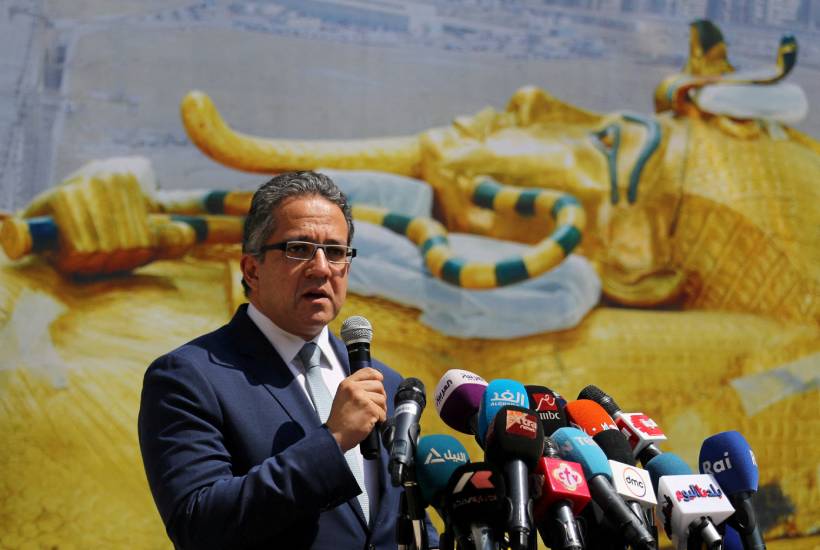
Former Egyptian tourism and antiquities minister Khaled El-Enany is expected to be confirmed on Thursday as the next director-general of UNESCO, despite mounting criticism over his record in protecting Egypt’s own heritage sites. Enany, 54, won the backing of 55 out of 58 votes from UNESCO’s Executive Board last month, defeating Congo-Brazzaville’s Edouard Firmin Matoko. His confirmation by all 194 member states will take place during the agency’s general conference in Samarkand, Uzbekistan.
If approved, Enany will become the first Arab head of UNESCO, succeeding France’s Audrey Azoulay in mid-November.
Criticism Over Heritage Management
Heritage groups have accused Enany of neglecting Egypt’s cultural preservation responsibilities, pointing in particular to the demolition of parts of Cairo’s “City of the Dead”, a UNESCO World Heritage site, and construction near St Catherine’s Monastery in Sinai.
The Berlin-based NGO World Heritage Watch led a coalition of over 50 organisations and experts urging member states to reconsider his appointment. “It is irresponsible to entrust someone with such a past with the top job at the organisation responsible for preserving world heritage,” the group said.
Stay ahead of the geopolitical week.
MD Briefing delivers expert analysis across five global fronts — the Indo-Pacific, energy, geoeconomics, European security, and the Middle East — every Monday morning. Free.
As minister (2016–2022), Enany oversaw the body responsible for managing Cairo’s World Heritage areas. Critics claim his ministry failed to register and protect key sites, allowing bridge and highway projects to destroy unregistered mausoleums and tombs.
Activist Sally Soliman called the destruction “erasing a huge part of Egypt’s history.” Egypt’s government, however, insists that registered monuments were spared and argues the urban projects are vital for modernising Cairo and boosting tourism.
Projects in Sinai Under Scrutiny
In South Sinai, the 2021 “Great Transfiguration” tourism project near St Catherine’s Monastery has drawn international concern for replacing a modest visitor centre with large domed structures that clash with the site’s ancient character.
UNESCO’s World Heritage Committee has since requested an expert mission to assess the damage.
Diplomatic Momentum and Regional Support
Despite the backlash, Enany’s nomination has gained strong regional backing. Arab and African nations have hailed his potential leadership as “long overdue representation.” Egyptian Foreign Minister Badr Abdelatty called the bid a correction of “historical injustice” against Arab and African states within UNESCO’s leadership.
What’s Next
Enany has promised to create “a UNESCO for the people,” streamline bureaucracy, and broaden funding sources particularly as the organisation faces a potential loss of U.S. contributions by 2026.
UNESCO stated that the election outcome is ultimately “a sovereign decision of member states.” If confirmed, Enany will officially assume office in mid-November, marking a significant diplomatic victory for Egypt amid lingering questions about his heritage legacy.
With information from Reuters.
