


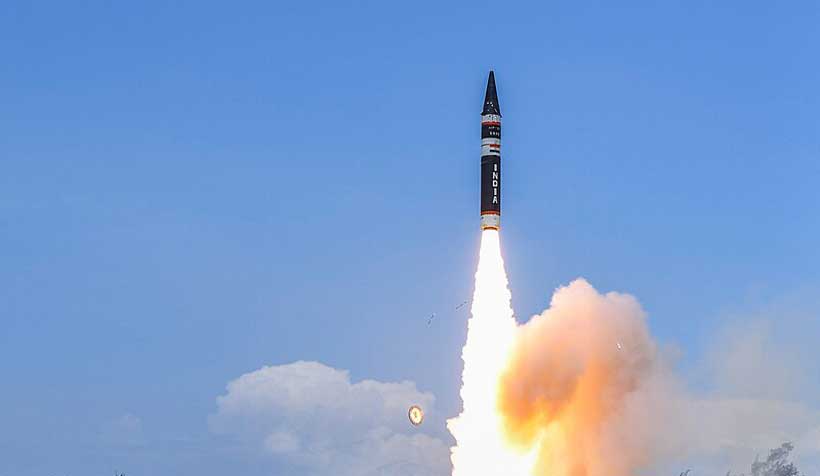
India’s recent launch of a rail-based Agni-Prime ballistic missile reflects the country’s continued expansion of its missile systems as part of its military modernization program. With the successful flight test of the Agni-P, India has joined the club of countries having rail-based missile launchers. However, the irony writes itself: in celebrating locomotion, India may have set the deterrence itself in motion. Is it to be concerned that mobility makes security stronger or simply shakier on its tracks?
The nuclear-capable Agni-Prime missile is the advanced variant of the Agni class of missiles. The rail-based launcher has the advantage of moving freely on the rail network, providing mobility and swift reaction capability. In addition, it can provide a low-visibility deployment for a strike up to the range of 2000 km. However, such capabilities only provide a false sense of superiority. Examples can be taken from history; the Soviet Union’s RT-23 Molodets and America’s Peacekeeper Rail Garrison proved that decades ago, as both strategic programs were eventually retired (too costly to maintain, too complex to control, and too risky to hide). Even superpowers with infinite tracks and near-infinite budgets found the idea more romantic than reliable.
While the US, Russia, China, and North Korea have already developed this capability, this is a new development in South Asia. Unlike the frozen silence of Siberia or the vast emptiness of the American Midwest, South Asia has a crowded map with no room for errors. The railway network in India is spread through cities, factories, and homes. Hence, deploying nuclear launchers on the same network is a clear sign of endangering domestic entities, besides its regional implications. The threats, like derailment, cyber-glitches, or a misread signal, could ripple far beyond engineering failure. In peacetime, it would cause panic, while, in crisis, it could give a perilous signal. Strategic ambiguity is not for regions like South Asia, where missiles can cross the borders faster than decisions can be made. Rail launchers do not have the courtesy of predictability but are ghosts in motion, which is, on one hand, a great feature for hiding, but on the other hand, creates uncertainties of misreading.
Another critique concerns the Indian command on the move while its control is in question. The Indian move of deployment of nuclear missiles on rails is an open invitation to chaos and introduces serious challenges of control and coordination. The Indian command and control structure was built based on its centralized and deliberate decision-making system, a framework designed for stability, not for mobility. Extending that system across hundreds of kilometers of railway networks increases exposure to communication failures, human and technical errors, and cyber intrusions. Such concerns are not hypothetical anxieties but the realities of any large infrastructure system. The derailed trains, grid failure, and signaling accidents can be a routine headline in India. Now, suppose a rail carrying a nuclear payload?
Stay ahead of the geopolitical week.
MD Briefing delivers expert analysis across five global fronts — the Indo-Pacific, energy, geoeconomics, European security, and the Middle East — every Monday morning. Free.
The Agni-Prime’s mobility represents resilience to Indian strategists, but for Pakistan, it is opacity packaged as progress. Each new development in India, from the MIRV-capable Agni-V and the Arihant-class subs to the S-400 shield and the Agni-P (a missile that can roam the map), tightens the psychological space between reassurance and provocation. On Pakistan’s end, its credible minimum deterrence doctrine is meant to maintain balance, not to chase parity. And this is how the South Asian arms race evolves. Every new weapon or policy is less about numbers and more about narratives, like India innovating to show strength and Pakistan adjusting to stay secure. Hence, each move meant for reassurance only deepens the other’s anxiety; a classic security dilemma is in play in South Asia.
Agni-P is not just a national milestone but a part of a larger pattern. Mobility has made a comeback across the world. The US, Russia, and China are all revisiting the mobile or hypersonic delivery systems, each promising the same elusive advantage of survivability. But South Asia is not suitable for them; its geography is compressed, warning time is measured in minutes or even seconds, and mistrust is measured in decades. A missile launched from central India could reach a Pakistani city before a prime minister could finish a phone call, and a retaliatory strike from Pakistan would need even less time. In such an environment, India has now introduced a technology that shortens reaction windows and multiplies misreadings fraught with weakness and broader implications on the strategic stability of South Asia. The result is not mature deterrence but deterrence on caffeine, a strategy that mistakes constant motion for strength and turns calculated stability into restless panic disguised as progress.
In short, India’s Agni-Prime on rails may showcase engineering brilliance, but technology alone cannot steady a fragile region. South Asia’s nuclear peace has always relied more on restraint than on technological advancements. Mobility may shield a weapon, yet it also speeds up misunderstanding and points out that real security will come not from how fast missiles move, but from how patiently leaders can think before action.
