


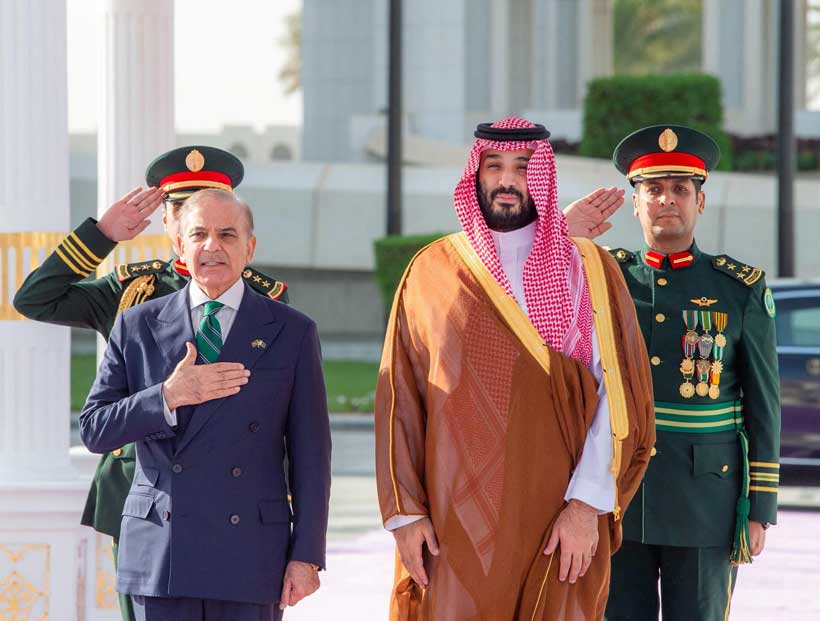
A few days back, Riyadh and Islamabad signed a “Strategic Mutual Defense Agreement,” a deal that could potentially bind KSA to Pakistan’s nuclear-armed military which is believed to be powerful and could be of great use to Saudi Arabia. Pakistan keeps insisting that being nuclear armed does not signals towards the fact that nukes are on the radar because they are not and this is a more conventional defence partnership. On the other hand, Saudi officials have hinted that this partnership is more significant that it seems. It is also fueling speculation whether Riyadh is signaling towards falling under Pakistan’s nuclear umbrella without officially possessing it. This partnership might have been seen as an important event in the international system but Saudi-Pakistan has always been involved in partnerships as such since 1960s, for instance Pakistan stationing its troops in KSA and Riyadh extending their financial support to Pakistan through the years. This marks as a significant event in the contemporary times because it signals towards Riyadh’s skepticism towards the U.S.
Key Issues
This pact has two dimensions to it, first, it reflects on Saudi’s unease with Israel’s growing dominance in the region and secondly, on Iran’s nuclear progress. The unprecedented strikes by Israel as in Qatar has alarmed the Arab world over unchecked Israeli power. On the other hand, Iran nuclearization continues and is progressing after years and years of sanctions by western powers throughout the years inciting fears in Riyadh due to their unstable relations.
Riyadh might have lost faith in the U.S after the 2019 attacks on Saudi’s oil facilities i-e: Abqaiq and Khurais, which ended up halving Saudi oil production temporarily.
For Pakistan, it is a simple economic proposal. Pakistan an economically strained country has found a partner to extend their helping hands and also from a more strategic prospective, it’s because of regional rivals like Israel and India- to wary them of potential nuclear undertones.
Stay ahead of the geopolitical week.
MD Briefing delivers expert analysis across five global fronts — the Indo-Pacific, energy, geoeconomics, European security, and the Middle East — every Monday morning. Free.
Key Stakeholders Involved
Saudi Arabia’s trust in U.S has been eroding due to various reasons and rightly so. Historically Riyadh’s leaders has been under the umbrella of U.S yet, a unwillingness was observed in Washington’s intentions to intervene decisively, specially to a Houthi missile attack on Saudi’s infrastructure. So basically, Riyadh is exploring new non Western allies with nuclear powers for its security.
Pakistan is taking a risk of being pulled into Gulf rivalries for financial assistance. It can be seen as a fair trade in times where Pakistan is drowning in debt crises and financial fall out.And Saudi ha always been a life saver for Pakistan in terms of loans and bailouts. But the risk of getting involved in further rivalries is still lingering as Pakistan has to fight both Indian extremism and terrorism at home.
Israel & Iran:
This pact is a direct threat to Israel as Israel was believed to be the only nuclear armed state in the Middle East. It’s strategic superiority is at stake.
However, Iran sees this as an encirclement strategy by Riyadh. This threat to Tehran might fuel a nuclear armament race.
India might presume this partnership to be alarming as it will strengthen Pakistan’s military capabilities, though their military spending are seven times greater than Pakistan’s.
Implications
This pact can be seen as a re-balancing act by the Riyadh to withdraw their sole reliance on the U.S and exploring further partnerships with nuclear armed states to ensure security like Pakistan and in the foreseeable future, China. U.S dominated the Gulf security after WWII, but now that dominance has been shifted.
Pakistan’s biggest interest right now is financial assistance from Saudi be it short term. But deep involvement might get Pakistan dragged into Gulf rivalries and potentially with Iran and may be Israel. This might lead to lying new fault lines, in a broader perspective, Pak-Saudi bloc vs Iran, India and their strategic partners.
Analysis
From a critical pro-Palestine stance, this pact underscores two realities. First, Muslim majority states are seeking to reclaim security autonomy and second, the region is increasingly skeptical of US reliability for obvious reasons. While the pact may not explicitly extend a nuclear umbrella, it symbolizes Islamic solidarity at a time when Palestinians face immense violence.
However, caution is very necessary. Pakistan must avoid being dragged into Gulf rivalries that distract from the core issue confronting Israeli aggression and supporting Palestine. If managed wisely, the pact could strengthen collective deterrence against external pressures, but it should be carefully aligned with the broader struggle for Palestinian self-determination.
with information from Reuters
