


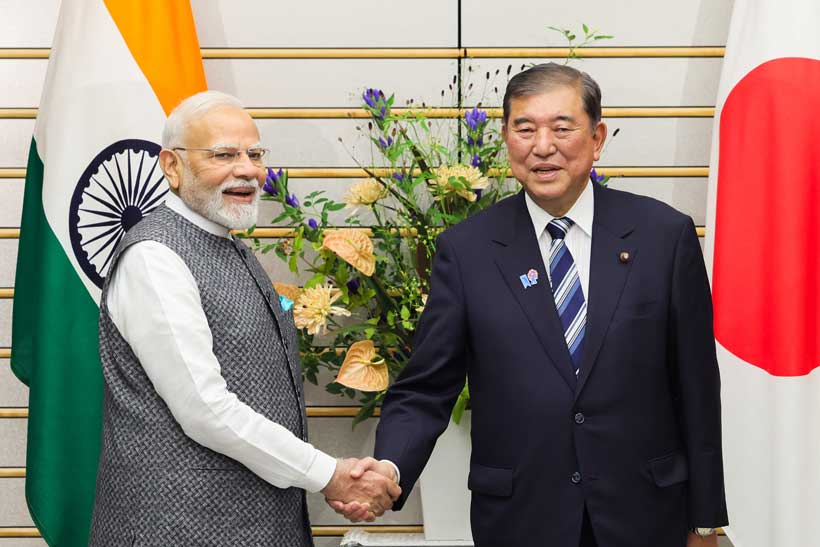
Prime Minister Narendra Modi reached Tokyo to attend the India-Japan Annual Summit-2025, with Japanese Prime Minister Shigeru Ishiba announcing ‘Japan-India Joint Vision for the Next Decade.’ The Annual Summit started a new era of next-generation partnership as the eight lines of direction decided to steer their bilateral Special Strategic and Global Partnership. All these drive next-gen economic partnership, security partnership, mobility, ecological legacies, tech & innovation partnership, health, state-prefecture partnership, and people-to-people connection. These sectors are not new to the India-Japan bilateral partnership, but the 2.0 version is a next-gen version of current efforts in place.
These two economies are mostly complementary in nature, hence providing the necessary cushion to collaborate, cooperate, and co-develop upon each other’s economic & human resource potential. In the year 2022, Japanese PM Fumio Kishida announced JPY 5 trillion in public and private investment and financing from Japan to India for the next five years. It is being claimed that the target was achieved in a mere three years after its announcement, but most funds are invested in climate & infrastructure projects rather than industrial initiatives. Upon seeing the progress, a joint statement by PM Modi & PM Ishiba set a new target of JPY 10 trillion for private investment in the nextdecade. Still, with all the warmth and geopolitical unison in bilateral relations, both countries’ commercial relations have ridden a tumultuous & bumpy road in the last decade and remain stagnant in the first half of this decade. Although, interestingly, Japan’s Official Developmental Assistance (ODA) disbursements mostly exceeded their commitment in this decade towards India.
High-Tech Vision, Low-Speed Delivery
The new next-generation partnership agreement signed relaunches the industrial cooperation framework catering to emerging technologies of the present and future. This is also the main tender point for both countries. Currently around 1434 Japanese companies are working in India, a mere 1% annual growth in numbers compared to the year 2017. The decade-long stagnation of the Japanese economy is reflected in their expansion of companies in India also. Despite much of the financial inflow from Japan with prolonged interest tenures to capital, India used the maximum of funds for infrastructure development and capacity building. Conclusively, the huge rise in financial inflow in years never materialized in a parallel rise of their companies in India.
Stay ahead of the geopolitical week.
MD Briefing delivers expert analysis across five global fronts — the Indo-Pacific, energy, geoeconomics, European security, and the Middle East — every Monday morning. Free.
India & Japan both targeted high-tech cooperation at every instance in accordance with the development of technologies. Starting from NTT Docomo-Tata Teleservices, Daiichi Sankyo-Ranbaxy, Maruti-Suzuki, Toyota-Kirloskar Motors, Renesas-Tata Electronics, etc., they prioritized emerging technologies of every era in the past to expand their footprints in countries aimed at manufacturing export-level products to solidify commercial supply chains. In current times, Japanese companies like Nippon Steel, Tokyo Electron, Fujifilm, and JFE Steel are actively involved in the expansion of new generation technologies in their respective sectors. Both countries drive on ‘High Tech Vision,’ yet it materializes in low-speed delivery. The delivery mechanism is so slow that in the last five years, even after signing the Comprehensive Economic Partnership Agreement (CEPA), their respective trade figures tumbled between $20 and $22 billion evidently.
Apart from this, free flow of funds is a major facilitator in expansion of economic growth among the institutions. India and Japan renewed their currency swap agreement of $75 billion up to the year 2026, signed in the year 2022, but this Bilateral Swap Agreement comes into effect after three years of delay in the year 2025. Low-pace growth also restricted the trade potential of both respective countries, keeping Japan ranked 17th in India’s total trade with a 2.1% share and India ranked 18th in Japan’s total trade with a 1.4% share in FY 2023-24. This low-speed delivery can be assessed from witnessing the issuance of NOCs duration, DPR creation, port congestion, mobilization of equipment, etc. in India also.
What bars swift execution?
Indian industrial growth has remained a ‘paper lion’ since its independence. Upon that, the Indian R&D ecosystem (academia-industry-government) is highly fragmented, which can be witnessed through the gross domestic expenditure on research and development (GERD) to GDP ratio. It’s 0.66% of Indian GDP, while Japanese enterprises are highly buckled with 3.405%, among the top on the global scale. It creates gaps in enforcement of intellectual property laws, talent pipelines, regulated use of licenses, etc. in emerging technologies. Japanese firms like Panasonic and NEC established R&D centers in India but purposely kept high-value research in Japan to protect their advanced technologies from green licensing & inter-corporation exchanges.
Those Japanese companies invested in high-tech manufacturing in India and did it on their own cluster-based production ecosystem. Infrastructure gaps like uninterrupted power, stable supply chains, cleanrooms, and high-quality logistics are still sparsely available in India. Out of 424 approved Special Economic Zones (SEZs) for industrial purposes, only 40% transitioned to notified status, in which 60% remain unoperational or partly stalled to date. Specialized technology hubs (T-Hub) established in India even have an 8% startup survival rate (lifespan over +10 years), in which Japanese financial institutions invested heavily after the COVID era. Their returns have downcast Japanese investors in the Indian technology ecosystem in recent years.
It is a no-debate argument after the year 2024 that Japan uses India more as a market than as a tech-manufacturing & development hub. Their major focus remains on ASEAN countries ($28.7 billion), where Japanese FDI is five times more than India ($5.3 billion). From these FDI investments of Japan in the year 2024, ASEAN countries invested funds in electronics manufacturing, semiconductor production & emerging tech ecosystems, while India used them in auto, infrastructure, and logistics domains.
After all these, issues like the absence of high-tech manufacturing, policy revisions, price-tech mismatch, poor deadline management, unskilled or semi-skilled labor, etc. made Japan rethink their techplomacy approach towards India. In this, historical delays in the Mumbai-Ahmedabad High Speed Rail Corridor (Indian Bullet Train project) stand tall as an example of abysmal failure of high-tech ecosystem failure in India, distressing both countries financially.
Hitting Arrows Everywhere
The eight directives released to steer the India-Japan Special Strategic and Global Partnership aim to address those issues with a new approach through re-energized organizations. Revision of CEPA, the India-Japan fund of funds, strengthening the India-Japan Industrial Competitiveness Partnership (IJICP), international financing of the India-Japan Fund, the India-Japan Digital Partnership 2.0, the Japan-India AI Cooperation Initiative (JAI), battery supply chain cooperation, the Japan-India Startup Support Initiative (JISSI), etc. are the key efforts put in place by the countries to remain in the race of next-generation technologies. It is true that the earlier programs like GIFT City, the Yamuna Action Plan, the Asia-Africa Growth Corridor, and defense equipment deals in yesteryears did not ripen the expected fruits for them significantly. But their Version-2.0, launched in the new Summit with corrections in approach and strategies of implementation, may benefit both countries.
As the humongous action plans, re-energized policies, and reworked initiatives with mammoth funding declarations are announced, India and Japan need to work mutually on the ground more rather than on paper. As the Japanese domestic policies towards foreigners are changing due to political & civil pressure, India-focused initiatives like specified skilled workers (SSW), the India-Japan Talent Bridge, the Technical Intern Training Program (TITP), etc. may not provide expected results. The announcement of a 5 lakh people-to-people exchange in the next five years is highly ambitious. The ‘announce first—plan and execute later’ strategy by both countries costs them in many sectors earlier. In next-gen techs like AI, Japan was one of the frontrunners in development & strategy building in the last decade. India and Japan tried to collaborate & co-develop AI techs but failed bitterly due to difficulty in the joint ventures (JVs) mechanism in both countries.
For a better good, due diligence to address functionary gaps and sectoral misreads by governments needs to be resolved. Both countries need to understand that market forces are the major drivers in successful bilateral cooperation among countries in this global village. These ambitious goals of the Annual Summit 2025 need more than government agreements.
‘Just a light touch regulation is expected from Indian & Japanese governments.’
