


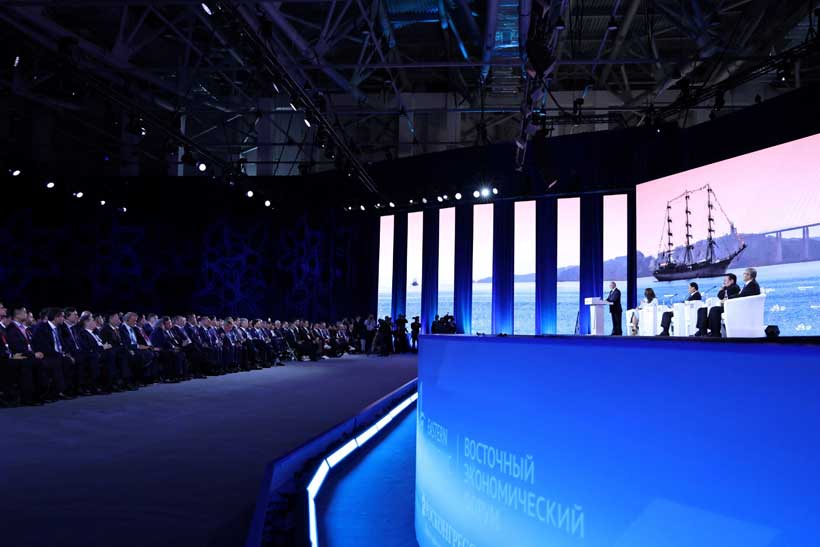
Russia and its Far East region have made an unprecedented turn, marking the 10th year of the Eastern Economic Forum (EEF) in Vladivostok, with tremendous emphasis on economic development and trade, manufacturing and production, and aims at transforming the region into a powerhouse. Russia and Vladivostok are geographically connected, completely inseparable with a huge territory. The resources are unbelievably huge and consequently stimulate strategic interest, above all for the rapidly growing Asia-Pacific region.
As is distinctively known, the development of the Far East and Siberia has been designated as Russia’s national priority for the entire 21st century. This was announced in the Address to the Federal Assembly at the end of 2013. Subsequently, the legal framework was formed and updated, and a whole range of instruments to support business was introduced, including advanced special economic zones, the Free Port of Vladivostok regime, preferential arrangements for the Kuril Islands, and the establishment of a special administrative district on Russky Island.
It sets ambitious targets for accelerated economic and technological growth and for improving the well-being of the population across the Far Eastern regions of the Russian Federation. The Far East’s resource base and mineral extraction are expanding. The growth of business and entrepreneurial activity, along with the expansion of economic opportunities in the Far East, forms the foundation for the region’s future development.
In the Far East, transport bridges to China have already been built: the Nizhne-Leninskoye-Tongjiang and Blagoveshchensk-Heihe bridges. Plans also include the construction of new bridges, including one to the Democratic People’s Republic of Korea across the Tumannaya River, which is scheduled to open in 2026.
Stay ahead of the geopolitical week.
MD Briefing delivers expert analysis across five global fronts — the Indo-Pacific, energy, geoeconomics, European security, and the Middle East — every Monday morning. Free.
Of course, a particularly significant topic for the Far East, for the entire country, and for the whole Eurasian continent is the development of the Trans-Arctic Transport Corridor. It runs from St. Petersburg through Murmansk, Arkhangelsk, and the Northern Sea Route, all the way to Vladivostok.
Based on existing successful experience, Russian President Vladimir Putin proposed taking a radical step and, as the saying goes, seamlessly, while keeping the terms and conditions for the existing investors unchanged, launching a single preferential regime for business throughout the entire Russian Far East and the Arctic. This work is scheduled to begin on January 1, 2027.
Putin has invited both local and foreign interested partners to take advantage of this opportunity in transforming and operating in the Transbaikal Territory, the Amur Region, the Jewish Autonomous Region, and the Khabarovsk and Primorye territories.
Regarding the single preferential regime for the Far East, Putin listed incentives, their precise parameters, deadlines, and industry focus that will be determined by the government together with colleagues in the Far Eastern entities of the Federation.
“Using the results achieved in the mining and processing industries and solid infrastructure, we must start a new development stage in the Far East, shaping an economy of the future, radically improving living conditions in cities and towns, training in-demand professionals, and launching high-tech projects,” Putin said at the well-attended session. “This is the essence of the new stage. We must turn the entire territory of the Far East into a hub for high-tech projects. It is a vast territory with a sparse population and large areas where people can be employed. We must use modern methods for the development of this territory.”
Next up, to develop and master technologies and to establish modern production facilities, at least 100 industrial, business, and technology parks with the proper areas and utilities will have become operational in Russia by 2030.
Putin has asked the government to carefully review the experience of this fund and to help scale up its activities to include technological leadership projects. In general, a transparent, modern, and effective financial ecosystem must be created in the Far East. The Russian Far East and the Asia-Pacific region as a whole are areas of dynamic change and burgeoning growth. The government approved a long-term strategy for the development of the Far Eastern Federal District to 2036.
In his contribution, Prime Minister of the Lao People’s Democratic Republic, Sonexay Siphandone, noted that the Russian Far East and the Asia-Pacific region as a whole, while the forum is an important driving force in promoting cooperation in the sphere of economy, social development, and cultural interaction, could forge cooperation and engage in a closer economic interaction, as well as promote innovative technologies in various sectors.
“The Far East brings together a number of countries with enormous potential. We can see that the Russian Federation plays a key role as a driving force for strengthening cooperation in this region, both in bilateral and multilateral formats,” stressed Sonexay Siphandone in his speech, and added that associations such as BRICS, the Asia-Europe cooperation framework, the SCO, and others contribute significantly to advancing regional economic cooperation. These formats are based on the principles of mutual respect and the independence of their members. The Lao People’s Democratic Republic believes that enhancing ASEAN requires the promotion of economic cooperation and connectivity in the region.
Prime Minister of Mongolia, Gombojavyn Zandanshatar, explained the great importance of shaping the future trajectories, creating a vital mechanism for dialogue in the Asia-Pacific region. Along with geographical advantages, Mongolia boasts abundant natural resources as well as a young and skilled workforce. The Government of Mongolia has been pursuing consistent policies to harness these assets, attract investment, and foster trade and cooperation, and these efforts are already delivering results.
Zandanshatar expressed readiness to design a roadmap of cooperation between Mongolia, Russia, and China and identified the priorities of trilateral interaction. Several days ago—in fact, three days ago—the leaders had a meeting in China to discuss further cooperation plans. The program of establishing an economic corridor between Mongolia, Russia, and China, designed to develop and enhance comprehensive cooperation within the strategic partnership between Mongolia, Russia, and China, will definitely enhance political trust, attract investment, and contribute to regional integration. In this context, Mongolia has always had the highest regard for the significance of and prospects for the 33 projects of the economic corridor. Laying foundations for mutually beneficial cooperation, especially in road transport, helps attract investment from international banks and financial institutions. Regular trilateral meetings on the implementation of these projects also promote their advancement.
“The Eastern Economic Forum will help open up new opportunities to fight crises in the Far East, Asia, and the Pacific Region; invigorate regional cooperation in the economy and other areas; and also launch new important joint projects and programs,” Gombojavyn Zandanshatar emphasized and further added, “We are totally ready to expand cooperation and to advance the development of the region together. Over the past time, we have initiated a multitude of programs and measures to enhance integration. Stepping up these efforts and filling them with new content will definitely serve our common interests.”
Vice Chairman of the Standing Committee of the National People’s Congress of China, Li Hongzhong, assertively pointed to China’s previous participation in the Eastern Economic Forum. Under the new conditions, Chinese enterprises and investors are very much looking forward to more possibilities for the implementation of important agreements reached at the highest level, the leadership of the People’s Republic of China, and President Xi Jinping, and Russia offers, of course, a friendly gesture to take steps in strengthening economic cooperation.
The Eastern Economic Forum was held in Vladivostok. Every year, it brings together a large number of participants that include official delegations, entrepreneurs, and members of the expert community. In September 2025, large Asian delegations attended, and sessions were held on the campus of Far Eastern Federal University (FEFU). It was organized by the Roscongress Foundation.
