


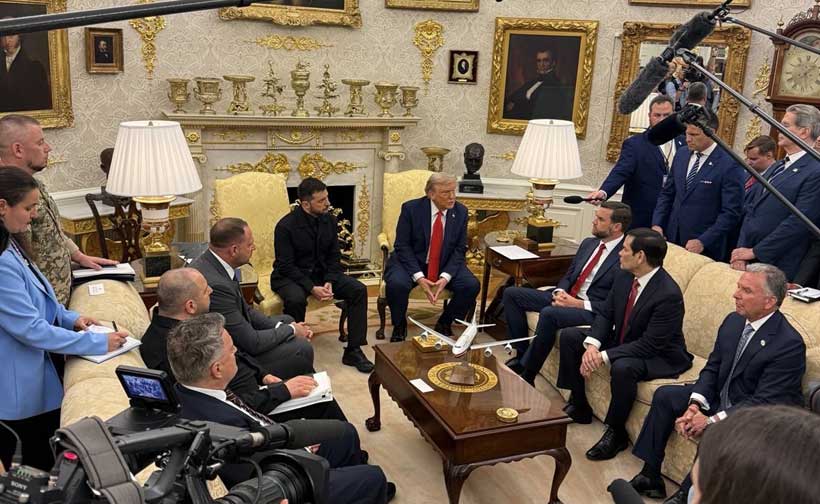
Is Ukraine really on the verge of peace, or is it facing a critical moment of danger? Over the past week, there’s been a sudden burst of diplomatic activity aimed at ending the three and a half year war. Following the much publicized summit between Donald Trump and Vladimir Putin over in Alaska, Ukraine’s President Volodymyr Zelensky traveled to Washington alongside a number of senior European leaders. But what exactly is being discussed? And why are so many afraid that Trump might be trying to impose a deal that could not only be deeply unjust for Ukraine, but could also potentially be dangerous for Europe more generally? The Ukraine war has been one of the most bitter and destructive conflicts of modern times. It’s certainly the most serious armed confrontation to have taken place in Europe since the end of the Second World War. The human cost has been staggering. In the three and a half years since Russia launched its full scale invasion, it’s estimated that over a million people have been killed or injured, and vast areas of Ukraine have been devastated, forcing millions more to flee their homes. But now there’s hope that the fighting could be brought to an end. The recent summits in Alaska and Washington have signaled a new drive to reach a solution. But just how realistic is a peace deal? And what could the terms of any agreement look like?
To begin with, there’s a question of what exactly is being discussed. Will it be a ceasefire that merely halts the fighting or a formal treaty that establishes the basis for a comprehensive settlement? Although Trump had previously wanted a truce, he’s now talking about a formal solution. This difference matters a lot. Any peace agreement would be based on reaching a full and final deal that both sides can accept, ultimately allowing for the full normalization of relations between Russia and Ukraine. But while Russia seems keen to discuss a final agreement that seals its sovereignty over the territory it seized, Ukraine and others will instead want a permanent ceasefire that will instead freeze the front line, but won’t hand over territory to Russia in any formal sense. Under this scenario, the fighting will end, but Ukraine will be able to continue to stake its claim to sovereignty over Crimea and the territories in the east that are now under Russian occupation. But this distinction between a ceasefire and a formal peace treaty is significant for several more reasons. Beyond its importance for Ukraine, Russia’s invasion has been one of the most profound challenges to the international legal order in over 80 years. By invading and annexing Crimea as well as large parts of eastern Ukraine, Russia has fundamentally violated the principle of the territorial integrity of states. Since the end of the Second World War, it’s been taken as given that countries can’t seize the territory of one another. Allowing Russia to formally retain any Ukrainian territory would therefore be disastrous.
It would mark a return to a far more unstable era of international relations when powerful states could seize land from a neighbour. But quite apart from the dangerous precedent that this would create, it would also open the door to another major challenge. If countries feel that their neighbours can seize their land, it may encourage more to turn to nuclear weapons as a last line of defence. For these reasons, Trump’s suggestion that Ukraine must accept the loss of land is far more worrying than he understands. Any permanent recognition of Russian sovereignty would fundamentally undermine international peace and security. But all this said, the reality is that Russia now holds significant amounts of Ukranian territory and won’t give it up. As Ukraine can’t retake it, there may have to be an acceptance that the land is lost, at least for now. In this sense, global peace is far better served by a permanent ceasefire that’s based on a halt to the fighting around the current front lines rather than the formal handover of territory as Russia clearly wants. But land certainly isn’t the only issue at stake. The second key point concerns security guarantees. Who will make sure that fighting doesn’t resume? From what Trump’s team have said, Moscow is now willing to allow some sort of security guarantee, but it won’t allow Ukraine to join NATO. However, Ukraine will argue that this is impossible. Leaving aside the principle that Russia shouldn’t have a say over what alliance it can and can’t join, it will also argue that membership is necessary. Any guarantee short of NATO membership would be worthless. After all, it will argue that an earlier guarantee of the country’s territorial integrity provided in the early 1990s by Britain, the United States, failed to stop Moscow’s invasion. But while many European leaders may share this sentiment and see NATO membership as the best guarantee of Ukraine’s security, the United States and others such as Hungary now appear to be firmly opposed to the idea as membership requires unanimous support. They can therefore block it. In this sense, there may be no alternative but to find another option to guarantee Ukraine security. One option would be to have NATO forces serving on the ground as peacekeepers. Another would be to give Ukraine an Article 5 guarantee that would, in effect, say that any further Russian attack would bring about a NATO response. Crucially, Trump has now indicated that the United States is willing to sign up for this, although it’s less than clear whether it would provide troops on the ground if needed. The third area concerns prisoners of war and hostages. In many ways, this should have been the easiest issue to resolve. There have already been numerous prisoner exchanges. However, looking ahead, it may become more complex.
While many prisoners may still be alive and therefore able to be handed over, many others will be dead. Ukraine will want the bodies back. The trouble is that this could throw up evidence of serious war crimes. Then there’s the question of retrieving bodies buried on either side of the disengagement line. Based on other cases, the question of the missing and prisoners of war could be an issue that might, in fact, last for decades. And then there’s another deeply troubling issue. The case of the thousands of children that Russia has abducted from Ukraine. This is an extremely important issue that’s even seen President Putin indicted for war crimes by the International Criminal Court. For Ukraine, this will inevitably remain a lasting issue. The fourth big area concerns the questions of sanctions and Russia’s reintegration into the international system. In many ways, this is in fact the most important long term factor in the equation. But while Moscow will be keen to see these lifted as soon as possible, they remain the most powerful form of leverage over Russia in terms of reaching an eventual final peace agreement rather than merely a permanent ceasefire. It’s also the best hope for preventing a return to war. If sanctions are lifted, then Russia has absolutely no incentive to return to the table to discuss a final agreement with Ukraine. In effect, it will have won. More to the point, by reopening its economy, it’ll be able to rearm. This will only fuel fears that the deal put in place will be merely temporary until Russia is strong enough to restart the war.
Stay ahead of the geopolitical week.
MD Briefing delivers expert analysis across five global fronts — the Indo-Pacific, energy, geoeconomics, European security, and the Middle East — every Monday morning. Free.
In this sense, lifting sanctions will be a double victory for Putin and will almost certainly ensure that eastern Ukraine will never come under direct Ukrainian sovereignty ever again. And it’s for these reasons that many will argue that if there is one element that needs to be held back at this stage, it’s the lifting of sanctions and easing Moscow’s return to international diplomacy. So what happens now after the Washington meeting? It appears that the proposed next steps involve a bilateral meeting between President Zelensky and Putin followed by a trilateral meeting with President Trump. But all this again creates further problems. Firstly, it’s unlikely that this will be a quick process. As shown, the sides are far apart on every single issue. Indeed, given the deep hostility between the two leaders, it seems difficult to see how any meeting between the Russian and Ukrainian presidents will produce results, if it can even be organized. In this sense, it may well be that a trilateral meeting will be the only way to try to break the deadlock. The problem is that these talks would occur against the backdrop of Trump’s well-known unpredictability and his apparent admiration for Putin. Putting Zelensky in a room with Putin and Trump could be extremely dangerous. If Trump decides to take Putin’s side and threatens to punish Ukraine for not agreeing to Moscow’s terms, Zelensky and European leaders will face a critical test.
Apart from ending all American support for Ukraine, including arms and intelligence, it’s possible that Trump may decide to unilaterally recognize Russian sovereignty over Crimea and Eastern Ukraine. A move that could encourage some other non western states to follow suit. More significantly, Trump might follow this by lifting sanctions on Russia. This would enable Moscow to begin rebuilding its economy. And if such a decision were linked to a step back from NATO, as Trump has repeatedly threatened, it would further weaken Europe’s security. With a more confident and assertive Russia and no US security guarantee, Europe would become dangerously exposed. And it’s for this reason that Ukraine and Europe may soon face one of the most dangerous moments of the war.
