


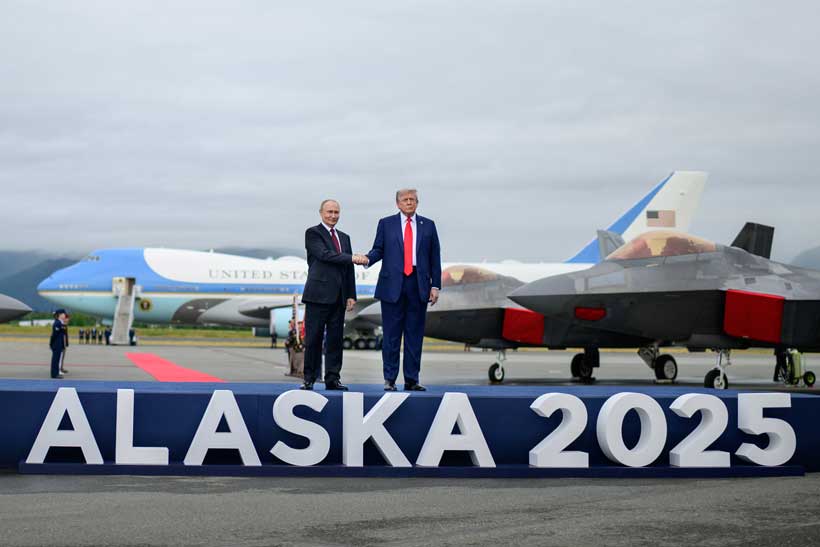
On August 15, 2025, the “fateful” meeting between U.S. President Donald Trump and his Russian counterpart took place in Alaska. The meeting marked the first encounter between Trump in his second term and President Putin. Moreover, Putin’s attendance at the summit with Trump was his first visit to the United States in 10 years, since 2021.
The outcome between the two leaders left observers disappointed with Trump. The two sides did not produce a “favorable” result, at least in terms of a ceasefire between Russia and Ukraine. Before running for president and after winning the election, Donald Trump had repeatedly emphasized that achieving a peaceful resolution between Russia and Ukraine was his top priority. However, given the current state of the global order, it seems he may have had to reconsider.
China, the United States’ top rival, has increased its presence in over 140 countries and territories since President Xi Jinping came to power. Meanwhile, Russia’s special military campaign in Ukraine from 2022 to the present has also received crucial support from Beijing. In April 2025, Secretary of State Marco Rubio acknowledged that China is expanding its military influence on an unprecedented scale. He also affirmed in July 2025, during an interview with Fox News, that Beijing is providing significant economic support to Russia and Iran. The conflict in the Middle East, mainly between Israel and Iran along with regional military forces, has always been a “hotbed” in the world, capable of erupting at any time and affecting U.S. interests in the region. In particular, issues related to the nuclear agreement (New START) and intermediate- and long-range missiles (INF) between the U.S. and Russia were suspended or terminated in 2023 by the Putin administration and during Trump’s first term, putting the world in a state of “insecurity.” Additionally, China is not constrained by these agreements, making it entirely plausible for Beijing to surpass Washington in military capabilities in the future. The U.S. in general, and Trump in particular, faced a situation where they could not address multiple issues simultaneously due to the clear weakening of American power and the overextension of resources in acting as a “policeman” in various regions.
The regional and global context described above reflects the cautious approach of the Trump administration. After concluding the meeting with his Russian counterpart Putin, Trump appeared cautious when speaking to reporters, stating that the two sides had made significant progress but were unable to reach any agreement, and that the decision rested with “them” [Putin’s government]. This event demonstrates Trump’s prudence, as he understood that reaching an agreement with Russia was not feasible given China’s significant influence over Russian decisions. CNN reported that Russian President Putin spoke for 8 minutes, while Trump only spoke for 3 minutes, reflecting the U.S. president’s careful approach and problem-solving strategy.
Stay ahead of the geopolitical week.
MD Briefing delivers expert analysis across five global fronts — the Indo-Pacific, energy, geoeconomics, European security, and the Middle East — every Monday morning. Free.
Whether or not Trump reached an agreement with Putin, it would still have been difficult to prevent the conflict from continuing. If an agreement were reached with Putin, European countries and Ukraine would likely voice criticism and opposition, and Ukraine might even launch attacks against Russia. Since Trump’s first term, European countries have become more proactive in regional and international affairs. Trump was particularly concerned about the warming relations between European nations and China. Conversely, harshly criticizing the Russian leader could provoke Russia to attack Ukraine.
Choosing a “vague” and limited approach in the agreement with Russia allowed the U.S. to maintain its image with European countries and Ukraine while creating a positive impression for the Russian delegation and Putin himself. Essentially, the meeting served to reduce the likelihood of a Russian attack on Ukraine if no substantial agreement was reached. Russia and Putin have long been targets of criticism and sanctions from Europe and the U.S. Therefore, inviting President Putin could be seen as a gesture of respect from the U.S. president, aimed at mending relations between the two nuclear powers and opening the door to more significant negotiations in the future, potentially including an INF agreement and efforts to draw Russia away from China. Maintaining the strategic balance without triggering new conflicts or straining existing relationships can be considered a major success in foreign policy, ensuring long-term U.S. strategic interests and influence.
The Trump–Putin summit in Alaska reflected Donald Trump’s precise and cautious approach, shaped by the global strategic context, including careful consideration of China’s role and influence in order to adjust foreign policy appropriately to counter Beijing. The goal was to reaffirm the U.S. leadership in the global order and reassure like-minded partners and allies of Washington’s commitment to critical issues.
