The Trilateral Statement of November 10, 2020, that was signed by the Republic of Azerbaijan, the Republic of Armenia, and the Russian Federation as the result of the Second Karabakh War and brought an end to the decades-long Armenia-Azerbaijan conflict over Karabakh, laid the foundation for new geopolitical realities in the South Caucasus and opened up an opportunity for Azerbaijan to restore its sovereignty over its internationally recognized territories that were occupied in the wake of the First Karabakh War by Armenia. In light of this development, the Azerbaijani side put forward a range of constructive initiatives to end the enmity between the two neighbors and establish lasting peace in the entire region.
However, there was no significant progress between the parties within two years since the Trilateral Statement of 2020 in the context of peace. That is why the Azerbaijani side put forward the following five-point proposal on 14 March 2022 to begin discussions on a peace treaty and the normalization of relations with Armenia:Mutual recognition of respect for the sovereignty, territorial integrity, inviolability of internationally recognized borders, and political independence of each other; Mutual confirmation of the absence of territorial claims against each other and acceptance of legally binding obligations not to raise such a claim in the future; Obligation to refrain in their inter-State relations from undermining the security of each other, from threat or use of force both against political independence and territorial integrity, and in any other manner inconsistent with the Purposes of the UN Charter; Delimitation and demarcation of the state border and establishment of the diplomatic relations; unblocking of the transportation and other communications, building other communications as appropriate, and establishment of cooperation in other fields of mutual interest.
However, although the negotiation continued on various political platforms, the normalization of relations between the two republics was mainly obstructed due to the failure of the Armenian side to fulfill its obligations regarding the transit corridor under the Trilateral Statement of November 10, 2020, and the territorial claim against Azerbaijan that appeared in the Constitution of Armenia.
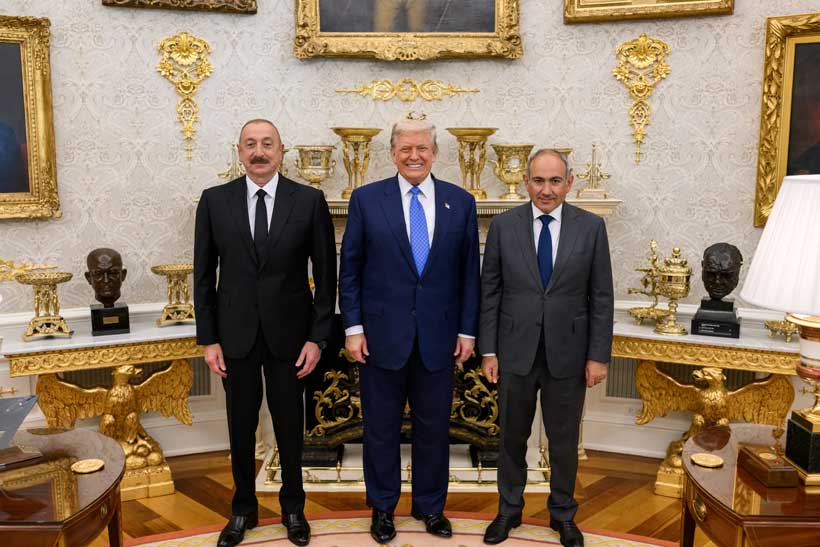
In this regard, the Joint Declaration signed between Ilham Aliyev, the President of the Republic of Azerbaijan, and Nikol Pashinyan, the Prime Minister of the Republic of Armenia, on August 8, 2025, in Washington, that was initiated by Donald Trump, the President of the U.S., represented a significant diplomatic development in the peace process between the two sides. The meeting between the leaders of the two republics in Washington should be considered a historic moment that shapes the post-conflict diplomatic landscape of the South Caucasus. Two aspects of the Joint Declaration signed during the Washington meeting regarding the former Karabakh conflict were of particular importance. First, the Agreement on Establishment of Peace and Inter-State Relations between the Republic of Azerbaijan and the Republic of Armenia, which was initialed by the Ministers of Foreign Affairs of the Parties, constitutes a tangible political will by both sides that shows the peace process has come to the final stage. Second, the official appeal that was signed jointly by the parties and submitted to the OSCE to officially stop the activities of the former Minsk Group, the mediator between the parties since 1994, in order to close the era of “conflict resolution” in the region symbolically and practically.
Stay ahead of the geopolitical week.
MD Briefing delivers expert analysis across five global fronts — the Indo-Pacific, energy, geoeconomics, European security, and the Middle East — every Monday morning. Free.
The Joint Declaration outlined the following key strategic perspectives:
Ensuring and consolidating peace—the commitment of both parties to establish relations on the basis of mutual respect for sovereignty and territorial integrity;
Termination of the Minsk Group’s activities—the formal and legal abolition of the international mechanism associated with prolonging the conflict;
Opening of communication lines—creation and restoration of new transportation and logistics connections domestically, bilaterally, and internationally;
Implementation of the Trump Route for International Peace and Prosperity (TRIPP) project—provision of an unobstructed and secure land connection between mainland Azerbaijan and the Nakhchivan Autonomous Republic;
Exclusion of a revenge policy—confirmation of a political commitment to prevent any future revanchist policies or military rhetoric.
These perspectives, specifically the inviolability of borders and the avoidance of the use or threat of force, indicate the emergence of a new basis for regional peace, security, and cooperation in the context of fundamental norms of international law. From the regional peace and security perspective, one of the most critical aspects of the Joint Declaration is the strategic infrastructure project entitled the TRIPP, which envisions connecting the main part of the Republic of Azerbaijan with the Nakhchivan Autonomous Republic via a direct land corridor that passes through the territory of the Republic of Armenia. However, this project is not only a significant initiative at the national level that connects two regions of Azerbaijan but also an internationally important project in the context of transportation, communications, and energy integration that will shape the landscape of the South Caucasus from a geopolitical and economic perspective and ensure a sustainable, secure, and diversified connection toward its western and southwestern directions. The integration of the project in the Middle Corridor initiative will lead to the transit of approximately 35 million tons of cargo annually through the territory of Azerbaijan, which will strengthen Azerbaijan’s geopolitical position as a regional logistics hub. Consolidation of the regional stability will also reduce investment risks and stimulate foreign capital inflows, particularly into the non-oil sector, while supporting economic diversification. However, Azerbaijan is not the only regional country that will benefit from the economic potential of the project. Beyond Azerbaijan, the project also presents a notable benefit for Armenia. Integration of Armenia into a regional transit network not only means new foreign investment but also diversification of its export and import routes and bringing the chance of opening borders with Türkiye.
The meeting in Washington is not only a significant stage in the peace process between Armenia and Azerbaijan. It is also considered a historical milestone in the relations between Azerbaijan and the United States of America, which laid the groundwork for a new strategic partnership between the two sides. This development represents a new stage in the diplomacy of Azerbaijan and further consolidates the geopolitical position of Azerbaijan in the policy of the USA toward the South Caucasus. Thus, during the meeting, a Memorandum of Understanding was signed between the Government of the Republic of Azerbaijan and the Government of the United States of America on the establishment of a Strategic Working Group to prepare the Charter on Strategic Partnership between the Republic of Azerbaijan and the United States of America, to foster cooperation in a wide range of areas, including energy, transport and logistics, the defense industry, artificial intelligence, digital technologies, and cybersecurity.
Particularly, the waiver of Section 907 of the US Freedom Support Act of 1992 will create new opportunities in the dimension of bilateral relations between the two parties. As President Ilham Aliyev mentioned during the interview with Azerbaijani media representatives in Washington on August 9, 2025, “Of course, I do believe that the waiver of Section 907 is a historic event. I also believe that we have already started a strategic cooperation format. Therefore, I am very pleased with the results of the visit, and I am sure that tangible results of this visit will manifest themselves in the near future.” The active involvement of the United States in the peace process between Azerbaijan and Armenia also offers additional funding potential for infrastructure and innovation projects, advanced technical expertise, and political assurances that increase international investor confidence.
However, while the meeting of the leaders in Washington represents a significant phase in the development of the lasting peace between Azerbaijan and Armenia and reshapes the geopolitical landscape of the region, it also paves the way for the various sensitive and unresolved issues, which raise the following challenges across political-legal, economic-infrastructure, and geopolitical dimensions, such as:
– Armenian Constitutional amendments – Removing the provision in the Constitution of the Republic of Armenia reflecting territorial claims against the Republic of Azerbaijan is a significant stage for strengthening the legal basis of peace and development between the two sides. However, this removal may increase tension in domestic political debates, raise opposition resistance, and increase the risk of socio-political polarization. Therefore, the persistence of political will is a decisive factor for the successful completion of the process.
– Uncertain implementation mechanisms and sustained international support – Due to the complexity of the infrastructure projects and the involvement of various stakeholders in the process, technical and legal standards, as well as financial mechanisms, are critical for the successful implementation of TRIPP. Therefore, sustained financial, technical, and political support from Washington and other partners will be significant not only for the realization of TRIPP and other projects but also to reinforce the stability and security in the region.
– Regional competition and the stance of other actors – The possible influence of the regional powers, such as Iran and Russia, on the ongoing processes through economic, political, military, and diplomatic means should also be taken into consideration, and a balanced strategy should be developed. Given the region’s realities and geopolitical environment, the attitude of these actors may have a significant impact on the processes and direction of the peace initiative.
In sum, the new regional geopolitical landscape shaped by the Washington meeting of August 8, 2025, offers tangible opportunities. However, the full realization of these opportunities needs the careful management of complex, multifaceted challenges. The Joint Declaration in Washington, the initialed “Agreement on Establishment of Peace and Inter-State Relations between the Republic of Azerbaijan and the Republic of Armenia,” and the TRIPP project must be regarded as among the most significant diplomatic achievements in the South Caucasus since the Trilateral Statement of November 10, 2020. These developments initiated a new chapter in the relations of Azerbaijan and Armenia and founded a strategic platform that pushes forward the reconstruction of the political, economic, and security landscape of the entire region. The emerging politico-legal configuration establishes an institutional foundation for ensuring sustainable peace in the region, based on the principles of international law—sovereignty, territorial integrity, the inviolability of borders, and the prohibition of the use of force—while necessitating adept management of delicate and complex strategic challenges.