



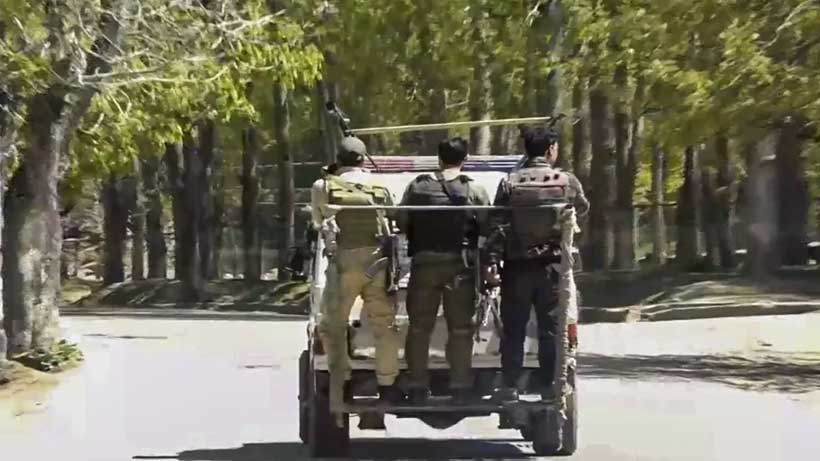
In the aftermath of the Pahalgam attack that claimed the lives of Indian tourists and inflamed nationalist sentiment across the subcontinent, we witness the familiar choreography of India’s security theater: social media jingoism, media outlets manufacturing outrage, and government officials engaging in strategic signaling through promises of “befitting responses.”
Yet beneath this tapestry of performative securitization lies an uncomfortable truth: contemporary India exists in a strategic paralysis, lacking both the material capabilities and the political resolve to fundamentally alter the asymmetric equilibrium with Pakistan.
The Pahalgam incident represents merely the latest manifestation of protracted fourth-generation warfare that India appears perpetually incapable of countering through either compellence or deterrence. While India’s foreign policy establishment celebrates ephemeral diplomatic victories and rhetorical triumphs in multilateral forums, the stark reality reveals a nation trapped in a security dilemma characterized less by the decisive grand strategy of the 1971 conflict and more by institutional satisficing and strategic drift.
The Specter of 1971: An Unreplicable Instance of Strategic Opportunism
The Bangladesh Liberation War (1971) stands as the apogee of India’s exercise of both hard and smart power projection in the subcontinent. Indira Gandhi’s approach transcended mere military victory; it achieved the geopolitical vivisection of an adversary. The creation of Bangladesh fundamentally reconfigured the regional security architecture and momentarily established India as the hegemon in South Asia’s security complex.
This unprecedented strategic success emerged from a confluence of factors that created a permissive environment for decisive action.
First, India successfully legitimized intervention through the rhetoric of humanitarian intervention avant la lettre, as millions of refugees flooded its territory amidst well-documented genocidal violence against Bengali civilians.
Second, the international system offered strategic maneuverability—Nixon’s administration focused on triangular diplomacy with China while the Soviet Union provided India with both diplomatic cover at the UN Security Council and material support.
Third, and perhaps most critically, Indira Gandhi embodied a Machiavellian calculus that Modi’s government, despite its performative muscularity, fundamentally lacks: the willingness to seize a strategic window of opportunity regardless of international normative constraints.
Today’s regional security environment bears little resemblance to that golden opportunity. Pakistan, despite its economic fragility and domestic instability, maintains credible nuclear deterrence that effectively creates a “stability-instability paradox”—preventing conventional military defeat while enabling sub-conventional aggression. The international system has evolved into a more complex multipolar configuration, with China having emerged as both Pakistan’s all-weather patron and India’s primary peer competitor.
Pahalgam and the Ritualization of Strategic Response
The recent Pahalgam attack exemplifies Pakistan’s strategy of calibrated violence—maintaining cross-border terrorism at an intensity sufficient to impose costs on India while remaining below the threshold that would trigger full-spectrum retaliation. Each terrorist incident generates domestic outrage, yet India’s response has become ritualized: diplomatic offensive through episodic “naming and shaming,” multilateral condemnation through counter-terrorism resolutions, and occasionally limited kinetic action exemplified by the post-Uri surgical strikes or the Balakot air strike. These tactical responses, while producing temporary domestic catharsis, fail to modify the strategic calculus that renders terrorism an economically rational policy instrument for Pakistan’s security establishment.
The Modi administration displays particular aptitude for securitization—transforming these limited tactical responses into narratives of strategic transformation. Both the surgical strikes and Balakot operation were masterfully framed as watershed moments heralding a new era of Indian resolve. Yet strip away this strategic communication, and the reality emerges that Pakistan’s deep state continues to view terrorism as a cost-effective form of asymmetric warfare against a conventionally superior neighbor.
The Balochistan Gambit: Rhetorical Escalation Without Operational Commitment
Following the 2016 Uri attack, Modi’s Independence Day reference to Balochistan represented a significant departure from India’s traditional strategic restraint doctrine—signaling potential Indian support for separatist movements within Pakistan. This rhetorical intervention generated considerable enthusiasm among offensive realists within India’s strategic community who envisioned reciprocal proxy warfare.
Seven years hence, this approach remains confined to the realm of strategic signaling rather than substantive policy. India has neither developed robust covert capabilities comparable to Pakistan’s proxy networks nor demonstrated the patience required for sustained sub-conventional warfare. Unlike Pakistan’s multi-decade investment in Kashmir militancy, India has failed to institutionalize the infrastructure necessary for credible gray zone operations.
The Balochistan card exemplifies strategic bluffing—periodically displayed yet never seriously deployed. Despite rhetorical commitments to reciprocity, India has not allocated the resources required to transform declaratory policy into operational reality. Meanwhile, Pakistan continues to exploit the structural asymmetry, where minimal investment in terrorist proxies generates disproportionate dividends through disruption of Indian security resources and erosion of public confidence in state protection.
POK: Irredentist Claims Without Revisionist Strategy
Pakistan-occupied Kashmir represents the quintessential disjuncture between India’s maximalist territorial claims and minimalist operational planning. Parliamentary resolutions may unanimously assert POK as integral Indian territory, cartographic annexation may incorporate these regions within Indian boundaries, but no credible military doctrine exists for reclaiming these territories.
The recovery of POK would necessitate a level of force mobilization, international diplomatic insulation, and escalation tolerance that exceeds India’s current strategic threshold. Even Israel’s operations in Gaza—orders of magnitude less complex than what reclaiming POK would entail—have required an acceptance of international opprobrium that India’s status-seeking foreign policy establishment finds intolerable.
Despite its nationalist rhetoric, the Modi government operates within a fundamentally risk-averse paradigm regarding actions that might trigger uncontrolled escalation spirals. The chasm between public articulation regarding POK and actual policy implementation reflects not strategic ambiguity but strategic incoherence—a nation uncertain whether it genuinely desires the territories it claims are non-negotiable.
Between Kantian Idealism and Hobbesian Realism: India’s Strategic Schizophrenia
India’s foreign policy suffers from a peculiar ontological contradiction: it cloaks realist objectives in idealist discourse. While rhetorically emphasizing international law, democratic values, and multilateral normative frameworks, it simultaneously seeks power projection capabilities and regional primacy without acknowledging the potential contradiction between means and ends.
This strategic schizophrenia stands in stark contrast to states like Israel or the United States, which more comfortably inhabit the realist paradigm when their security interests demand it. Israel’s approach to Hamas in Gaza or Hezbollah in Lebanon demonstrates a clarity of purpose and willingness to absorb international criticism that India has never demonstrated regarding Pakistan.
Modi’s denunciations of terrorism in international forums produce compelling political theater but achieve negligible strategic outcomes. Pakistan has calculated—with empirical validation—that India’s threshold for decisive retaliation exceeds the persistent, low-intensity provocation it maintains through terrorist proxies. India’s fixation on maintaining its image as a responsible stakeholder in the rules-based international order effectively constrains its response options to within predictable parameters.
The China Factor: Strategic Distraction Through Misplaced Prioritization
India’s Pakistan fixation represents not merely a security challenge but a strategic misdirection of attention from the more consequential competition with China. While India diverts disproportionate resources and national psychological energy to the Pakistan question, the capability gap with China widens inexorably.
Even as India celebrates tactical victories against Pakistan, the strategic asymmetry with China expands across multiple domains. China’s economy, despite recent structural challenges, remains approximately five times larger than India’s. Its military modernization proceeds at a pace India cannot match within existing budgetary constraints. Its infrastructure development along contested borders dwarfs Indian capabilities. Most concerning, its economic penetration—even within India’s traditional sphere of influence in South Asia—continues unabated.
A genuinely realist Indian foreign policy would recognize that the Pakistan challenge, while emotionally resonant, pales in strategic significance compared to the China challenge. Yet the Modi administration, like its predecessors, finds itself trapped in what international relations theorists would term a “commitment trap”—unable to ignore provocations yet equally unable to resolve them decisively.
Defensive Realism and the Constraint of Strategic Culture
India has emerged as the archetypal defensive realist power—prioritizing security over power maximization, focused on preserving the status quo rather than revisionist expansion. This defensive orientation manifests in multiple dimensions: reluctance to employ hard power except in circumscribed circumstances, preference for diplomatic over military solutions, and risk aversion regarding potential conflict escalation.
In contrast, Pakistan—despite its material disadvantages—operates as an offensive realist actor, willing to accept significant risks to alter the status quo. This asymmetry in risk tolerance explains why Pakistan can sustain proxy warfare while India responds primarily through diplomatic channels and limited military actions.
The 1965, 1971, and 1999 conflicts with Pakistan represented anomalous periods when India temporarily adopted more offensive postures. In each instance, however, battlefield successes were followed by reversion to strategic restraint. India repeatedly won tactical engagements but squandered opportunities to permanently resolve its security dilemma with Pakistan.
Nuclear Weaponization: The Strategic Equalizer Modi Cannot Neutralize
Any analysis of Indo-Pakistani security dynamics must acknowledge the nuclear dimension as the defining constraint on conventional options. Pakistan’s nuclear doctrine—emphasizing first-use posture and tactical nuclear weapons—effectively neutralizes India’s conventional military superiority. The specter of nuclear escalation imposes a ceiling on conventional operations regardless of tactical advantages.
While Modi’s supporters might mythologize him as capable of calling Pakistan’s nuclear bluff, rational actor models suggest that no responsible Indian leader can risk even a marginal probability of nuclear exchange. The game-theoretic dynamics of nuclear deterrence favor Pakistan—the conventionally inferior power with an explicit nuclear doctrine—over India’s more ambiguous posture.
This nuclear reality imposes structural constraints on India’s options in ways that didn’t limit Indira Gandhi in 1971. Modi can project strength through declaratory policy and limited operations like surgical strikes, but he cannot fundamentally alter this strategic constraint without risking catastrophic escalation dynamics.
The Persistence of Institutional Weakness in India’s Security Architecture
Despite the nationalist rhetoric and claims of transformative governance, India continues to exemplify what comparative politics scholars term “state capacity deficit”—where policy formulation exceeds implementation capability, where institutional infrastructure lags behind national aspirations, and where electoral imperatives frequently override strategic necessities.
India’s intelligence capabilities, despite incremental improvements, still cannot match Pakistan’s ISI in human intelligence networks and operational tempo. Its military modernization proceeds at a bureaucratically constrained pace, hampered by procedural inefficiencies and insufficient resource allocation. Its diplomatic corps remains numerically inadequate compared to other middle powers with global ambitions.
Most significantly, the political will required for sustained strategic action—as opposed to episodic responses to crises—remains underdeveloped. Each terrorist attack generates temporary political capital for action, but this momentum dissipates rather than being channeled into systematic capability enhancement or doctrinal evolution.
The Israeli and American Models: Strategic Cultures India Cannot Emulate
Israel’s approach to national security offers a revealing contrast to India’s. When Israel identifies a threat vector, its response is comprehensive and sustained—integrating intelligence operations, targeted eliminations, military pressure, and diplomatic isolation. It accepts international criticism as an inevitable cost of security maximization rather than seeking universal normative approval.
Similarly, the United States demonstrates both the capability for strategic patience and institutional memory in pursuing security objectives across administrations and domestic political configurations. Whether implementing containment during the Cold War or counterterrorism strategies after 9/11, American grand strategy maintains core continuity despite tactical adjustments.
India, conversely, allows each security crisis to be treated as a discrete event rather than part of a continuum requiring consistent response. The predictable result is a pattern where Pakistan can reliably anticipate Indian reactions and calibrate its provocations to remain below response thresholds.
India’s Nuclear Doctrine: Between Credibility and Constraint
India’s nuclear doctrine of “credible minimum deterrence” combined with “no first use” represents another domain where declaratory policy diverges from operational reality. The ambiguity surrounding India’s nuclear thresholds creates a paradoxical situation where Pakistan can exploit conventional gaps while remaining confident that its actions fall below India’s nuclear redlines.
The Modi government has occasionally signaled potential reconsideration of the “no first use” doctrine, yet these statements appear more as strategic signaling than substantive policy shifts. This generates ambiguity without credibility—the worst possible combination in deterrence theory.
This nuclear inconsistency mirrors broader patterns in India’s strategic posture: bold declarations without corresponding capability development, rhetorical escalation without operational preparation, and nationalist signaling without institutional investment.
The Militarization-Securitization Gap
India’s approach to Pakistan exemplifies what security studies scholars term the “militarization-securitization gap”—where threats are rhetorically emphasized (securitized) without corresponding resource allocation (militarization). Each terrorist attack generates extensive discourse about existential threats without proportionate investment in capabilities to address these threats.
The Modi government displays particular aptitude for securitization—framing issues as existential security concerns requiring exceptional measures. However, this discursive securitization rarely translates into proportionate resource allocation or institutional development.
This gap between rhetoric and resources manifests across multiple domains: border infrastructure development that lags behind China’s, intelligence capabilities that remain reactive rather than preventive, and counterterrorism strategies that respond to incidents rather than preemptively disrupting networks.
Conclusion: Transcending the Cycle of Strategic Paralysis
Modi cannot replicate Indira Gandhi’s 1971 triumph because contemporary structural constraints, altered regional dynamics, and India’s own capacity limitations render such resolution unattainable. India’s strategic community would benefit from acknowledging this reality rather than perpetuating myths of transformative leadership or muscular foreign policy.
Rather than promising decisive victories beyond its capability, India would be better served by systematically increasing Pakistan’s costs for proxy warfare while simultaneously developing the economic and military capabilities required for long-term strategic competition with China.
Progress requires less rhetorical flourish and greater resource commitment, fewer public declarations and more capability development, less strategic signaling and more leverage accumulation. Most fundamentally, it demands strategic patience—not the reactive patience of absorbing provocations but the proactive patience of systematically developing asymmetric advantages.
Until such reorientation occurs, each terrorist attack will regenerate the familiar cycle of outrage, limited response, and reversion to status quo ante. The victims of Pahalgam, like countless others before them, deserve more than transient outrage followed by strategic amnesia.
Modi may indeed be India’s most politically dominant prime minister in decades, but in the unsentimental calculus of international relations, dominance is measured not through electoral mandates or public approval but through the capacity to permanently alter strategic equations. By this empirical standard, the divergence between rhetorical promises and strategic outcomes in India’s Pakistan policy remains as wide as ever, trapped in a perpetual cycle of action-reaction without resolution—a testament to the enduring gap between India’s great power aspirations and its middle power capabilities.
