


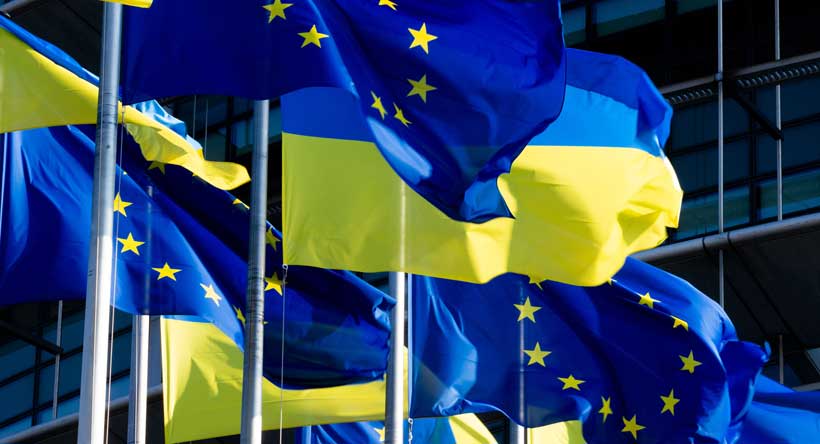
A senior centre right MEP says the Russian “war of aggression” against Ukraine “further underscores the need for a stronger Europe.”
The comments come in the wake of a major poll showing America’s allies are nervous about Trump 2.0 – and doubt it will bring positive change.
The study, by European Council on Foreign Relations, says there is “scepticism” that a Trump presidency will make any difference to the situation in Ukraine.
President Trump said before the U.S election that the war could be ended on the first day he was back in office.
Stay ahead of the geopolitical week.
MD Briefing delivers expert analysis across five global fronts — the Indo-Pacific, energy, geoeconomics, European security, and the Middle East — every Monday morning. Free.
Speaking this week, David McAllister, a German MEP, said, “Mr Trump has often spoken of a “quick deal” to resolve Russia’s war of aggression against Ukraine. The question remains: what would such a deal look like?”
He goes on, “If Ukraine’s sovereignty were compromised, thereby strengthening Russia, it would be a catastrophe for Ukraine and a significant strategic mistake with far-reaching consequences for Europe and the world. A dictated peace favouring Russia must not be allowed. Europe must be prepared to provide advanced weapons systems, financial assistance, and robust security guarantees to Kyiv. Supporting Ukraine’s defence and its path toward EU membership is both a moral obligation and a strategic necessity for us.”
According to the European Council on Foreign Relations survey, America’s allies are “nervous” about Trump 2.0 – and doubt it will bring positive change.
It says that, in the UK, South Korea and countries of the EU – all of which are key allies of the US – there is scepticism that a Trump presidency will make any difference to the situation in Ukraine or the Middle East. Just 24% in the UK, 31% in South Korea, and 34% in the EU (average result across 11 EU countries polled) believe Trump’s return would make achieving peace in Ukraine more likely, while even fewer people (16% in the UK, 25% in the EU and 19% in South Korea) believe he will make it more likely to achieve peace in the Middle East.
More broadly, just one in five in the EU (22%) say they now view the US as an ally. This is down significantly from two years ago (31%) and stands in contrast to the proportion of Americans who view the EU as an ally (45%).
The EU, meanwhile, is held in high regard – with many seeing growth in the bloc’s influence.
Majorities in India (62%), South Africa (60%), Brazil (58%), and Saudi Arabia (51%), and pluralities in Ukraine (49%), Türkiye (48%), China (44%), Indonesia (42%) and the US (38%) believe the EU will wield “more influence”, globally, in the coming decade. The bloc is also widely seen as an “ally” or “necessary partner” by respondents of the countries surveyed. This view is most pronounced in Ukraine (93% ally or partner, vs. 4% rival or adversary), the United States (76% ally or partner, vs. 9% rival or adversary), South Korea (79% vs. 14%). But it’s also a majority view everywhere else – except for Russia.
Foreign policy experts and report authors, Mark Leonard, Ivan Krastev and Timothy Garton Ash suggest European leaders may struggle to find internal unity or global allies if they try to shape a worldwide liberal resistance to the U.S president.
In the last two years, with the Biden administration standing shoulder-to-shoulder with Europe on Russia’s full-scale invasion of Ukraine, it was still possible to speak of a “united west” on foreign policy, says the Council. However, with President Trump’s return, divisions run not just between the US and Europe, and other key allies such as South Korea, but within the EU itself.
Co-author and historian Garton Ash said: “Europe may stand almost alone in a Trumpian world, but this doesn’t mean we Europeans are powerless to act. There are opportunities in this new, transactional space for alliances and influence. Indeed, the very fact that the EU is held in such high regard by people in so many countries and is even expected to grow in strength in the coming decade, should give leaders hope that there is room for a strong and independent-minded Europe in the world.”
The survey and accompanying analysis form part of a wider project by the European Council on Foreign Relations to understand the views of citizens across major global issues.
