The USA is frequently referred to be the “Champion of Democracy and Human Rights.” But over the past two decades, as it transitioned to a multicultural society, the USA has encountered numerous domestic human rights problems, including institutional racism, hate crimes, and extrajudicial murders by law enforcement. Numerous figures demonstrate the worrisome increase in gun-related violence, including extrajudicial executions and hate crimes, as well as the systemic violation of human rights. Hate crimes, extrajudicial killings, and police violence are daily problems for US society. Additionally, the government is failing to start or enact efficient policies. Additionally, there is a widespread culture of impunity when it comes to extrajudicial killings. The champion appears to be struggling lately at home.
This is not the first occasion that armed men have attacked in the US. A young man from a Bangladeshi community living abroad in the US was shot and killed by police in Cambridge, Massachusetts.
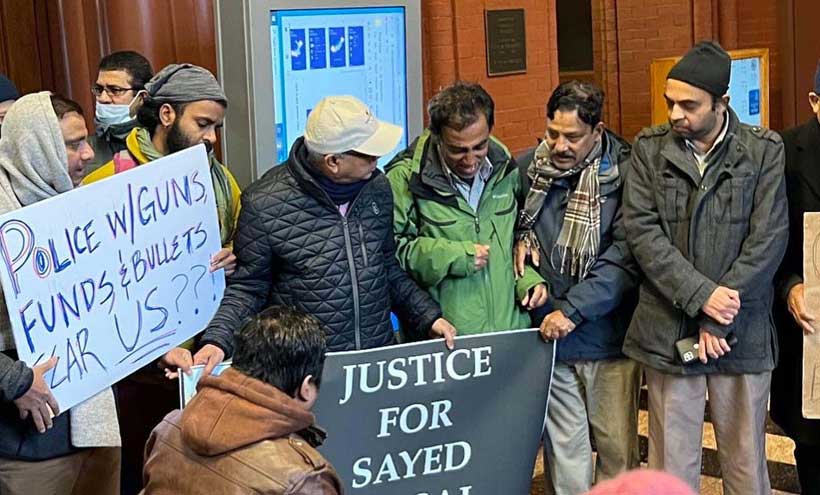
The Bangladesh Association of New England organized demonstrations against the “brutal killing” of 20-year-old Sayed Faisal, a student at the University of Massachusetts Amherst, outside Cambridge City Hall on Thursday.
They labeled Faisal’s death, the family’s lone fatality, as a “racist act by white police officers.” The association posted on Facebook, saying, “This is not acceptable in any sense.”
Stay ahead of the geopolitical week.
MD Briefing delivers expert analysis across five global fronts — the Indo-Pacific, energy, geoeconomics, European security, and the Middle East — every Monday morning. Free.
Members of the association were to meet with Cambridge Mayor Sumbul Siddiqi to seek an explanation, according to the statement. For this young brother, justice must be served. Police brutality must end, the message continued.
It stated that organization members would meet with Cambridge Mayor Sumbul Siddiqi to inquire about the matter. For this young brother, justice must be served. The abuse by police must cease.
In this unfortunate sequence of events, Cambridge, Massachusetts police shot and killed a young Bangladeshi-American student on Wednesday. This has sparked protests and enraged the state’s Bangladeshi population.
According to media accounts, the victim is University of Massachusetts Amherst student Arif Sayed Faisal, age 20. His uncle Selim Jahangir revealed that although he was born in the US, his parents are from Chittagong’s Fatikchhari upazila.
According to CBS News, who cited the authorities, Faisal was in possession of a huge knife. Jahangir, a Massachusetts resident, vehemently refuted this claim. Media reports state that they were not handed any videos of Faisal brandishing a sharp object.
Jahangir asserted that Faisal had a tranquil demeanor. He inquired, “We don’t understand why police shot at him.” Moreover, he urged that the incident be fairly investigated and that the police officer who fired first be punished.
Recent years have seen a lot of attention focused on police deaths of unarmed civilians, which has sparked widespread protests. In the US, fatal police shootings continue to be a divisive and ongoing subject, sparking protests and repeated demands for significant enforcement reforms.
AK Abdul Momen, Bangladesh’s foreign minister, said on Friday that his country does not support hate crimes anywhere in the globe in reference to the murder. Foreign Minister AK Abdul Momen stated on Friday that Bangladesh does not want any hate crimes to occur anywhere in the globe in reference to the assassination of a Bangladeshi in the US.
A Bangladeshi expatriate was killed on Thursday after being shot by US police in Cambridge, Massachusetts. “The Bangladeshi community there (US) are alleging it to be a hate crime,” Momen told reporters. Momen stated that the goal was to bring about world peace and put an end to racism and intergroup conflict.
Blood was spilled once more on the campus of the United States on Tuesday, May 24, 2022. With a gun he received as a gift for his 18th birthday, a young man by the name of Salvador Ramos murdered 19 children and two teachers one by one. Ramos, the shooter, targeted Rob Elementary School in Uvalde, Texas, a small community an hour’s drive from the border with Mexico. As they arrived on the scene, Border Patrol agents shot the young man to death. In other words, there was another extrajudicial killing in the country.
Such occurrences were frequent. Ten people were slain in a shooting at a superstore in Buffalo, New York, just days prior to the shooting event on Tuesday, according to the BBC and AFP. Twenty children and six other people were killed in a shooting at Sandy Hook Elementary School in Connecticut in 2012. Last year, there were 26 of these occurrences in the US. In 2020, shootings will outnumber auto accidents as the main cause of death for kids and teenagers.
Shortly after shots were fired at an elementary school in Texas, a shooter was shot and killed by police in the vicinity of a Toronto, Canada, school.
These are an example of extrajudicial executions that have taken place in the United States and Canada, two nations that are known for having advanced human rights laws.
The topic of extrajudicial executions in Bangladesh has received attention from the U.S. Department of Human Rights. It has been asserted, using a number of figures, that Bangladesh’s law enforcement authorities are complicit in these extrajudicial executions.
Let’s examine extrajudicial executions carried out by American law enforcement. Important information concerning the United States leading the world in extrajudicial executions by law enforcement has been provided by the Turkish media channel TRT World. In the seven years between 2013 and 2019, 7,666 persons died in total in police shootings in the United States, according to research released on June 1, 2020. 1,106 of these people were shot by police in 2013, 1,050 in 2014, 1,103 in 2015, 1,071 in 2016, 1,095 in 2017, 1,143 in 2018, and 1,098 in 2019, according to statistics. Of them, 2018 had 1,143 police shooting deaths, which is the most ever. Approximately 1,100 people were killed on average per year between 2013 and 2019. More than 1,200 Black persons were reportedly slain by police shootings in 2015, according to the reports. The deaths in police custody or from other causes are not included in these figures.
In contrast, 13% of Black Americans in the United States—at least three times as many as White Americans—have been killed or injured in police shootings.
According to a story from the Washington Post on February 12, 2019, the number of individuals murdered in police shootings in the US has been close to 1000 for four years running. The study states that 996 persons were killed by police shooting in 2018, 987 in 2017, 963 in 2016, and 995 in 2015.
According to reports from the Associated Press-AP, USA Today, and a team of scholars from North-Eastern University, the United States recorded the most mass murders of any year in 2019.
In the United States in 2020, there were 996 extrajudicial executions. 96% of homicides were the result of police gunfire. Although they make up 13% of the population overall, African-Americans make up 27% of the deaths. In 98.8% of the incidents, no action has been taken against the police, according to the Human Rights Report. However, under the guise of human rights abuses, the United States filed accusations against Bangladesh.
Any extrajudicial execution is wrong. Such extrajudicial killings occur in numerous nations. However, the United States lacks the guts to make such a move there. He said, “The United States does not take such action on its own,” in response to worry.
It is accurate to argue that nations like the United States or Canada should now examine themselves in the light of recent events. It is past time to alter the lenses through which they view Bangladesh’s human rights situation.
Extrajudicial killing is an act of “violations of core human rights,” and it supersedes the “right to justice” and the appropriate legal procedure, in addition to international rules and conventions.
It appears that the U.S. takes questionable national activities that violate human rights and has a propensity to disobey current international laws and standards when it serves its own interests. As a result, the U.S. itself violates human rights, making it ineligible to “lecture” others on the subject. The United States must abandon its infractions, contradictory policies, and “immoral” elements if it wants to be considered the “real” champion of human rights.