



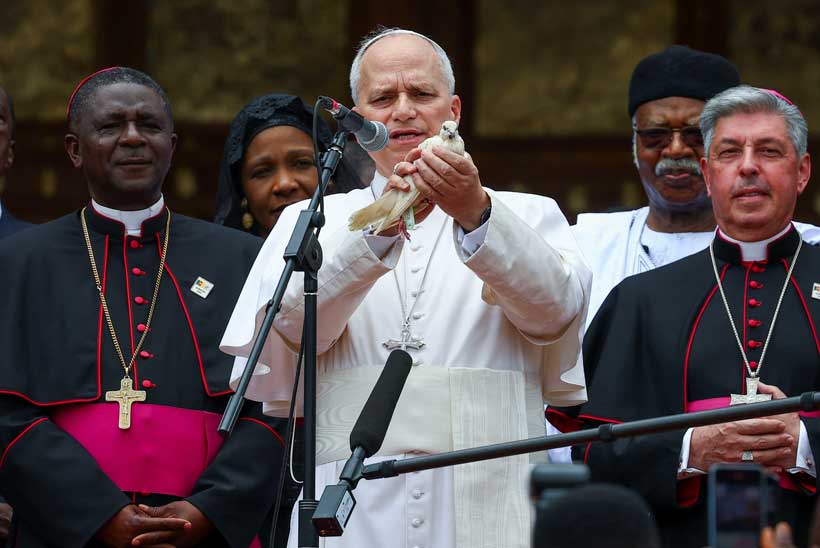
The public clash between Donald Trump, J.D. Vance, and Pope Leo XIV is being treated as another episode in the permanent spectacle of American politics. That reading misses the deeper point. What is unfolding is a struggle over moral authority in public life, over who gets to define the ethical meaning of war, power, borders, and democracy. The immediate trigger was Leo’s criticism of the war with Iran and his insistence on speaking against it. Trump answered by attacking the Pope in personal terms, while Vance tried to draw a line between theology and state policy.
How theology is used in the American political right
In the political language of the Trump era, theology often functions less as doctrine and more as legitimacy. Christian language is used to fortify sovereignty, cultural identity, civilizational boundaries, and the moral right of the state to act with force. Religion, in this frame, becomes a source of authorization for political order. It helps define who belongs, what must be defended, and why conflict is sometimes presented as morally necessary. That is why Vance’s remark that the Vatican should “stick to matters of morality” is so revealing. It assumes morality can be separated from policy, as if war, migration, and public power belong to a neutral sphere beyond theological judgment.
Why the Vatican rejects that boundary
The Vatican does not accept that division. Catholic teaching treats war, migration, democracy, poverty, and human dignity as moral questions at the center of public life, not at its margins. Pope Leo has underlined this by warning that democracy remains healthy only when rooted in moral law and by cautioning against “majoritarian tyranny” and the concentration of economic, technological, and military power in a few hands. In the same period, he reaffirmed his opposition to war and signaled that silence in the face of suffering would be a moral failure. This is not a papal intrusion into politics in the narrow American sense. It is the old Catholic claim that power itself must be judged by a higher ethical standard.
This confrontation did not begin with Leo. It was prepared during the earlier clash between Pope Francis and J.D. Vance over migration and the meaning of ordo amoris. Vance had invoked the concept to justify a hierarchy of obligations, family first, then nation, then those farther away. Francis replied in his February 10, 2025, letter to the U.S. bishops that the “true ordo amoris” is found in the parable of the Good Samaritan. In other words, Christian love is not an argument for narrowing moral concern. It is an argument for widening it. That exchange matters because it exposed the core split within contemporary political theology in the United States. One side uses Christian language to rank loyalties. The other uses it to universalize responsibility.
The deeper anthropological divide
At the heart of the dispute lies a different understanding of the human person. The Trump-Vance worldview tends to begin with order, threat, national cohesion, and civilizational survival. The individual appears first as a member of a political body that must protect itself. The Vatican starts elsewhere. It begins with the dignity of the person as such, including the migrant, the civilian trapped in war, and the outsider who carries no political utility. This is why Rome speaks in universal terms while the nationalist right speaks in concentric circles of obligation. The conflict is not merely strategic. It is anthropological. It concerns what a human being is before the state claims him. This is an inference drawn from the contrast between the Vatican’s public teaching and the rhetoric used by Trump and Vance in the current dispute.
Why Leo is a uniquely difficult adversary
Pope Leo is a difficult opponent for Trump for reasons that go beyond the current war. He is the first Augustinian pope and the second pontiff from the Americas, but unlike Francis, he comes from the United States itself. That changes the optics of the confrontation. It becomes harder for American conservatives to dismiss papal criticism as the voice of a distant European or Latin American Church that does not understand the United States. Leo understands the American language of politics from within, yet speaks from a church that insists Christianity cannot be reduced to national destiny. That gives his criticism greater symbolic force.
There is another layer to this conflict. Both sides are drawing, directly or indirectly, on the Christian tradition. Leo’s Augustinian background matters because Augustine’s legacy remains central to Christian thinking about power, moral disorder, coercion, and peace. Vance, for his part, has defended the possibility of morally justified force by referring to historical examples such as World War II, which places his argument closer to just war reasoning. The result is not a simple opposition between secular politics and religion. It is a contest between rival interpretations of Christianity itself, one that tends toward national order and one that insists on transnational moral accountability. This is partly interpretive, but it is strongly grounded in their public arguments and Leo’s intellectual formation.
Why the clash matters politically
For Trump, the danger is not only theological. It is political. U.S. Catholics remain an important electorate, and a pope who is both American and openly critical of war complicates the attempt to monopolize religious symbolism on the right. Trump’s attacks, including the reported Christ-like AI image and his public insults, also triggered negative reactions among Catholic observers and even among some conservatives. Vance’s effort to contain the damage by narrowing the pope’s role to “morality” only made the contradiction clearer, because Catholic teaching does not treat morality as separate from public action.
What this fight is really about
The real issue is who gets to define the moral meaning of power in America. Trump and Vance use religious language to reinforce sovereignty, hierarchy, and executive authority. Pope Leo uses theology to judge war, defend the dignity of persons, and remind democratic societies that moral law stands above majorities and above force. That is why this dispute feels sharper than an ordinary political quarrel. It is a struggle between Christian nationalism and Catholic universalism, between a theology enlisted by the state and a theology that insists on judging the state.
