



The United States is contemplating military strikes against Iran due to its violent response to recent protests. Understanding Iran’s political system is complex, especially with its unique governance structure and the role of the Revolutionary Guards, making it challenging to predict how Iran might respond to external threats.
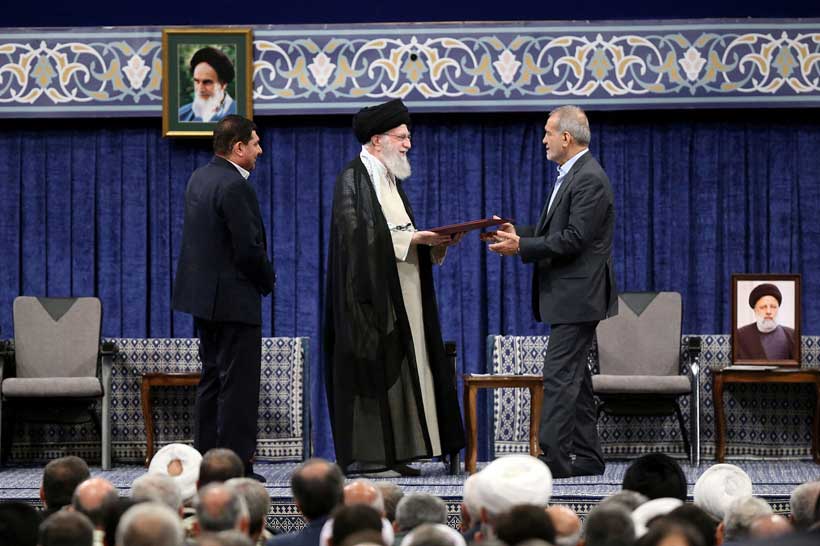
Iran’s political structure is guided by the principle of “vilayat-e faqih,” which means that a supreme cleric rules until the return of the 12th Imam. Ayatollah Ruhollah Khomeini was the first Supreme Leader after the 1979 Islamic Revolution, establishing a model where a cleric holds authority over elected officials. Current Supreme Leader Ayatollah Ali Khamenei has maintained significant power since 1989, controlling major policy decisions and creating a secondary system governed by loyalists. Khamenei’s closest advisers include figures like Ali Larijani, Ali Shamkhani, and Ali Akbar Velayati. At 86, Khamenei has not selected a successor, raising uncertainties regarding future leadership, with figures like his son Mojtaba and Hassan Khomeini being potential candidates.
Iran can be seen as a theocracy, with a clerical class holding power over various institutions. The Assembly of Experts, composed of senior ayatollahs elected every eight years, is responsible for appointing the Supreme Leader and has the authority to question or remove one, although this power has never been exercised. The Guardian Council, with half its members appointed by the leader, can veto parliamentary laws and block election candidates, often used to shield Khamenei from criticism. Another important body, the Expediency Council, resolves conflicts between the parliament and the Guardian Council. Iran implements Shi’ite interpretations of sharia law, and its judiciary, led by Gholamhossein Mohseni Ejei, consists of clerics, some of whom oppose the current regime or strive for reform.
The Islamic Revolutionary Guards Corps (IRGC), a powerful military branch directly loyal to the Supreme Leader, has evolved significantly since its formation. Its power has grown, particularly during the Iraq war, and it has become a formidable force within Iran’s military and political landscape. The Quds Force, an elite unit within the IRGC, supports Shi’ite groups across the Middle East. The IRGC has also expanded its economic influence, particularly through contracts in the oil and gas sector.
In terms of democracy, Iranians elect a president and a parliament every four years. The president, within the boundaries set by the Supreme Leader, manages daily policy. While voter turnout was initially high, recent restrictions by the Guardian Council and controversial election results, particularly in 2009, have diminished public trust in the electoral process. In a recent election, moderate President Masoud Pezeshkian was elected amid low voter turnout, defeating a hardline candidate close to Khamenei. The current parliament speaker has been former Guards commander Mohammad Baqer Qalibaf since 2020.
With information from Reuters
