



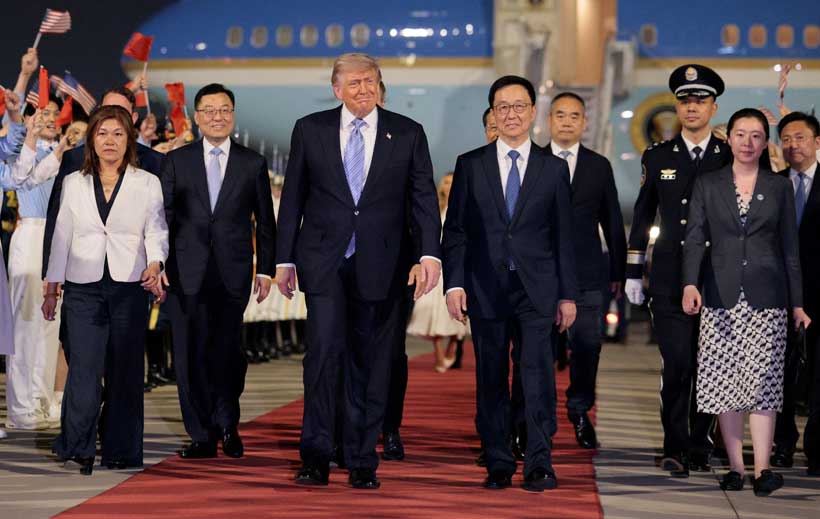
The Chinese diplomatic reception of President Trump differed from previous visits by American presidents. The Chinese perception of Trump had shifted compared to his historic visit in 2017. While he received the usual protocol, Beijing did not repeat the exceptional imperial celebration of his earlier visit, reflecting a change in the balance of power. On the other hand, President Trump’s visits to China (both during his first term and his most recent presidential trip) yielded significant gains, most notably the signing of multi-billion dollar defense and economic deals, the revitalization of major American companies’ interests, and the strengthening of Washington’s diplomatic influence and strategic presence in the region. The most important gains for the American administration were the economic and investment benefits, represented by major contracts and deals. The historic visits during Trump’s presidency resulted in the signing of massive arms and trade deals worth tens of billions of dollars to support American defense industries, as well as American companies. He was accompanied by CEOs from major American companies to bolster commercial influence and facilitate entry and investment in global markets. Regarding the political and security gains, Trump’s visit to China was an attempt to bolster American influence in the Middle East. His presidential tour reflected Washington’s strong desire to assert its strategic presence, safeguard its vital interests, and ensure the military superiority of its allies while confronting international challenges. Trump used these visits as tools for international pressure and negotiation, aiming to reaffirm American power and redraw the map of global alliances. The historic visit of US President Donald Trump to Beijing in May 2016 concluded with tactical trade gains for the United States, alongside significant political and strategic gains for China, amidst an atmosphere described as a summit of stalemate, as it failed to achieve a comprehensive breakthrough on major geopolitical issues.
In this context, Asian alliances and balances played a pivotal role in shaping the contours of President Donald Trump’s visit to China, as Beijing relies on its regional influence as a bargaining chip. The most prominent impact of the Asian file on this summit includes the North Korea issue, where the US administration seeks to pressure Beijing to use its influence to restrain Pyongyang, while China demands economic concessions from Washington, such as easing restrictions on the export of artificial intelligence chips. The Strait of Hormuz crisis and Iran are also on the agenda, with China pressing the US to ensure stable energy supplies, especially after US accusations that Beijing is purchasing Iranian oil. This has led Beijing to leverage its relationship with Tehran as a bargaining chip to gain trade advantages. The issue of tensions in the (South China Sea and Taiwan) remains a central topic in US-China discussions, with issues of sovereignty and US alliances in the (Indo-Pacific) region, such as alliances with Japan and Southeast Asian countries, featuring prominently on the table, potentially disrupting the traditional alliance system in the region.
As for the details of the gains for both sides from this visit, the United States benefited from Trump’s focus on direct economic gains, such as reducing the trade deficit and supporting American farmers and factories, especially after the successful Boeing aircraft deal with China. China agreed to purchase an initial batch of 200 American-made Boeing aircraft to bolster its manufacturing sector. China also pledged to purchase agricultural products, such as soybeans and meat, worth $17 billion annually for the years 2026-2028. Furthermore, the US and China agreed to establish new trade councils, creating the US-China Trade Council and the US-China Investment Council, as formal mechanisms for managing economic relations and reducing tariffs on non-sensitive goods. Agreements were also reached on strategic energy supplies, with China expressing its willingness to purchase American oil and gas as a safe alternative amidst the escalating energy crisis in the Strait of Hormuz. Additionally, China pledged to address Washington’s concerns regarding shortages of rare earth elements, which are crucial for the (semiconductor industry).
As for the gains of China and President Xi Jinping, China emerged with strategic and political gains through which it imposed its influence as an equal international power, by establishing strategic stability. President Xi succeeded in extracting American recognition of a joint diplomatic framework called “constructive strategic stability,” which guarantees a temporary freeze on escalation and the trade war while protecting the Taiwan issue. Beijing imposed Taiwan as a military red line, and publicly warned Washington that any mismanagement of this issue would lead to a dangerous clash, which made Washington more cautious. In addition, in managing the Iran and Middle East issue, China did not offer substantial concessions or decisive commitments to pressure Tehran, but rather confirmed its presence as a major player that cannot be ignored in securing the waterways (the Strait of Hormuz). While Beijing sought to buy time to extricate itself from the grip of US technological restrictions, China gained additional time to mitigate the impact of US digital sanctions. It refused to make concessions that would compromise its cybersecurity, such as those related to artificial intelligence chips. China reaped significant strategic, economic, and political gains from US President Donald Trump’s recent visit to Beijing, capitalizing on Washington’s need for de-escalation and its diminished influence due to the Iran War and the Strait of Hormuz crisis.
A number of important gains for China stemmed from this visit, including solidifying Beijing’s role as a global power on par with the United States and compelling it to adhere to a trade truce. China’s most significant gains from this visit can be divided into several axes. Firstly, there are the political and strategic gains for Beijing, achieved through the recognition of China’s parity and leadership role. The visit revealed Trump seeking Beijing’s cooperation in resolving complex international crises such as the Strait of Hormuz crisis and the Iranian nuclear issue. This solidified China’s international image as an indispensable superpower capable of managing the global economy and maritime security. Secondly, it established new parameters for framing relations within the framework of strategic stability. Beijing dictated the terms of the final communiqué by agreeing to build a relationship based on constructive strategic stability. This implies a freeze on American escalation and recognition of China’s vital interests. Thirdly, the visit neutralized the Taiwan issue. Chinese President Xi Jinping successfully placed Taiwan as a key point of contention, warning that mismanagement of the issue would lead to a military confrontation. This prompted Trump to keep a $14 billion arms deal with Taiwan on hold as a bargaining chip, granting Beijing a significant geopolitical advantage. As for China’s economic and trade gains, these included extending the truce and avoiding the shock of US tariffs. China secured the continuation of the fragile trade truce with Washington. The US presidential visit successfully averted the threat of sweeping US tariffs on China (which had previously reached 145%), giving Chinese companies an opportunity to adjust their plans and address domestic economic challenges.
One of the most significant outcomes of this US presidential visit to Beijing was the (establishment of joint trade councils). The (Joint Trade Council and the Joint Investment Council) were formed between Washington and Beijing. These mechanisms allow Beijing to negotiate directly to ease restrictions on its companies and potentially eliminate billions of dollars in tariffs in the future. Here, Beijing achieved a significant success in its flexible approach to procurement deals. Despite Trump’s announcements of massive agreements, such as China’s purchase of 200 Boeing aircraft and $17 billion worth of agricultural products annually, Beijing framed these commitments flexibly, without committing to final, binding figures in its official statements. This allowed it to maneuver according to its interests, such as relying on cheaper Brazilian soybeans.
Trump’s visit also yielded gains for China in the energy and technology sectors. China demonstrated its leverage in rare earth metals, entering the summit wielding the sword of Damocles export restrictions on rare earth metals and semiconductors, which had previously crippled American supply chains. Beijing used this leverage to compel Washington to make concessions and consider lifting sanctions on Chinese companies. Furthermore, China maintained its independent policy toward Iran, refusing to make any firm commitments or submit to American dictates to pressure Tehran. This allowed China to maintain preferential oil flows from Iran and strengthen its role as a stable international energy broker.
Thus, we understand that despite the numerous gains achieved by both sides as a result of Trump’s visit to China, the most sensitive issues—from technology and Taiwan to regional crises and tariffs—remain unresolved, keeping the relationship between China and the United States in a state of temporary détente rather than a comprehensive settlement.
