


Every few years, the same obituary is written again. America is finished, we are told. It has lost its nerve, exhausted itself in the Middle East, divided itself at home, and opened the door to a Chinese century. It is a powerful story, and like many powerful stories it contains enough truth to be tempting. The United States is no longer living through the easy unipolar moment of the 1990s. It faces a more ambitious China, a more dangerous Iran, a fractured Europe, and a domestic political climate that is anything but serene. Yet none of this proves that America is a declining power in the sense usually suggested. It proves something different: that American primacy is being contested, not replaced.
The distinction matters. A declining power is one that others stop needing. The United States is not there. If anything, the crises of the present age continue to reveal how much of the international system still turns around Washington. When shipping lanes are threatened in the Gulf, when Taiwan becomes a flashpoint, when Europe asks how much it can still rely on deterrence, and when semiconductor supply chains become a matter of national survival, the question asked in every capital is still the same: what will the United States do?
Start with the Persian Gulf. It is fashionable to say that the region no longer matters to Washington because America imports far less energy from there than it once did. That argument misses the point. The Gulf is not only a petrol station. It is one of the great pressure valves of the global economy. The Strait of Hormuz remains a strategic choke point through which a huge share of seaborne oil and liquefied natural gas moves toward Asia. Even if the United States itself is less dependent on Gulf crude, China, India, Japan, South Korea, and much of the industrial world are not. Whoever can protect, influence, or threaten the stability of those routes retains geopolitical leverage far beyond the coastline of Arabia.
This is why instability in the Middle East is not simply evidence of American weakness. It also shows the continuing demand for American power. The Gulf monarchies can diversify their commercial relationships, buy Chinese technology, welcome Chinese investment, and speak the language of multipolarity. But when the issue is air defense, missile deterrence, naval protection, intelligence sharing, military training, and the ultimate guarantee against Iranian pressure, the indispensable partner remains the United States. Beijing can buy oil and build infrastructure. It cannot yet replace the American security architecture that has underwritten the Gulf for decades.
That is where the anti-Chinese dimension becomes clearer. Washington does not need to own the Gulf. It needs to prevent Beijing from turning economic dependence into strategic command. China wants stable energy flows, friendly ports, political access, digital infrastructure, and a reputation as a non-Western power able to do business with everyone. The United States wants to make sure that this remains a commercial influence rather than a full strategic sphere. In practice, that means keeping Gulf states tied to American defense systems, American intelligence networks, American finance, and increasingly American technology.
The 2025 National Security Strategy should be read against this background. Its language is sharper, less universalist, and more openly centered on national interest than many previous U.S. strategy documents. It speaks less like a sermon about global order and more like an audit of American strength. But beneath that shift in tone lies a very clear priority: the United States intends to stop China from converting industrial scale into technological, financial, and military supremacy. The document does not always frame China in the ideological language of a new Cold War. In some ways, that makes it more revealing. The competition is not treated as theater. It is treated as steel, chips, ports, minerals, factories, algorithms, shipyards, supply chains, and sea lanes.
The core message is simple: America made a strategic mistake by allowing too much of its productive capacity to move into the orbit of its greatest competitor. The promise that trade would soften China and draw it harmlessly into a rules-based order did not deliver what its supporters expected. China became richer and stronger, and it used that strength to expand its room for maneuver. The 2025 strategy responds by placing reindustrialization, reshoring, and supply-chain security at the center of national security. This is not economic nostalgia. It is strategic repair.
Seen this way, tariffs, export controls, semiconductor policy, critical minerals, and defense production are not separate technical issues. They are pieces of the same contest. A country that cannot produce essential components, secure rare earths, build enough ships, protect its digital infrastructure, or maintain technological superiority cannot remain a superpower for long. The anti-Chinese logic of the strategy is therefore not only military. It is industrial. It is a decision to rebuild the material base of American power before a crisis exposes the cost of dependence.
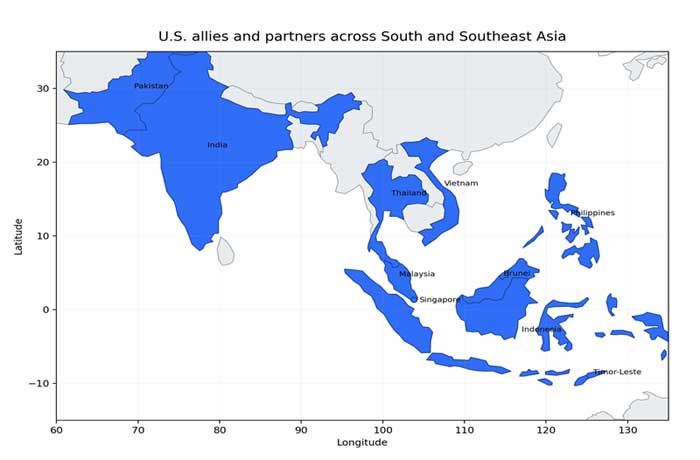
The Indo-Pacific is the main stage of this struggle. The region already represents a vast share of global production and trade, and its importance will only grow. Japan, South Korea, Australia, and the Philippines are formal pillars of the American position. India is not an ally in the treaty sense, but it is a crucial balancing power against China. Singapore is a small state with outsized logistical and strategic importance. Vietnam, Indonesia, Malaysia, and Thailand each move with their own caution, but none can ignore the pressure created by Chinese power in the South China Sea. Even Pakistan, complicated and often ambiguous, remains part of the wider map of U.S. strategic relationships in South Asia.
Taiwan is the point where geography and technology meet. It is not merely a symbol of democracy or a disputed island off the Chinese coast. It sits at the center of advanced semiconductor production and occupies a position that affects access to the first and second island chains. If Beijing could break Taiwan’s autonomy by force or intimidation, the effect would not be local. It would reorder the balance of maritime Asia, frighten American partners, and give China a far stronger hand over the Western Pacific. This is why the 2025 strategy treats deterrence over Taiwan as a central priority while maintaining the traditional U.S. position against unilateral changes to the status quo.
The South China Sea is the other essential piece. A hostile power able to dominate those waters would not simply control a few reefs and artificial islands. It would acquire leverage over one of the busiest arteries of global commerce. For Southeast Asian states, this is not an abstract problem. It concerns fishing grounds, energy exploration, naval access, trade, and sovereignty. For the United States, it concerns freedom of navigation and the credibility of its regional order. If American power were truly disappearing, regional states would quietly adapt to Chinese primacy. Instead, many are hedging, balancing, rearming, or deepening cooperation with Washington in different ways.
At this point, critics often invoke overstretch. They say America cannot manage the Gulf, Europe, and Asia at once. There is a serious argument here, but it should not be exaggerated. The United States does carry heavy burdens, and the 2025 strategy itself reflects a desire to force allies to do more. Yet American power is not just the number of soldiers it can deploy. It is a network: bases, currencies, universities, venture capital, intelligence partnerships, aircraft carriers, sanctions, software, energy markets, defense contractors, diplomatic habits, and institutional memory. China has become a formidable competitor, but it has not built anything comparable to this ecosystem.
Europe, for all its talk of strategic autonomy, confirms the point. Its security architecture remains tied to the United States. Its defense industry is fragmented. Its political will is uneven. Its approach to China has moved from commercial enthusiasm toward risk reduction, but it still lacks a unified strategic spine. The result is that Europe may complain about Washington, bargain with Washington, and sometimes resent Washington, but it still relies on Washington when the question becomes deterrence, intelligence, and hard security.
This does not mean the United States can do whatever it wants. It cannot. Its relative advantage has narrowed. Its allies are more demanding. Its rivals are more capable. The age of effortless dominance is over. But there is a difference between the end of effortless dominance and the end of dominance itself. The current world is not post-American. It is an American-centered order under strain.
That is precisely what makes the 2025 National Security Strategy important. It is not a sentimental document. It does not pretend that every problem in the world is an American mission. It asks what matters most, what can actually be done, and which dependencies have become dangerous. In doing so, it makes the anti-Chinese turn more concrete. The United States is not simply trying to lecture Beijing or surround it with slogans. It is trying to deny China the conditions that would allow it to become the organizing power of the next century.
From this perspective, the Gulf and the Indo-Pacific are not separate theaters. They are connected by energy, shipping, technology, and deterrence. The Gulf supplies the Asian industrial machine. The South China Sea carries the trade that feeds the global economy. Taiwan anchors the semiconductor balance. Europe remains dependent on the American security umbrella. And across all these fronts, the United States continues to act as the central organizer of response, reassurance, and resistance.
So the question is not whether America is weaker than it was in 1992. Of course it is, in relative terms. The real question is whether any rival has replaced it. The answer is no. China is powerful, but it is also constrained by geography, demography, energy dependence, nervous neighbors, and a still incomplete alliance network. Russia can disrupt but not lead. Europe can regulate but not defend itself alone. The Gulf can bargain but not guarantee its own security. The Indo-Pacific can balance, but only if the United States remains present.
This is why the language of American decline is often more slogan than diagnosis. The United States is not retreating from history. It is trying, unevenly and sometimes brutally, to reorder its priorities around the one challenge that matters most: preventing China from turning economic weight into strategic supremacy. As long as the world’s decisive crises still require an American answer, the obituary can wait.