Polygon still has one of the strongest names in Ethereum scaling, but its token story has changed.
MATIC was upgraded 1:1 to POL in September 2024, and Polygon later said 99% of MATIC on the Polygon network had migrated, with POL now used as the native gas token on Polygon PoS.
That matters for any Polygon price prediction in 2026.
Many traders still search for MATIC because the old ticker is widely known, but the live token story now centers on POL, its market price, and whether Polygon can rebuild stronger momentum.
Stay ahead of the geopolitical week.
MD Briefing delivers expert analysis across five global fronts — the Indo-Pacific, energy, geoeconomics, European security, and the Middle East — every Monday morning. Free.
Meanwhile, Poly Truth is gaining attention from traders watching newer crypto projects tied to AI-style data analysis and prediction markets.
How Polygon Is Trading in May 2026
CoinCodex recently listed Polygon near $0.098, down 2.29% over 24 hours. Its short-term model showed a 5-day target near $0.09492 and a 1-month target near $0.08725, which points to a soft near-term setup.
The same page showed bearish sentiment, a Fear & Greed score of 42, and high volatility at 5.02%. That does not mean POL has no upside, but it shows why traders are cautious around the token right now.
Can Polygon Recover From Here?
Polygon has the network base to stay relevant. It remains tied to Ethereum scaling, apps, payments, and the wider Polygon ecosystem.
However, the token price still needs stronger demand. CoinCodex forecasted Polygon at $0.09524 by the end of 2026, slightly below its listed current price, while its 2026 trading range sat between $0.06917 and $0.09762.
Kraken’s POL price tool gives a slower long-term view when using a 5% yearly growth setting. It shows POL at
- $0.10 in 2027
- $0.12 in 2030
- $0.16 in 2036
- $0.20 in 2041
While noting that the figures come from the selected growth rate rather than a future price signal.
Why the MATIC to POL Shift Still Matters
The MATIC-to-POL upgrade was more than a ticker change. POL became the native gas and staking token for Polygon PoS, while the upgrade also opened the door to a broader role across Polygon’s cross-chain plans and Agglayer roadmap.
That gives POL a cleaner utility role inside Polygon. It also means the market is no longer judging the token only by the old MATIC story.
Still, price recovery takes time. Token migrations can update the technical setup, but they do not always create fast price demand on their own.
For POL, traders may want to see stronger network use, more app activity, and a clearer reason for capital to rotate back into Polygon-linked assets.
Why Traders Are Looking Beyond Older Layer 2 Tokens
The broader market has changed since MATIC’s strongest cycle. Ethereum scaling is more crowded, newer Layer 2 networks are competing for users, and traders are also watching AI, data, and prediction market themes.
That shift does not remove Polygon from the conversation. It simply means POL now competes for attention against projects with newer stories and smaller starting valuations.
As traders compare older infrastructure tokens with newer crypto ideas, $PTRUE is gaining attention for a different reason. It is tied to prediction market intelligence, where the goal is to help users read event data with more context.
How $PTRUE Brings a Different Market Angle
Poly Truth is not trying to compete with Polygon as an Ethereum scaling network. It targets a more focused area of crypto, where prediction events move on sports, politics, crypto prices, and real-world news.
Its system uses three parts to make that idea easier to follow.
- The Runners collect data from active prediction events.
- The Starlet compares sources, finds patterns, and calculates probability scores.
- The Presenter turns the data into a clear event report with a stronger outcome and reasoning.

That makes $PTRUE different from POL. Polygon is an infrastructure play with a mature market history. Poly Truth is an early-stage AI-linked project built around data, odds, and decision support.
Poly Truth Tokenomics and Roadmap
$PTRUE has a total supply of 11.5 billion tokens. The token split gives the presale the largest share, while also setting aside supply for liquidity, development, staking, marketing, and community growth.
- Presale: 40%
- Liquidity pool: 17%
- Development: 13%
- Team: 10%
- Staking rewards: 10%
- Marketing: 8%
- Community and airdrops: 2%
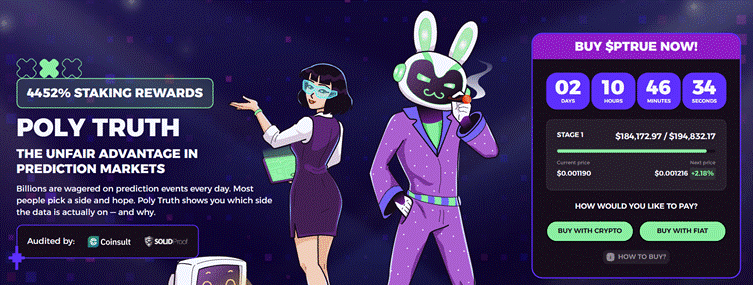
Poly Truth also lists 4,452% staking rewards, an Ethereum token address, and audit logos from Coinsult and SolidProof on its website.
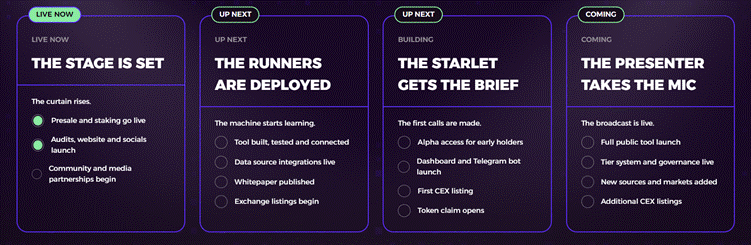
Its roadmap starts with presale and staking, then moves toward data source integrations, whitepaper publication, exchange listings, alpha access, a dashboard, Telegram bot, token claim, public tool launch, governance, new markets, and added listings.
Polygon vs. $PTRUE in 2026
Polygon and Poly Truth sit in different parts of the market. POL has a history, network use, and a known role in Ethereum scaling. $PTRUE has a newer story tied to prediction markets and AI-style data analysis.
For traders focused on a Polygon price prediction, the main question is whether POL can regain demand after the MATIC migration and a long price decline. Current forecasts from CoinCodex and Kraken point to slower movement rather than a sharp recovery.
Meanwhile, Poly Truth gives traders another type of setup. It does not depend on Layer 2 competition. It depends on the growing need for clearer information in markets where events move quickly, and data is scattered.
What Comes Next for Polygon and New Data-Led Tokens
Polygon still has a serious role in crypto infrastructure, but POL needs stronger market demand to turn that role into price growth.
The token’s near-term forecasts remain cautious, and its long-term path may depend on Polygon’s ability to bring more users, apps, and activity back into the ecosystem.
However, the search for newer crypto narratives is also growing. Poly Truth fits that shift because $PTRUE is connected to prediction intelligence, a category built around data, probability, and fast-moving events.
The Polygon price prediction debate is no longer only about whether MATIC, now POL, can recover. It also shows why traders are comparing older infrastructure tokens with newer projects like Poly Truth, where the story is simpler, fresher, and tied to how crypto users read the market in 2026.