


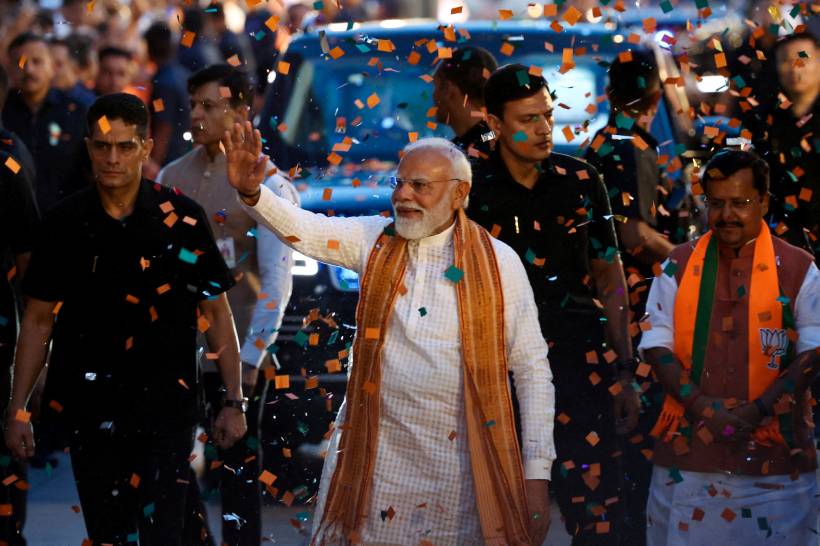
Recent state election results in India have revealed deepening religious polarisation in the country’s political landscape, with Hindu voters strongly backing Prime Minister Narendra Modi and Muslim voters increasingly consolidating behind the opposition Indian National Congress party.
Political analysts say the trend reflects a widening ideological divide between India’s two largest political forces and highlights how religion continues to shape electoral politics in the officially secular nation.
Modi’s Bharatiya Janata Party has promoted a Hindu nationalist platform since coming to power in 2014, drawing broad support from the country’s Hindu majority, which makes up nearly 80 percent of India’s population. Muslims account for around 14 percent of the country’s 1.42 billion people.
Muslim Voters Shift Towards Congress
Analysts say Muslim voters are increasingly rallying behind Congress and other major regional parties rather than smaller Muslim focused political groups that have struggled to gain influence at the national level.
Stay ahead of the geopolitical week.
MD Briefing delivers expert analysis across five global fronts — the Indo-Pacific, energy, geoeconomics, European security, and the Middle East — every Monday morning. Free.
Political analyst Rasheed Kidwai described the development as a form of “reverse polarisation,” arguing that the rise of the BJP has encouraged Muslim communities to unite behind parties seen as capable of challenging Modi’s dominance.
The trend was particularly visible in the northeastern state of Assam, where Congress secured strong Muslim support. Eighteen of the party’s nineteen newly elected lawmakers in the state belong to the Muslim community.
Meanwhile, the Assam based All India United Democratic Front, which traditionally relied heavily on Muslim voters, saw its representation collapse from sixteen seats to just two.
BJP Expands Hindu Support Base
The BJP and its allies performed strongly in the recent elections, winning control of three states while Congress and its alliance managed to secure only one.
In West Bengal, the BJP achieved a major breakthrough by winning the state for the first time with 207 lawmakers in the 294 member assembly.
The BJP did not field any Muslim candidates in either Assam or West Bengal, underscoring its reliance on Hindu voter consolidation.
Senior BJP leader Suvendu Adhikari openly described the party’s victory as a triumph for Hindutva, the Hindu nationalist ideology closely associated with the BJP and its wider ideological network.
Congress Rejects Religious Politics Allegation
The BJP has frequently accused Congress of appealing excessively to Muslim voters and labelled it a “new Muslim League,” a reference to the political movement associated with the partition of British India in 1947.
Congress leaders reject the accusation and argue the party continues to represent a broad cross section of Indian society.
Congress spokesperson Pawan Khera said the party’s elected representatives reflect India’s religious diversity and insisted Congress stands for disadvantaged communities regardless of religion or caste.
Debate Over India’s Political Identity Intensifies
Critics and analysts say communal rhetoric has become increasingly prominent under Modi’s leadership, especially during election campaigns.
Political commentator Radhika Ramaseshan argued that the BJP and its ideological allies are reshaping public discourse around the concept of India as a Hindu nation.
Supporters of the BJP, however, maintain that the party’s popularity reflects development focused governance and strong national leadership rather than religious polarisation.
Modi himself has repeatedly denied using religion as a political tool and previously stated that engaging in Hindu Muslim politics would undermine his credibility as a leader.
Political Polarisation Likely to Continue
The latest election results suggest that religious identity is becoming an increasingly powerful factor in India’s electoral politics.
Analysts warn that continued consolidation of Hindu voters around the BJP and Muslim voters around Congress could deepen social and political divisions in the years ahead.
At the same time, the trend may further strengthen the BJP’s electoral advantage due to the country’s demographic realities, potentially reshaping India’s political landscape for the foreseeable future.
With information from Reuters.
