


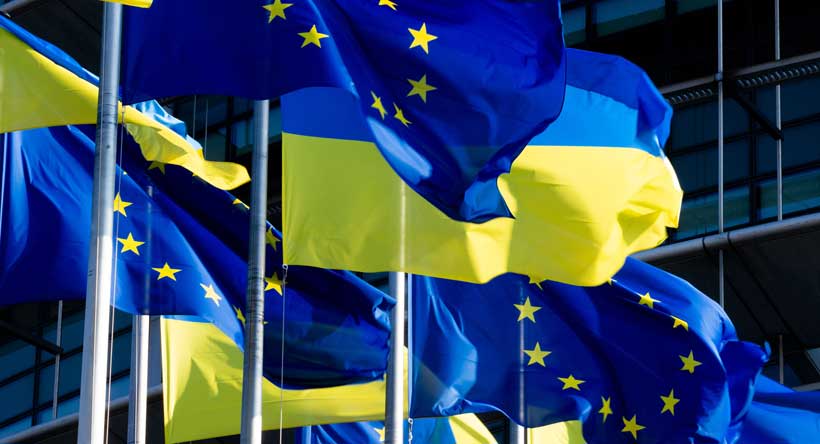
The European Union has formally approved a €90 billion financial package for Ukraine alongside its 20th round of sanctions against Russia. The decision comes at a critical moment in the war, as Ukraine faced the risk of running out of funds by mid year without external support.
The agreement was initially delayed due to a veto by Hungary, but consensus was reached, allowing the package to move forward ahead of an informal summit in Cyprus attended by Volodymyr Zelenskiy.
The loan is designed to cover approximately two thirds of Ukraine’s financial needs over the next two years, ensuring continuity of both government operations and wartime spending.
Structure of the Financial Package
The €90 billion loan will be distributed over several years rather than immediately. Around half of the funds will be released this year, while the remainder is expected later in the decade.
Stay ahead of the geopolitical week.
MD Briefing delivers expert analysis across five global fronts — the Indo-Pacific, energy, geoeconomics, European security, and the Middle East — every Monday morning. Free.
A significant portion of the funding will go toward military expenditure, while roughly €17 billion annually is allocated to civilian needs such as healthcare, education, and public administration.
This dual allocation highlights the challenge Ukraine faces in sustaining both its war effort and basic state functions simultaneously.
Expansion of Sanctions
Alongside financial assistance, the EU has reinforced its economic pressure on Russia through its 20th sanctions package. These measures are part of a long term strategy to weaken Russia’s war economy rather than deliver immediate results.
The continued rollout of sanctions indicates that the EU remains committed to isolating Russia economically, even as the conflict stretches into a prolonged phase.
Strategic Context
The decision reflects broader geopolitical pressures beyond the Ukraine conflict. Rising tensions in the Middle Est, particularly linked to the Iran war, have raised concerns within Europe about energy security and inflation.
In response, the European Commission is focusing on preventive measures such as coordinating gas storage and managing electricity costs. Unlike in 2022, the EU is currently avoiding more aggressive interventions like price caps or windfall taxes on energy companies.
This suggests a more cautious and calculated approach aimed at balancing external commitments with internal economic stability.
Analysis
The approval of this package underscores the EU’s long term commitment to Ukraine, both financially and politically. By stepping in at a moment of fiscal urgency, the EU has effectively prevented a potential economic breakdown in Ukraine that could have undermined its war effort.
At the same time, the reliance on loans rather than grants raises questions about Ukraine’s future financial burden. While the immediate crisis is addressed, long term sustainability remains uncertain.
The persistence of sanctions also highlights a shift in strategy. Rather than expecting rapid economic collapse in Russia, the EU appears to be pursuing gradual economic attrition. This approach requires sustained unity among member states, which has already proven challenging.
Overall, the move signals that the EU views the conflict not as a short term crisis but as an extended geopolitical confrontation requiring consistent financial support, economic pressure, and internal resilience.
