


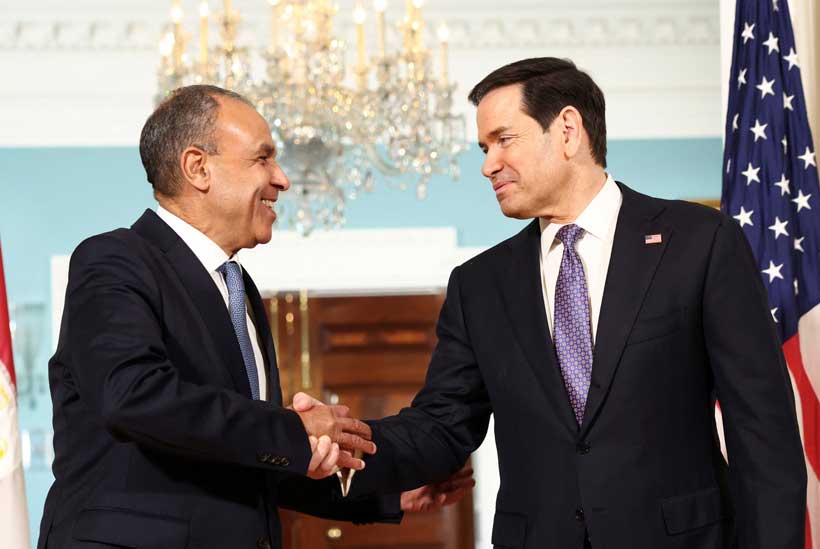
Chinese media and think tanks focused on the Middle East paid close attention to the talks between Egyptian Foreign Minister Badr Abdel-Aty and his American counterpart Marco Rubio in Washington on April 14, 2026. Beijing views the stability of the Middle East as a cornerstone of its national security and the success of its Belt and Road Initiative. China emphasizes that the Egyptian foreign minister’s visit to Washington and his meeting with Rubio in April 2026 were part of the necessary diplomatic efforts to de-escalate tensions in the Middle East, particularly the Iranian conflict, an objective in which Beijing actively participates. This meeting came at a sensitive time, marked by escalating military tensions in the region. The discussions between Abdel-Aty and Rubio focused on the issues of a ceasefire in Gaza and Sudan and securing international navigation, matters of paramount importance to Chinese national security and the Belt and Road Initiative. The Chinese perspective on this Egyptian diplomatic initiative is embodied in its support for the glimmer of hope for negotiation. Chinese Foreign Minister Wang Yi described the signals emanating from the region regarding the desire to end military conflicts as a glimmer of hope, emphasizing during his communication with the Egyptian side that Beijing supports diplomatic efforts aimed at restoring peace. This coincided with Egyptian-Chinese coordination, as close consultations between Cairo and Beijing preceded Egyptian Foreign Minister Badr Abdel-Aty’s visit to Washington. Foreign Minister Wang Yi held a telephone conversation with his Egyptian counterpart Badr Abdel-Aty immediately before the latter’s visit to Washington, expressing China’s support for Egypt’s balanced role in the region and its rejection of any escalation that could destabilize global energy supplies.
Here, China is relying on Egyptian mediation efforts in Washington to reaffirm a joint Egyptian-Chinese rejection of the US blockade policy. While China welcomes any diplomatic solutions that might emerge from the Egyptian-American meeting, it has simultaneously warned against escalating US actions, such as the US naval blockade of the Strait of Hormuz, describing them as dangerous and irresponsible. China also welcomes Egypt as a strategic gateway to play a crucial mediating role in preventing the situation from deteriorating further. China views Egypt as a reliable partner that adopts a policy of strategic balance and believes that the strength of Egyptian-American relations does not contradict the comprehensive strategic partnership between Egypt and China but rather contributes to creating a balance that achieves regional stability.
We can analyze the Chinese perspective on the main issues under discussion between the Egyptian and American foreign ministers by examining China’s interest in the talks regarding a ceasefire in Gaza. Chinese think tanks analyze Egyptian-American moves from the perspective of the necessary stability for economic development in the region, while supporting Egyptian mediation efforts. China, through its official media outlets such as Xinhua and CGTN, has praised Egypt’s pivotal role as a strategic partner with a shared vision with Beijing in prioritizing diplomacy over escalation. China is focusing on the two-state solution talks between Palestine and Israel within the framework of Egyptian-American discussions. Here, Chinese think tanks, such as the Middle East Institute for International Studies, emphasized that any Egyptian-American coordination must ultimately lead to a two-state solution and the establishment of an independent Palestinian state. They warn against settling for temporary security solutions that could threaten Chinese trade routes in the future. Chinese analysts and think tanks tend to monitor US Secretary of State Rubio cautiously, given his historically hardline positions, and favor the Egyptian approach, which seeks a comprehensive truce that guarantees the flow of humanitarian aid, a goal that aligns with China’s ongoing aid to Gaza.
Here, the issue of international navigation and Red Sea security is considered a top priority for China due to its direct link to the Suez Canal and the maritime corridor of China’s Belt and Road Initiative, aimed at securing the Maritime Silk Road. Chinese think tanks believe that the discussions between Abdel-Aty and Rubio regarding maritime security should not devolve into exploratory military alliances that disrupt trade. China prefers a cooperative security model based on shared and sustainable security, while consistently emphasizing the preservation of the Egyptian Suez Canal. There is growing Chinese concern about any proposed alternative routes, such as Israel’s Ben Gurion Canal. Therefore, Beijing supports any Egyptian-American effort to de-escalate tensions in the Bab El-Mandeb Strait and the Red Sea to ensure the Suez Canal remains the primary artery for Chinese trade with Europe.
Stay ahead of the geopolitical week.
MD Briefing delivers expert analysis across five global fronts — the Indo-Pacific, energy, geoeconomics, European security, and the Middle East — every Monday morning. Free.
China also took great interest in the file of the crisis in Sudan and the joint Egyptian-Chinese interest in it, as Sudan is viewed by China as the gateway to the Belt and Road Initiative in East Africa, with China rejecting foreign intervention in the Sudanese crisis. Here, the Chinese media supported the Egyptian position, which was emphasized by the Egyptian Foreign Minister Badr Abdel-Aty, regarding the need to respect the sovereignty of Sudan and its national institutions, a position that is completely in line with the Chinese Five Principles of Peaceful Coexistence. With the interest of relevant intelligence, military, defense, and security circles in Beijing in the political track for resolving the Sudanese crisis, a large number of Chinese think tanks concerned with the Middle East have observed these Egyptian moves, which are consistent with and similar to China’s political positions. Among the most prominent of these Chinese think tanks are
) The Center for China and Globalization Studies (CCG), The China Institute of Middle Eastern Studies (IMES), The China Institutes of Contemporary International Relations (CICIR), China-Arab Network of Schools of Public Policy and Administration (CANSPPA), The Center for Middle Eastern Studies at China Foreign Affairs University, The Center for Middle Eastern Studies at Fudan University, The China Institute of International Studies (CIIS), as an official Chinese research center affiliated with the Chinese Ministry of Foreign Affairs in Beijing)
All these aforementioned Chinese think tanks concerned with the Arab world and the Middle East are monitoring such Egyptian foreign policy moves, especially towards Washington, to assess their impact on the regional balance and the competition between major powers in the Middle East. They all believe that stability in Sudan, on Egypt’s southern border, is essential to protecting Chinese investments in the energy and infrastructure sectors, and they welcome Egyptian-American coordination if it leads to a humanitarian truce in Sudan, paving the way for a comprehensive political process.
For this reason, China’s overall strategic vision is focused on this issue, as analyzed by a number of Chinese think tanks concerned with the Middle East, most notably the Institute of Middle East Studies at Shanghai International Studies University (SISU), which believes that Egypt’s move to diversify its partnerships between Washington and Beijing grants Cairo a role as a regional center of gravity. Hence, China does not see the current Egyptian-American talks as a threat to its interests but rather considers them a stabilizing factor that may reduce the costs of protecting its investments in the region as long as they adhere to the rules of international law and do not target growing Chinese influence. Accordingly, this Chinese perspective indicates a fundamental shift in Egyptian foreign policy, as Chinese think tanks believe that Cairo is no longer content with traditional alliances but is adopting a strategic balancing policy. According to this Chinese interpretation, Egypt’s success in maintaining close relations with Washington (as a security and military partner) in parallel with deepening the comprehensive partnership with Beijing (as an economic and technological partner for Cairo) brings it several gains, in terms of strengthening Egyptian independence by reducing excessive dependence on a single power, thus granting Egyptian political decision-making greater flexibility. With attention, China views Egypt’s regional leadership as crucial, as its transformation into a bridge connecting major powers and regional interests underscores its importance to China as an indispensable center of gravity in Middle Eastern and African affairs. Therefore, Chinese circles analyze the importance of diversifying Egyptian relations and partnerships with the United States and the West as a multiplier for attracting investments to Cairo, thus enabling Egypt to benefit from China’s Belt and Road Initiative in infrastructure projects and the Suez Canal, while ensuring the continued flow of Western aid and investment.
