


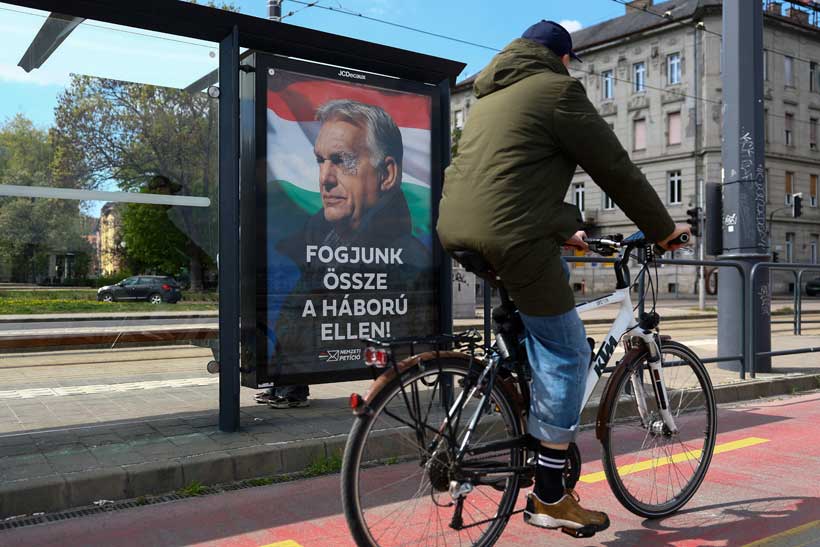
On the 12th of April, Hungarians head to the polls in what is being called their most important election. Being a foreign national in Hungary’s election season is fascinating for a host of reasons, the two biggest being these. The first is that when living as a foreign national in an increasingly anti-immigration state, you are acutely aware of how big an impact the possible outcome may have on you. The second is that your gateway into elections is through the very many posters thrown up all over cities and from what you are able to read on the few news sites that write for an English audience.
Having been studying in Hungary for a little over five years, I have become somewhat familiar with Hungarian politics via the methods that history has shown to be the most reliable: being a cautious participant of beer-fueled political discussions between colleagues in dimly lit pubs, extended debates with people I know to be opposition members in the aisles of department stores, and impromptu talks with Hungarians in train cabins carried by Hunglish, Google Translate, and charades (this last one the lingua franca of internationals in any foreign country). In many cases my being South African is what sparks political conversation with strangers (it would seem South Africa is something of a celebrity among those who are familiar with it). One time, when having my passport checked at the Polish border, three officers held onto it while talking amongst themselves—in Polish—for over five minutes. My friend and I thought I was being detained. It turned out one of them was telling his colleagues that South Africa has two countries inside its borders, and the other two did not believe it.
Even though the entirety of this election is conducted in Hungarian, there is one thing that stands out: a serious sense of déjà vu at how similar the electoral atmosphere is between the two countries, in terms of visible popular narratives and maybe even likelihood of outcomes.
For those unaware, Hungary is a largely mono-ethnic state somewhere in Central Eastern Europe or just Eastern Europe (depending on who you ask) that is slightly smaller than the South African province of KwaZulu-Natal in terms of area and population. Despite the very obvious differences in size and make-up, both countries share a particular political condition that is maybe the most important thing for our conversation: a political landscape intertwined deeply with the events of the past and the experience of democratic transition followed by the immediate entrenchment of a single dominant party.
Stay ahead of the geopolitical week.
MD Briefing delivers expert analysis across five global fronts — the Indo-Pacific, energy, geoeconomics, European security, and the Middle East — every Monday morning. Free.
Hungary’s story, in its broadest strokes, is one of a small nation perpetually caught between larger powers. Between the thirteenth and nineteenth centuries, they were conquered first by the Ottomans and then absorbed into the Habsburg Empire. After being pulled into the First World War as a German ally and losing, the Treaty of Trianon in 1920 redistributed two-thirds of Hungary’s territory and the ethnic Hungarians who inhabited it to what are now Croatia, Serbia, Bosnia, Slovakia, Romania, and Ukraine. It is, to put it plainly, the kind of national trauma that does not go away. Hungary was then invaded by Germany in 1944 in an effort to maintain its loyalty, only to be occupied shortly after by the Soviets who replaced the German forces they had expelled. The 1956 Uprising—a popular revolt against Soviet-imposed communist rule—was crushed by the Red Army, becoming one of the defining wounds of the Cold War era and a moment that, as we will see, never really left Hungarian political life. Hungary remained a Soviet satellite until 1990, when it transitioned and held its first free multiparty elections four years before South Africa.
South Africa’s political history is shaped by something different but not entirely dissimilar in feeling: not conquest from outside so much as racialised dispossession from within. Apartheid, formalized after the National Party’s 1948 election win but rooted in a much longer history of colonial land appropriation and racial classification, subjected the Black majority to one of the most thoroughly documented systems of institutionalized oppression of the twentieth century. The African National Congress, founded in 1912, became the primary vehicle of the liberation movement, spending much of the apartheid era operating from exile or underground after its banning in 1960. The Soweto Uprising of 1976, in which schoolchildren took to the streets against the imposition of Afrikaans as a language of instruction and were met with live ammunition, became, like 1956 in Hungary, a generational wound and a symbol of a people standing up against a state that had turned against them. Decades of internal resistance, international pressure, and economic isolation eventually brought the apartheid government to the table. The unbanning of the ANC and the release of Mandela in 1990 set in motion the transition that ended with the first democratic election in April 1994 the moment that, for a generation of South Africans, everything before had been pointing toward.
Now, the parallels here are worth naming directly because I think they are easy to miss if you are only looking at the surface. Both countries carry a history of a people under domination, occupation, and partition in Hungary’s case and systematic racial subjugation in South Africa’s. Both have histories marked by popular uprisings violently suppressed by the state: 1956 in Budapest and 1976 in Soweto. Both transitioned to democracy within four years of each other, arriving at multiparty elections with the full weight of that history still very much alive. And both transitions produced, almost immediately, the dominance of a single party that claimed, with real justification, at least at the time, to be the rightful custodian of the national story, the political vehicle through which the country’s long suffering had at last been redeemed.
Since 1994 the ANC has been at the pinnacle of South African politics, and, even though it lost its outright majority in 2024, it remains the dominant force in the Government of National Unity. Fidesz has enjoyed similar dominance since 2010, sustained partly through its alliance with the KDNP, an arrangement that functions, in practice, not entirely unlike the ANC’s tripartite alliance with the SACP and COSATU.
But the parallels go further than shared timing, and this is where it starts to get interesting.
The first and most important is the relationship both parties built between themselves and the national story. The ANC did not merely win the 1994 election; it inherited the moral authority of the liberation struggle and positioned itself as the only credible custodian of South Africa’s democratic future. To vote ANC was, for a generation, not really a partisan choice at all; it was an act of loyalty to everything the struggle had meant. Fidesz constructed something very similar, just with different raw materials. Orbán’s rise to political prominence is inseparable from the 1989 reburial of Imre Nagy at which a twenty-six-year-old Orbán stood before hundreds of thousands of people and demanded the withdrawal of Soviet troops. At a moment when the outcome of the transition was still genuinely uncertain, it was an extraordinary thing to do, and it became the founding myth of his political identity. What followed, under Fidesz’s extended rule, was a sustained program of historical reclamation: statues, monuments, the renovation of public spaces in the language of national memory, and a retelling of Hungary’s centuries of occupation and humiliation as the story of a people who have always, against all odds, fought for their freedom. The Trianon settlement operates in this narrative as the defining national wound, kept open not to relitigate old borders but to sustain a particular feeling: Hungary as a country perpetually encircled, perpetually underestimated, perpetually required to defend itself against forces that would diminish it. Opposition politicians are framed as sympathizers of the old communist regime. Confrontations with Brussels become the modern equivalent of 1848 or 1956. The party and the national story are made, over time, very hard to tell apart.
The ANC ran the same operation, just with different material. Apartheid’s brutality needs no embellishment, and its memory remains a powerful political resource for any party that can credibly claim to have ended it. For a long time, criticism of the ANC could be effectively neutralized by framing it as disloyalty to the liberation, a suggestion that to question the party was to side, in some sense, with those who had done the oppressing. It is a remarkably effective political inoculation, and it holds as long as the generation for whom that history is personal experience remains the majority of the electorate. The question in South Africa, as in Hungary, is what happens when that generation is no longer the one doing the voting.
The second parallel is how both parties handled internal dissent. The ANC’s culture of discipline, resolving disputes inside the party before they reached the public and treating open criticism as something close to betrayal, kept a lid on fractures for longer than was probably healthy. Fidesz managed it with a harder edge: critics do not just face social pressure; they risk losing access to the patronage networks in media, business, and local government that a decade and a half in power have made very extensive. In both cases, loyalty was rewarded materially, and the cost of speaking out was real and visible. In both cases, this worked until it produced individuals for whom the cost of staying silent finally outweighed the cost of saying something.
There is a facet of this election that has repeatedly made me snap my fingers and say, “I have seen that before.” It is one surrounding a vibrant young man, once a member of the leading party, who eventually became tired of its greed, its alleged corruption, and its grip on everything; who broke publicly and loudly; made his grievances a matter of national spectacle rather than internal procedure; and, in doing so, lit a political fire that nobody in the establishment had seen coming. This is none other than Ju—I mean, Péter Magyar, now the effective leader of the Tisza Party.
The comparison with Julius Malema and his Economic Freedom Fighters is imperfect, as all comparisons are, and it would be unfair to flatten the very real ideological distance between them. Malema’s break was about redistribution, nationalization, and land, the language of economic liberation for the Black majority. Magyar’s is about institutional reform, rule of law, anti-corruption, and a centrist vocabulary aimed at a European electorate. They are not the same.
But the structural story of how they got here is remarkably similar. Both men came from inside the establishment they went on to indict. Malema was ANC Youth League president, not a critic from outside but a creature of the party’s own machinery, celebrated and deployed by the same leadership that would eventually expel him. Magyar was a Fidesz-aligned figure, embedded in the party’s networks, until a personal and political rupture, a scandal involving his then-wife, a government minister, and allegations of a cover-up of abuse at a children’s home pushed him out and into the open. In both cases what gives the criticism its power is precisely the former proximity to power. These are not people pointing at a system from a distance. They are people describing from the inside a system they were once part of. That is a different proposition entirely, and a more uncomfortable one for the party being described.
Both also understood, whether by instinct or design, that the moment of break needed to be staged in a way that matched its significance. Malema launched the EFF at Marikana, a site so symbolically loaded it required no explanation. Magyar held his first major rally on the 15th of March, Hungary’s commemoration of the 1848 revolution against Habsburg rule, the single date in the Hungarian calendar most associated with popular resistance to foreign domination. That Tisza’s largest march in recent memory fell on this date was not a coincidence. It was a statement, legible to every Hungarian who showed up, that this was not just another opposition campaign but something closer to a new independence movement. A power move with the same instinct for political theater that made the EFF’s founding moment so hard to ignore.
The support bases they built also have a familiar shape. Tisza draws from younger, urban, university-educated voters frustrated with a system that feels closed, captured, and uninterested in their futures. The EFF built its initial base from young, economically excluded South Africans who had grown up in the post-apartheid democracy and found its promises mostly unfulfilled. The specific complaints are different: Magyar’s voters worry about institutional decay and constitutional erosion; Malema’s worry about land, unemployment, and structural economic exclusion. Yet the emotional register is the same: these are voters for whom the dominant party no longer represents liberation or progress but simply the perpetuation of a class of people who got comfortable and stopped looking back.
Magyar has also been described as good at retail politics, what we would call working the ground. He travels to villages, holds town hall meetings, shakes hands, and talks to people. It sounds simple, but it is exactly the kind of thing that both the ANC and Fidesz, in their long periods of institutional comfort, quietly stopped doing. There is something telling in the fact that what makes both challengers feel new is not really their ideology but their manner, the basic willingness to show up and act like the vote is something that has to be earned.
Whether Magyar ends up achieving what Malema has not actually achieved in government will depend less on how popular he is and more on the institutional terrain his popularity has to cross. Malema’s EFF has been a real force in South African politics for over a decade but has not been able to turn that into governing power without partners whose politics make the combination unworkable. Magyar faces a different but equally serious problem: an electoral system that was designed, in considerable part, to make it difficult for a challenger to convert a national lead into a parliamentary majority. He can be ahead in every poll and still lose if the constituency map and the mechanics of the mixed-member system absorb the gap before it becomes seats.
What both figures represent, though, is something worth holding onto: dominant-party systems do not only die slowly, worn down election by election. They can also be cracked open by a single person who, through the particular accident of their biography and a feel for political theater, turns a widespread but formless frustration into something with a name and a face. The ANC did not lose its majority because the EFF took it. It lost it because the EFF, among others, made it normal to imagine voting against the ANC without feeling like you were betraying something (not to mention the internal fracturing within the ANC that formed an entirely new party on the eve of the election). Whether Tisza does the same thing for Hungarian opposition politics or whether it breaks the psychological hold of Fidesz as much as the electoral one is maybe the most important question the 12th of April will answer.
And so here we are. Hungarians will vote in an election that will either show that dominant-party systems can be broken from within by the right person at the right moment or show that they cannot, at least not when the rules were written by the very party that benefits from them.
What I keep coming back to, watching this campaign from the specific vantage point of a South African living in Szeged, is how similar the two political cultures feel at the level of texture and atmosphere, even where the formal details are different. The sense in both countries is that the ruling party has become less a political organization than a feature of the landscape, something so present for so long that imagining it gone requires a kind of effort that has been, not accidentally, made to feel unreasonable. The way support for the opposition gets expressed in private, with real conviction, in a way that does not always show up where it counts. The posters, the marches, the energy on the streets, and underneath all of it, the same quiet and stubborn question: Is any of this going to be enough?
South Africa has already answered its version of that question. The ANC’s majority did not end because of one election, or one person, or one scandal. It ended because thirty years of declining performance, compounding inequality, and a generational shift in who South African voters are and what they remember slowly emptied out the legitimacy that 1994 had put in the bank. When it finally went, the system recorded it faithfully.
Hungary’s version of the question is still open. Magyar is not Malema; his politics are less radical, his obstacles are considerably more structural, and the system he is up against was built with exactly this kind of challenge in mind. But he is, like Malema was, the person who made a previously difficult thing feel possible: that the dominant party is not a permanent feature of the landscape, that its version of the national story is not the only one available, that the election could actually go the other way.
