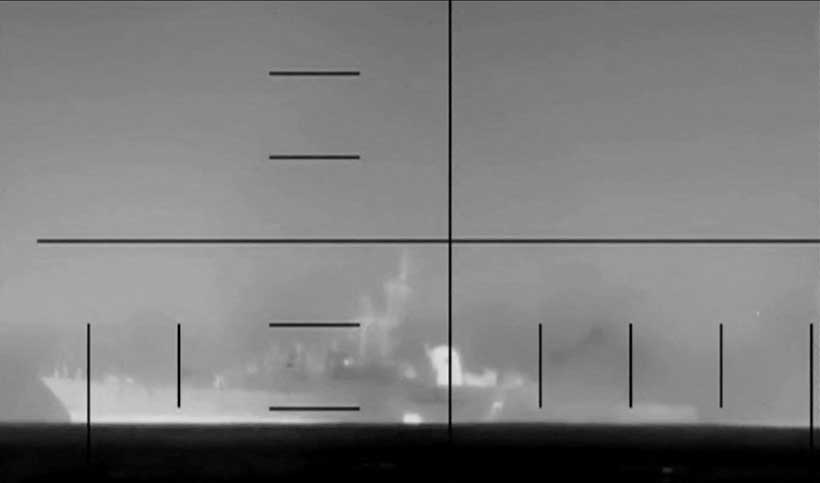
The US sinking of the Iranian warship IRIS Dena off Sri Lanka on 4 March was not just another incidents in the widening West Asian war. In fact it was a warning shot to the entire Indian Ocean Region. A conflict initiated far from South Asian and Indian Ocean shores spilled directly into the “oceanic space” that sustains the trade, energy, and security of littoral states from East Africa to Australia. Despite this the political response across the region was fragmented, and remained grim. This absence of unified Indian Ocean bloc highlights the lack maritime consciousness in Indian Ocean. Henceforth, the Indian Ocean is strategically shared but remain politically fragmented
Since Donald Trump has come to power his action throughout the year resemblance his innate desire to dominate. His recent misadventure in Iran is just another example among many. In fact the strike on IRIS Dena was not simply preemptive it was a projection of force intended to show that Washington could carry its war into any maritime theatre it chose, including waters that is far away from western hemisphere. An American political scientist Hans J. Morgenthau had a phrase for this kind of behavior in power politics – animus dominandi. The innate desire to dominate or “lust to power”. In his realist paradigm, politics is driven not merely by interest, but by the recurring human impulse to assert power over others, Rösch called it a Pouvoir that is ruthless and egoistic pursuit of the domination and power.
Moreover, this strike took place roughly 20 nautical miles west of Galle, in Sri Lanka’s search-and-rescue region. Sri Lanka responded responsibly, but narrowly that included rescuing survivors, handling bodies, granting visas to crew from another Iranian vessel, while stressing on humanitarian aid it maintained neutral foreign policy. Parallelly India did what a regional power should do in immediate operational terms – launching search-and-rescue efforts, allowing an Iranian vessel to dock in Kochi, and talking to Tehran about shipping safety and energy security. But all these were still state-by-state responses to this attack. Thus, they were reactive, not collective!
If one look at the Indian Ocean is not a small region rather it is where West Asian energy routes meet South Asian dependency, where extra-regional military power intersects with vulnerable littoral states. Today more than 80% of world trade by volume move by sea and here Strait of Hormuz alone handled about 20 million barrels of oil per day in 2024 along with it 84% of that crude and condensate goes to Asian countries’ market. In fact, around one-fifth of global LNG trade also passed through Hormuz. Here if conflict spills into the Indian Ocean, it does not threaten one coastline alone or the one country rather it imperils the shared economic lifeline of the entire Indian ocean rim.
Stay ahead of the geopolitical week.
MD Briefing delivers expert analysis across five global fronts — the Indo-Pacific, energy, geoeconomics, European security, and the Middle East — every Monday morning. Free.
This expansive connectivity represents a “network community” that demands a more robust “network strategy”. Evidently, this region is so deeply bound by sea-lanes, energy flows and maritime interdependence that it can no longer afford to respond as a set of disconnected national silos. Yet, here, the response to this incident was largely driven by states self-interest. Pakistan launched Operation Muhafiz-ul-Bahr to protect its shipping and energy flows. On the other hand Australia distanced itself from the attack even as it was drawn awkwardly into the story through AUKUS-linked personnel on the US submarine, and has since refused to send naval ships to help reopen Hormuz. The tragedy is that this fragmentation is not something new. The recent Mauritius-Maldives disagreement over Chagos is another reminder that the Indian Ocean’s small and medium states still struggle to imagine “Indian Oceanness” as a meaningful political identity. On 27 February, Mauritius suspended diplomatic relations with Maldives after Malé rejected Mauritian sovereignty over the Chagos Archipelago.
This is why the IRIS Dena episode should be read as more than an incident rather its I place where different identities, security, states interest converge but yet response remain fragmented. It exposed the political deficit at the heart of the Indian Ocean. But the public response to this crisis showed no equivalent regional political impulse. The region has mechanisms, meetings, declarations, and vocabularies of cooperation but what it lacks is a collective maritime consciousness and the role of “epistemic community” becomes more important for forging it . That consciousness must be built around a “will to resist” any form of “will to domination”. The sinking of IRIS Dena should therefore force a pressing question onto the regional agenda: can Indian Ocean states remain merely neighbours of one another, or will they finally become a political maritime collective? Until that shift happens, every appeal to regional stability will remain hollow. And every promise of a unified Indian Ocean response will remain grimly out of reach.