


China’s media and political discourse towards Israel in 2026 represents a strategic shift from positive neutrality to structural criticism, aiming to undermine public confidence in the Israeli government’s security and legal policies, especially after the military escalation with Iran and the Israeli Knesset’s passage of the law to execute Palestinian prisoners in March 2026. Here, China adopts a strategy of biased neutrality in dealing with current events in Israel, focusing its efforts on weakening the current Israeli government’s political position through soft power and targeted diplomatic and media discourse, particularly after the escalation with Iran and the passage of the law to execute Palestinian prisoners in March 2026. China’s role in influencing Israeli public opinion and pressuring the government is manifested through media discourse aimed at undermining confidence in the Israeli government, along with criticism of the political acumen of Benjamin Netanyahu’s government. Beijing has described the Israeli government as lacking political intelligence in its crisis management, which fuels internal criticism against Prime Minister Benjamin Netanyahu. China also holds the Israeli government responsible for the current escalation through its media platforms, such as Xinhua News Agency and CGTN. Through these platforms, China promoted a narrative that the Israeli government’s adventurous policies are the reason for dragging the region into war with Iran and failing to protect Israelis, thus deepening the divisions within Israeli society.
The Chinese political and media discourse has focused on delegitimizing the Israeli government’s suicidal choices. For example, statements by the Chinese Foreign Ministry, such as those made by spokesperson Mao Ning in March 2026, focus on portraying the government’s decisions as the Israelis view these actions as strategic errors that harm the security of the Israelis themselves. Beijing adopted a discourse warning Israeli public opinion of the catastrophic economic consequences and the collapse of supply chains resulting from a war with Iran, considering the military escalation a reckless adventure that serves the narrow political interests of the extreme right at the expense of the security of ordinary Israeli citizens. China also described the law allowing the execution of Palestinian prisoners as a flagrant violation of international humanitarian law and a policy of apartheid. Here, we observe that Chinese political and media discourse is not only addressing Palestinians but also sending a message to Israeli society itself, that these extremist and racist laws create a generation more determined to fight, which means a lack of future security for Israelis themselves.
Here, China, through its media outlets, exploited the law allowing the execution of Palestinian prisoners, issued at the end of March 2026 by the Israeli Knesset, to morally isolate the Israeli government and to mobilize the international community against it. With the Chinese government labeling the Tel Aviv government as practicing apartheid, China condemned the Israeli Knesset’s passage of the law to execute Palestinian prisoners in March 2016, deeming it a blatant application of apartheid policies.
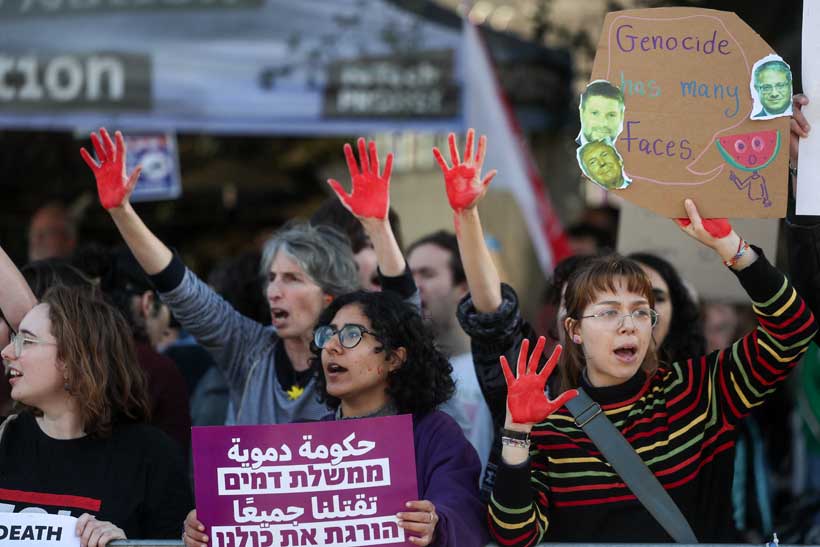
This coincided with China’s encouragement of the internal opposition in Israel. Here, China’s repeated condemnations aim to bolster the position of liberal and opposition forces within Israel who fear international isolation and the erosion of Israeli democracy, thus increasing public pressure on the governing coalition. China also exploited the escalation with Iran to undermine the Israeli government’s security credentials. China presented itself to the Israeli public and the international community as representing quiet diplomacy in contrast to Israel’s war machine, portraying itself as a voice of reason and a potential mediator, while describing the Israeli government’s actions as a flagrant violation of international law. China’s refusal to condemn the Iranian response, after Beijing refrained from directly condemning the Iranian attacks, further contributed to this situation. This led to a direct confrontation between China and the Israeli government regarding the mobilization of Israeli public opinion on the objectives of a potential war with Iran. The government of Benjamin Netanyahu, along with Israeli intelligence, military, defense, and security agencies, most notably the Mossad (Israel’s foreign intelligence agency) and the Shin Bet (Israel’s security service), worked to erode Israeli public trust in China (raising the percentage of Israeli citizens opposed to China’s policies toward Tel Aviv to over 54%, who currently view China as a hostile state). However, Chinese circles simultaneously sought to convey a message to the Israeli public that their government’s policies were causing Israel to lose important international allies.
Stay ahead of the geopolitical week.
MD Briefing delivers expert analysis across five global fronts — the Indo-Pacific, energy, geoeconomics, European security, and the Middle East — every Monday morning. Free.
China also attempts to exert indirect influence through digital platforms such as TikTok and other social networks. Reports indicate that China has used Chinese algorithms and digital platforms to disseminate content criticizing the Israeli government’s handling of the war and highlighting the losses resulting from its actions. China plays an active role in shaping digital narratives surrounding international conflicts, including the war in Gaza, through the use of various digital platforms and algorithms. This Chinese influence can be observed through algorithmic bias and the promotion of content that aligns with Chinese narratives and counters Israeli public discourse. Reports from the Network Contagion Research Institute (NCRI) indicate a high probability that TikTok amplifies content that supports the interests of the Chinese government, including content critical of Israel. Data shows that pro-Palestinian content on the platform far outnumbers pro-Israel content, sometimes by as much as 15 times. Studies have also identified organized Chinese digital influence campaigns aimed at portraying Israel and the United States as solely responsible for the suffering in Gaza, with the goal of weakening the US position internationally and increasing public pressure. With the promotion of the internal Chinese narrative regarding Israeli policies among the Chinese public, Chinese social media platforms like Weibo have witnessed an influx of anti-Israel content, sometimes including harsh rhetoric and criticism of the conduct of the war, with little intervention from the usually strict Chinese censorship. This suggests tacit support for this Chinese narrative to achieve strategic political goals for China, as promoting this content serves geopolitical objectives, including highlighting human and economic losses to embarrass Western allies and portraying Beijing as a champion of peace and international justice. On the other hand, TikTok has continued to deny these accusations of bias, asserting that the spread of content critical of Israel reflects the spontaneous views of its young users (especially in the West) and is not the result of deliberate algorithmic manipulation by China.
Here we observe the effectiveness and power of the Chinese media machine, a tool of soft power and direct influence. China employs a sophisticated media arsenal to reach the Israeli public through Hebrew-language Chinese channels. This is further evidenced by the continued activity of Chinese figures like Itzik the Chinese (Shi Xiaozhi) on China Radio International’s Hebrew-language service, who presents the Chinese perspective in fluent Hebrew, attempting to build a people’s bridge that transcends the Israeli government’s narrative. Israeli government reports, such as the report issued by the Israeli Institute for National Security Studies (INSS) in April 2025, indicate that Chinese-controlled social media platforms, such as Weibo and TikTok, along with other digital platforms and algorithms, have amplified content criticizing the Israeli government’s recklessness, highlighting internal protests in Tel Aviv to exacerbate societal divisions within Israeli society.
It is noteworthy that Chinese media outlets link security and economic growth in their messaging to the Israeli public. Recently, Chinese media, such as Xinhua News Agency and CGTN, have focused on the following: The argument that Israel’s international isolation due to laws like the execution of Palestinian prisoners will lead to a decline in Chinese technological investments (which have reached billions of dollars in Israel) is a narrative that directly impacts the economic interests of the Israeli elite and middle class.
Herein lies the strategic objective of Chinese mobilization: to influence Israeli public opinion against their government along specific lines, such as portraying the Israeli government as an outcast entity, even in the eyes of non-Western superpowers. This aims to make Israeli voters feel they have lost an alternative international ally to the United States. With China employing mechanisms of moral and legal pressures, focusing on Israel’s death penalty law for Palestinian prisoners, Beijing sought to incite liberal and human rights groups within Israel, warning that these laws would turn Israel into a legally pariah state. China also exploited Israel’s security failures following the Iran-Iraq War, focusing its rhetoric on the failure of deterrence and suggesting that the solution lies in the Chinese peace initiative, not military force, a message that resonates with anti-war movements within Israel.
Based on the preceding analysis, we understand that China does not directly interfere in Israeli domestic affairs but rather uses its diplomatic and media tools to reinforce the idea that the current government is an obstacle to peace and security, thus serving its strategic objectives of offering an alternative to American influence in the region. In short, China has shifted from the role of silent observer to media facilitator, capitalizing on internal Israeli divisions and presenting itself as a rational force advocating for peace, while portraying the Israeli government as an obstacle to the security and prosperity desired by the Israeli public.
