


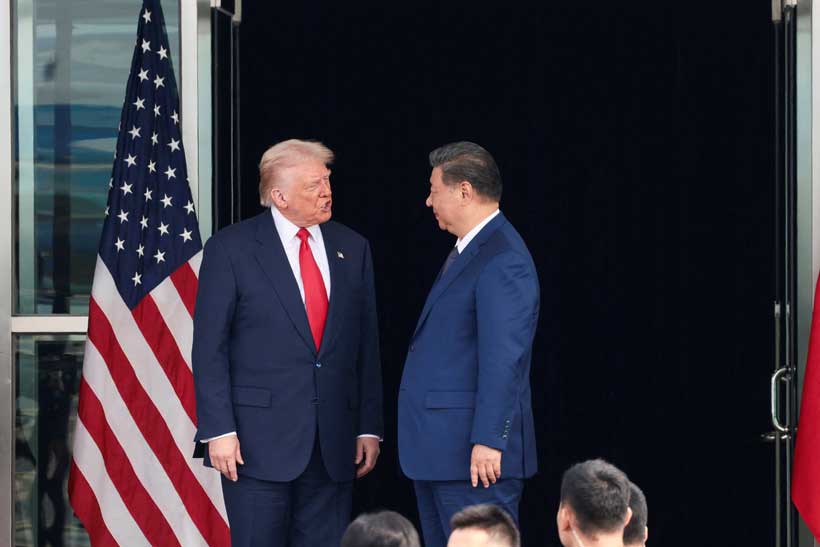
U.S. President Donald Trump will meet Chinese President Xi Jinping in May during his first visit to China in eight years, a closely watched trip that was postponed due to the ongoing Iran war. The visit, now set for May 14 and 15, reflects Trump’s effort to project confidence amid a challenging Middle East conflict while managing the increasingly tense relationship between the world’s two largest economies.
Initially slated for next week, Trump announced the revised schedule in a Truth Social post on Wednesday, adding that Xi would reciprocate with a visit to Washington later this year. “Our Representatives are finalizing preparations for these Historic Visits,” Trump wrote. “I look very much forward to spending time with President Xi in what will be, I am sure, a Monumental Event.”
China’s embassy in Washington said it had no information to provide regarding the announcement. Beijing typically does not release details of Xi’s schedule more than a few days in advance.
Geopolitical Events Have Repeatedly Intervened
The trip, long planned as part of Washington’s broader strategy to reset relations in the Asia Pacific region, has repeatedly been overtaken by global events. In February, a U.S. Supreme Court ruling curtailed the president’s power to impose tariffs, a key point of leverage in negotiations with China, the United States’ third-largest trading partner. Later that month, Trump’s joint military operation with Israel against Iran introduced additional tensions with Beijing, which is Tehran’s major oil buyer.
Stay ahead of the geopolitical week.
MD Briefing delivers expert analysis across five global fronts — the Indo-Pacific, energy, geoeconomics, European security, and the Middle East — every Monday morning. Free.
Trump’s last visit to China was in 2017, making this the first in-person meeting between the two leaders since an October encounter in South Korea, where they agreed on a trade truce.
White House Says Xi Understands the Delay
The two-day trip is expected to combine the ceremonial pomp typical of Trump’s foreign visits with substantive diplomatic negotiations. While some goodwill agreements may be reached on trade in sectors like agriculture and aircraft, discussions are likely to focus on areas of deep tension, including Taiwan. Little progress is expected in this regard, as Trump has dramatically ramped up U.S. arms sales to Taiwan during his second term, angering Beijing, which claims the island as its own territory.
A spokesperson for China’s defense ministry, Jiang Bin, urged Washington to exercise “extreme caution” regarding Taiwan, highlighting the sensitivity and potential harm associated with U.S. arms sales.
Iran War Adds Uncertainty to Agenda
It remains unclear whether the Iran conflict, which has disrupted global oil markets and contributed to a broader energy crisis, will be settled by the time of the Xi-Trump meeting. Trump has sought cooperation from major oil consumers, including China, to counter Iran’s efforts to close the Strait of Hormuz, though Beijing has so far largely rebuffed these requests. China imported around 12 million barrels of oil per day in the first two months of 2026, the highest in the world.
White House spokeswoman Karoline Leavitt told reporters that estimates suggest the conflict could wind down in four to six weeks, leaving open the possibility of a more stable environment for the May meeting. Leavitt also confirmed that Trump and Xi had discussed rescheduling the trip, and that Xi had understood the reasons for the delay. “President Xi understood that it’s very important for the president to be here throughout these combat operations right now,” she said.
Balancing Diplomacy and Domestic Challenges
Trump’s visit to China comes at a time of heightened global uncertainty. He faces the dual challenge of managing a volatile Middle East situation while keeping momentum in U.S.-China relations. The outcome of these talks could have significant implications for global trade, energy markets, and security dynamics in the Indo-Pacific region.
Analysis: Strategic Calculus Behind the Visit
Trump’s May trip to China is more than a diplomatic formality it is a calculated effort to project stability and control amid simultaneous crises in the Middle East and economic friction with Beijing. By postponing the visit, Trump positions himself as fully engaged in the Iran conflict while signaling to China that the U.S. seeks to manage tensions in the Asia-Pacific strategically.
The timing also reflects Trump’s dual objectives: securing trade and energy cooperation while maintaining leverage over Beijing on Taiwan and regional security. However, the unresolved Iran war and rising energy prices introduce uncertainty, potentially limiting the scope of concrete agreements.
For China, the visit is an opportunity to gauge U.S. intentions directly, but it comes with risks. Beijing must balance cooperation with Trump on trade and oil supply against domestic and regional expectations, particularly regarding Taiwan.
Ultimately, the success of the May meeting will depend less on ceremonial gestures and more on whether both sides can navigate overlapping crises the Iran war, energy security, and U.S.-China strategic competition without escalating tensions further.
With information from Reuters.
