


The escalating conflict between Israel and Iran, alongside US involvement, has caused major disruptions across the whole Middle Eastern region. The end goal of these attacks appears to be the potential regime change of the “Islamist leadership,” but Iran’s retaliation has completely changed the conflict into a struggle for regime survival. Due to its relatively weak air force, Iran has been relying on its missile and drone arsenal, where its missile arsenal exceeded 3,000, according to the estimates by the United States Central Command. However, since most of the missiles are limited to short- or medium-range targets, Iran has to rely on divergent tactics. As Iran does not have an ICBM capability capable of targeting the US, it relies on attacking the US military bases in Gulf states, i.e., Al Udeid Air Base in Qatar, which serves as the forward headquarters of the US Central Command’s air operations. While this has really affected the US’s strategic depth in the Arab world, it has also created an environment of insecurity in the Gulf region.
The Gulf region has been pursuing a doctrine of prevention of direct engagement, which appears to be increasingly ineffective. This neutrality of the Gulf Cooperation Council (GCC) is based on the logic of hedging, or as they call it, “The Hedging Strategy.” In a hedging strategy, states try to assign different roles to different states and try to balance out various relational aspects to save themselves from potential vulnerabilities. Under this approach, the GCC implemented a hedging strategy where they maintained economic interdependence with Iran (as Iran is the UAE’s second-largest trading partner at $28.4 billion in 2024, and Qatar is also a partner with Iran in their South Pars/North Dome field, which provides 70% of Iran’s gas), while at the same time, the Gulf states maintained a security partnership with the US, providing it with military bases on their own lands (as the US is the Gulf’s main external security provider in the region to counter Iran). The Gulf states are also dependent on the United States for weapons, as the US approved $9 billion in weapon sales to Saudi Arabia, following a $142 billion deal in 2025, according to Al-Jazeera.
Here, hedging allowed the GCC states to preserve economic ties while reducing escalation risks and avoiding direct alignment with regional rivalries. Today, due to the escalating conflict between Iran and Israel, neutrality is becoming harder and harder to pursue, as the growing confrontation increases the risk of retaliation spilling into the Gulf territory. The Iranian strikes on the Gulf countries have also, in their view, “exposed US security guarantees.” This situation is best described by security analysts as the GCC being ”bound by Washington, exposed by Iran.” ”.
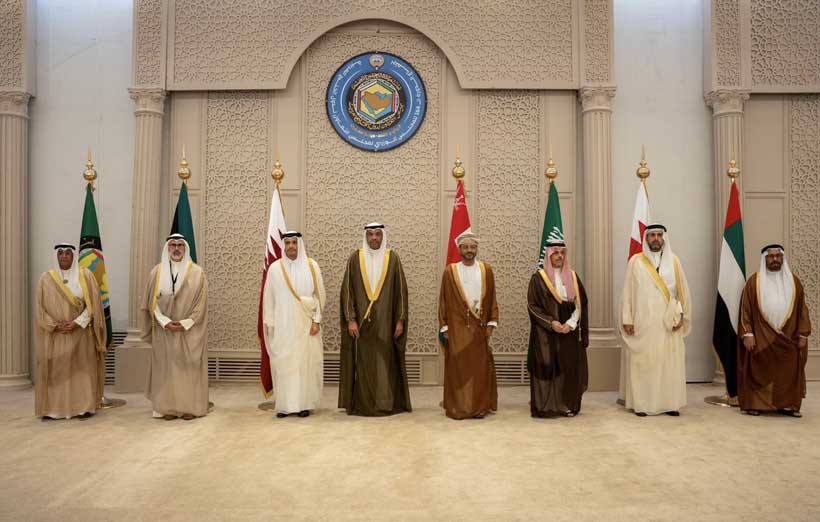
The attacks have set major economic and security setbacks in the region and the whole world. The closure of the Strait of Hormuz has pushed the oil prices to $119 per barrel, according to Reuters this Monday. The production of gas and oil has also been suspended by Qatar and Saudi Arabia, respectively. These economic setbacks, along with the violations of sovereignty, have prompted the GCC Ministerial Council to issue a statement in their March 1 emergency meeting saying that the next Iranian aggression will be met with a fateful response under Article 51 of the UN Charter. Though this shows a firm response from the GCC leadership, it also shows how their original doctrine, emphasizing the prevention of direct engagement, has failed.
Stay ahead of the geopolitical week.
MD Briefing delivers expert analysis across five global fronts — the Indo-Pacific, energy, geoeconomics, European security, and the Middle East — every Monday morning. Free.
According to H.O. Agarwal in his book on international law, a neutral state is the one that does not support any of the belligerent states participating in a conflict, either directly or indirectly. While in the case of Gulf states, there was ample support for the US in their operations through the military and air bases and multiple logistics bases existing in all the GCC states, including Qatar, Bahrain, Saudi Arabia, the UAE, Kuwait, and Oman. The existence of these support bases weakens the GCC’s claim of neutrality and inclines Iran to attack them.
Today, when the bubble of GCC’s neutrality has been busted and the states might actually have to fall into direct engagement with their neighbors, it is time to recalibrate the hedging strategy for the Gulf to move forward with peace. To maintain their framework of collective security, they have to proceed with better diplomatic ties with Iran for better regional stability while also keeping in consideration their Western ally. For now, it is pretty difficult to determine what steps the Gulf policymakers will take next. However, there are a few prospective policies that would serve Middle Eastern collective security the best.
Firstly, the GCC have to recalibrate their security protocols. The Gulf should focus on better defensive security doctrines, as it has now been understood that they can no longer rely on the US security guarantees. The Gulf should be investing more in their security strategy as well as their military technologies and strengthening their indigenous defense capability.
Secondly, for the GCC to move forward with actual neutrality, it needs a policy with the US under which it should be stipulated by the Gulf countries that the use of US bases in the Gulf should only be for defensive purposes. The GCC should restrict US bases to defensive use. Restricting US offensive capabilities in the Gulf will lower the regional insecurity and will act as a pathway for better chances of diplomacy. Where the US can maintain the defense deals with the GCC, and a new era of better regional security will be pursued through diplomatic engagement with Iran.
