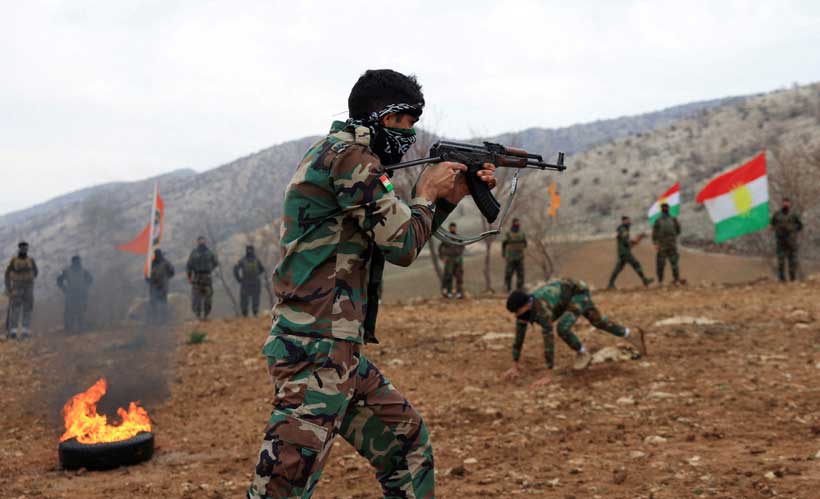
Israel is conducting airstrikes in western Iran to support Iranian Kurdish militias, who aim to take advantage of the ongoing U. S.-Israeli war with Iran to capture towns near the border. U. S. President Donald Trump recently expressed support for these Kurdish forces potentially crossing the border, highlighting the significance of a Kurdish insurgency in Iran. Such an uprising could significantly impact Iran as it is already under air attack, and the militias have consulted with the U. S. about potential assaults on Iranian security forces.
Israel has been in talks with Iranian Kurdish groups based in Iraqi Kurdistan for about a year. The discussions involve plans for an offensive aimed at capturing Iranian territory, specifically towns like Oshnavieh and Piranshahr. Reports indicate that thousands of Kurdish fighters are amassing on the Iraqi side of the border, with preparations for an assault within a week, although this has not been independently confirmed. While these fighters are equipped with only light arms, they could still create disturbances along the border with support from the U. S. and Israel. It is believed that the objective is not to topple the Iranian government but to destabilize its control and divert attention from its military forces.
Recently, five Iranian dissident groups, including several Kurdish factions, formed an alliance. However, the Iraqi Kurdistan leadership has denied plans to assist these groups despite external pressure, indicating a lack of support for the insurgency from Iraqi Kurds. There are also concerns that the situation may worsen American and Israeli interests if they appear to encourage nationalism among the Kurdish people.
Intelligence sources indicate that Iranian Kurds are providing valuable targeting information for airstrikes. Some Israeli analysts suggest that the goal may be to undermine the Iranian regime, while others, including former intelligence officers, caution that an insurgency doesn’t enjoy widespread backing among Kurdish communities. Turkish and Iraqi officials also have reservations about supporting the insurgency due to concerns about ethnic secessionism.
Iran has been attacking Kurdish armed groups in Iraq and recently warned against the deployment of hostile forces on its borders. The Kurdish factions are reportedly maintaining closer coordination with the U. S. than Israel, but any cross-border operation would need air support from both allies. Kurdish leaders are wary about being betrayed similar to earlier instances and have asked the U. S. for unspecified guarantees. The ultimate goal of these Kurdish groups is to establish a semi-autonomous region in a potentially federal Iran, mirroring the structure in Iraq.
With information from Reuters