


Global financial markets remained volatile on Tuesday after United States President Donald Trump announced that he had paused a planned military strike against Iran to allow time for renewed negotiations over Tehran’s nuclear programme.
Trump later stated there was a strong possibility of reaching an agreement that would prevent Iran from obtaining nuclear weapons. His comments eased immediate fears of a broader regional escalation and triggered a decline in global oil prices after recent sharp gains linked to Middle East tensions.
Despite the temporary market relief, investors remain cautious following heightened geopolitical uncertainty caused by attacks in the Gulf region and continuing concerns about energy security and inflation.
Oil Prices Retreat but Remain Elevated
Oil markets reacted quickly to Trump’s remarks, with both Brent crude and United States crude futures falling after fears of an immediate military escalation eased.
Stay ahead of the geopolitical week.
MD Briefing delivers expert analysis across five global fronts — the Indo-Pacific, energy, geoeconomics, European security, and the Middle East — every Monday morning. Free.
However, prices remain significantly higher than levels seen before the outbreak of the conflict. Traders continue monitoring developments surrounding the Strait of Hormuz, one of the world’s most critical shipping routes for oil exports.
Any disruption in the region could have major consequences for global energy supplies and inflation, particularly as economies are already facing fragile recovery conditions and persistent price pressures.
The decline in oil prices provided temporary relief to broader financial markets, especially bond markets that had suffered heavy losses amid fears of prolonged inflation.
Stock Markets Reflect Continued Investor Anxiety
Global equity markets showed mixed and unstable trading patterns as investors struggled to balance optimism over diplomacy with fears of further geopolitical shocks.
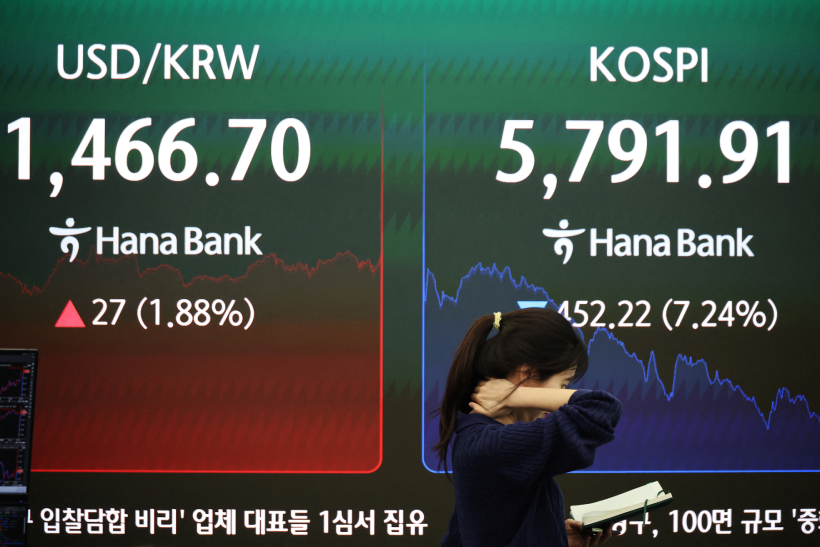
Asian markets recorded notable declines, particularly in South Korea and China, while United States futures also weakened after early gains faded. European markets remained relatively steady but cautious.
Investors are increasingly sensitive to geopolitical headlines because of their direct impact on energy costs, inflation expectations, and global economic growth.
At the same time, financial markets are preparing for upcoming earnings from Nvidia, whose performance is seen as a major test for the ongoing artificial intelligence driven rally in global equities.
Nvidia has become one of the most influential companies in world markets due to its dominance in advanced semiconductor technology and artificial intelligence infrastructure.
Bond Markets Stabilise After Sharp Selloff
Government bond markets steadied after suffering heavy selling pressure in previous sessions. The easing in oil prices reduced some fears of a prolonged inflation shock that could force central banks to maintain tighter monetary policy for longer.
Yields on United States Treasury bonds pulled back slightly after reaching their highest levels in more than a year. Japanese government bond yields also declined following earlier record highs.
Nevertheless, investors remain concerned that sustained geopolitical instability and elevated energy prices could reignite inflationary pressures globally.
Finance ministers from the Group of Seven economies recently acknowledged growing concerns over rising public debt levels and volatility in bond markets, highlighting broader fears about long term financial stability.
Currency Markets and Safe Haven Demand
The United States dollar continued benefiting from safe haven demand as investors sought stability amid uncertainty. The Japanese yen remained under pressure, increasing speculation about possible intervention by Japanese authorities to support the currency.
Meanwhile, both the euro and British pound weakened against the dollar as global risk sentiment remained fragile.
Gold prices also slipped as higher bond yields reduced the attractiveness of non yielding assets, although the precious metal continues to attract interest during periods of geopolitical uncertainty.
Analysis
The market reaction highlights how deeply interconnected geopolitics, energy prices, inflation, and financial markets have become.
Trump’s decision to delay military action against Iran offered temporary reassurance to investors, but markets remain highly vulnerable to sudden changes in regional security conditions. The sharp swings in oil prices demonstrate that traders still view the Middle East conflict as a major threat to global economic stability.
The situation also presents a difficult challenge for central banks. Rising energy costs risk pushing inflation higher at a time when many economies are already dealing with elevated borrowing costs and slowing growth. If oil prices remain high for an extended period, policymakers may face pressure to keep interest rates elevated longer than markets previously expected.
At the same time, the strong focus on Nvidia’s earnings reveals another important dynamic shaping modern markets. Artificial intelligence continues driving investor optimism and stock market valuations, even as geopolitical tensions create uncertainty elsewhere.
Ultimately, global markets are entering a period where geopolitical developments may influence investor sentiment just as strongly as economic fundamentals. Until there is greater clarity on both the Iran situation and global energy stability, volatility across equities, bonds, currencies, and commodities is likely to remain elevated.
With information from Reuters.
