


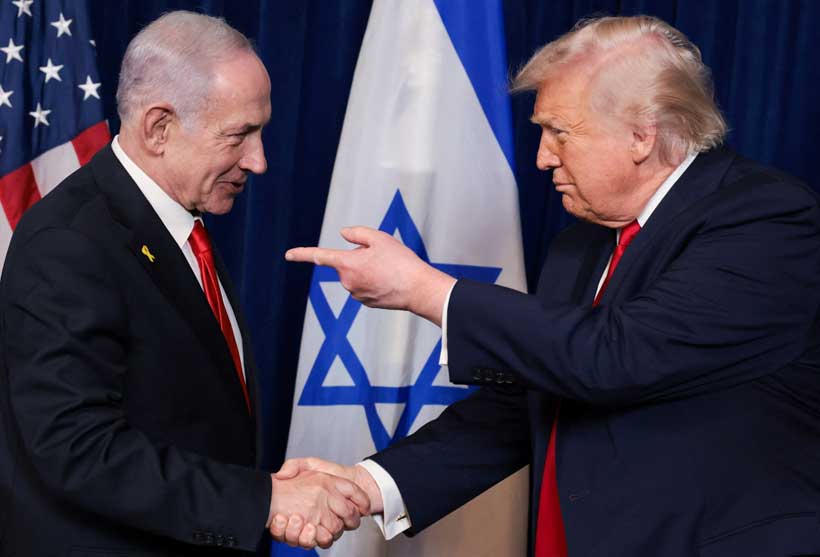
At the start of the bombing campaign, both leaders framed the mission as one aimed at regime change in Tehran. But within days, their messaging began to diverge.
Following Israeli strikes that killed Iran’s Supreme Leader Ali Khamenei, Trump shifted emphasis. Speaking at the White House, he described U.S. objectives as destroying Iran’s missile systems, degrading its navy, and preventing it from obtaining nuclear weapons not explicitly overthrowing the government.
His defence chief, Pete Hegseth, reinforced that the campaign was not a “regime-change war.” Netanyahu, by contrast, has continued publicly urging Iranians to rise up against their leadership, signalling that Jerusalem’s ambitions may stretch further than Washington’s.
Privately, U.S. officials acknowledge the two countries are not fully aligned: for Israel, regime change remains central; for Washington, it is secondary or optional.
Stay ahead of the geopolitical week.
MD Briefing delivers expert analysis across five global fronts — the Indo-Pacific, energy, geoeconomics, European security, and the Middle East — every Monday morning. Free.
Who Decides When It Ends?
While Netanyahu has long pushed successive U.S. administrations to confront Iran more aggressively, Israeli officials privately concede that Trump will ultimately determine the war’s duration.
Former U.S. ambassador Dan Shapiro has suggested Trump could seek an early “off-ramp” if domestic or political costs rise. And those pressures are mounting.
Polling shows limited American public support for the strikes. Rising fuel prices already climbing as shipping and energy routes are disrupted could sharpen voter discontent ahead of midterm elections. Within the U.S., views of Israel’s government have also grown more polarised, complicating Trump’s political calculus.
If Washington pulls back before Israel achieves broader strategic goals, Netanyahu could find himself constrained despite having successfully persuaded Trump to launch the operation.
A Carefully Planned Campaign
Behind the scenes, the military operation was months in the making. Even as U.S. envoys pursued nuclear talks in Geneva and Oman, American and Israeli officials were coordinating strike planning.
Netanyahu’s February 2026 White House visit a closed-door meeting lasting three hours was a key moment. Shortly after, the USS Gerald Ford carrier group repositioned to the Mediterranean, signalling operational readiness.
Trump has rejected suggestions that Israel dragged the U.S. into the war, claiming instead that he acted pre-emptively to prevent a wider Iranian strike.
Netanyahu’s Political Gamble
For Netanyahu, 76 and facing elections by October, the Iran campaign is as much about legacy as security. His long-standing warning about Tehran’s nuclear ambitions has shaped his political identity for decades.
Yet he governs amid fractures: corruption charges he denies, coalition tensions, and lingering anger over the October 7, 2023 Hamas attack that shattered Israel’s sense of security. Though Israel has weakened Iranian-backed groups like Hamas and Hezbollah and seen Syrian leader Bashar al-Assad fall, the trauma of recent years remains raw.
Some analysts argue that a swift and decisive victory in Iran could rehabilitate Netanyahu’s image as Israel’s indispensable security leader. Others contend that no foreign policy success can fully offset domestic grievances and the heavy toll of prolonged war.
Analysis
The tension between Netanyahu and Trump is not personal it is structural. Israel seeks transformative strategic change in Iran; the United States may prefer containment over open-ended entanglement.
Trump’s political incentives favour flexibility and rapid recalibration. Netanyahu’s incentives favour decisive, lasting change that secures his legacy and reshapes Israel’s regional balance. Those timelines may not align.
If the war delivers quick, visible gains with limited economic fallout, their alliance will appear ironclad. But if energy prices spike, casualties mount, and global criticism intensifies, Trump may pivot leaving Netanyahu to navigate the consequences.
In that sense, the Iran crisis is testing not only a military partnership, but the durability of a political alliance shaped by ambition, urgency, and very different domestic pressures.
With information from Reuters.
