


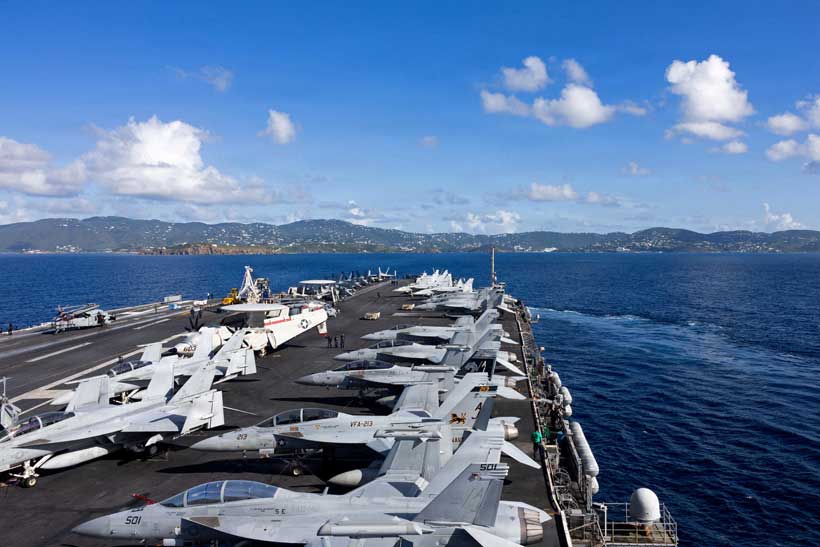
War is expensive, but the price tag Americans notice first is often the wrong one. The early bills for air strikes, carrier operations, and missile salvos are big, yet they are still the easy part. The hard part is what a high tempo campaign does to the United States’ inventory of precision weapons and missile interceptors, and what it forces Washington to stop doing elsewhere.
Let’s start with the visible spending. One widely cited estimate put the first 24 hours of Operation Epic Fury at about 779 million dollars, plus roughly 630 million dollars spent in the run up through deployments and positioning. The same reporting put aircraft carrier operating costs around 6.5 million dollars per day, before you add the munitions being fired and the sortie surge that burns through engines, spares, and maintenance hours.
Those numbers matter, but they also mislead. A day one cost figure mostly counts operations, not replacement. In modern air and missile warfare, replacement is where the bill grows teeth. A Tomahawk is not just “spent,” it becomes a procurement action with a long lead time, a supplier chain, and a delivery schedule that collides with other priorities. If the campaign stays intense for weeks, the cost is not a neat daily rate times day. It becomes a recapitalization problem that can spill into future budgets.
There is also a baseline context that is easy to miss. Brown University’s Costs of War project estimated that from October 2023 through September 2025, the United States spent about 31.35 to 33.77 billion dollars tied to the post October 7 wars, including 21.7 billion dollars in military aid to Israel and about 9.65 to 12.07 billion dollars in US operations in Yemen and the wider region. That matters because it describes a system already running hot before this Iran campaign began.
Stay ahead of the geopolitical week.
MD Briefing delivers expert analysis across five global fronts — the Indo-Pacific, energy, geoeconomics, European security, and the Middle East — every Monday morning. Free.
Now the more dangerous cost: munitions scarcity. The public debate often assumes the United States can always “turn on the tap” of missiles. In reality, industrial capacity is slow to expand, and the same missile families are demanded across theatres. Patriot interceptors are a clean example. Reuters reported in early January 2026 that Lockheed Martin aims to more than triple PAC 3 production capacity from roughly 600 to 2,000 per year under a multiyear agreement, but the ramp is measured in years, not days.
The naval side has the same pattern. Raytheon and the Navy have been pushing to expand Tomahawk and SM series output, including plans to lift SM 6 production to more than 500 per year and Tomahawk to over 1,000 per year, but again, that is a ramp, not a magic refill.
This is why the “lack of weapons” point is not a side note, it is the core strategic constraint. If Iran can keep launching large numbers of ballistic missiles, cruise missiles, and drones, defenders may be forced into ugly arithmetic: spend scarce interceptors on every inbound threat, or accept damage. One analyst put it plainly: “There is a risk the United States and its partners could run out of interceptors before Iran runs out of missiles.”
That constraint turns into money quickly. When you fire interceptors at a high rate, you are not just paying for today’s defence, you are buying future vulnerability unless replacement arrives fast enough. And replacement competes with Ukraine packages, Indo Pacific deterrence stocks, and homeland readiness. Even if Congress writes supplemental checks, industry still has to build the items, test them, and deliver them.
There is another cost bucket most war coverage underweights: readiness and opportunity cost. Every B 2, F 35, or carrier strike group day in theatre is a day not training for other contingencies, not resting airframes, not building depot backlogs down. Those are real costs that show up later as higher maintenance bills, lower availability rates, and emergency contracts. They are also political costs, because the Pentagon will come back asking for more money to “reset the force,” and the public will be told it is a separate issue from the war itself.
So how much will this war cost the United States? If the campaign stays mostly air and maritime for a short period, the direct operational burn could land in the low tens of billions, especially once you add replenishment orders. If it stretches into a month’s long regional fight with sustained missile defence, large scale strike packages, and repeated naval deployments, the total could climb into the many tens of billions, and that is before you count longer term obligations like higher procurement in out years, interest costs, and veterans’ care. The headline number will be debated. The decisive number is simpler: how many critical munitions are left, and how fast can the US industrial base replace them.
